The Confidential Report - September 2026
America
The attention of investors is definitely moving away from developments in the Middle East and Trump back to interest rates and the quarterly results of S&P500 companies. The weak jobs number combined with the consumer price index (CPI) of 3,4% in July, which was down for the second month, helped investors to believe that the monetary policy committee (MPC) would hold interest rates unchanged through to the end of 2026. July 2026 retail sales were down 0,6% after June’s upward move of 0,2%. When the University of Michigan’s consumer sentiment index fell back to 51 in August well below July’s figure of 55,2, investors began to feel that perhaps the US consumer was losing some momentum.
In his first address at Jackson Hole, the new Chairman of the Federal Reserve Bank, Kevin Warsh made it clear that his goal was to bring the Personal Consumption Expenditure (PCE) index back to 2% - which is still far away from July’s PCE of 3,7%. He emphasised that despite lower job creation, the labour market was “broadly consistent with full employment”. It would appear that Warsh is not going to be as dovish as Trump might have hoped, but that he will follow the traditional conservative approach of his predecessors and keep inflation under control.
Fifteen S&P500 companies have gained more than 100% in 2026, all of them linked to the boom in artificial intelligence (AI). SanDisk was the strongest with a gain of 600%, but others including Dell, Intel, and Hewlett Packard also showed gains. Oil refiners, Marathon Petroleum and Valero, are benefitting from the massive build out of data centres across America and their energy needs. Amazon, Microsoft, Alphabet, and Meta are spending a total of $700bn in capex in 2026. This combines with industry leader Nvidia’s 18% share price rise over the year so far, despite profit-taking.
The Nvidia 2nd quarter figures were amazing. Revenue was $96,2bn and generated earnings of 222c (US) per share with the company’s market capitalisation gaining more than $400bn at one stage on the news. Nvidia’s performance also dragged up other chip makers like Micron, Marvell and Western Digital.
Overall, the S&P500 3rd quarter figures have been very positive so far. For the last 12 quarters in a row, profits have increased and are expected to climb by 22,3% year-on-year in the third quarter off revenues up 10,8%. There is also evidence that the growth is becoming broader and expanding beyond its Big Tech core. The strong growth in the 3rd quarter comes immediately after the 2nd quarter’s 43% growth in earnings off a 15% increase in revenue. The growth has spread out into transportation, finance, aerospace, industrials, utilities, and construction. This shows that the boom in the US economy is continuing, widening and overshadowing Trump’s Iran war in the market.
The cyclically adjusted P:E ratio (CAPE) of Wall Street has now reached over 42 which is its highest level in 26 years. The last time it was at this level was just before the dot-com crash of 1998. The situation today is somewhat different from that of 1998 because many of the high tech companies with very high valuations are also very profitable and not speculative as they were in 1998. The CAPE ratio measures the S&P 500 relative to the inflation-adjusted earnings of its companies over the previous 10 years. By using a decade of earnings, the measure attempts to smooth out temporary economic disruptions that can distort conventional price-to-earnings ratios. Basically, it means that investors are paying 42 times the annual profits of the companies whose shares they buy. The average for the CAPE ratio is 27 times – so the market is undoubtedly expensive at the moment with investors betting on substantial increases in future profits.
In our view, while the S&P is undoubtedly high by almost any measure, it is likely to go still higher. We believe that the impact of AI is only beginning to be felt in the profits of most S&P500 companies and that there is much more still to come. The continued high level of the S&P supports this position.
Consider the chart:
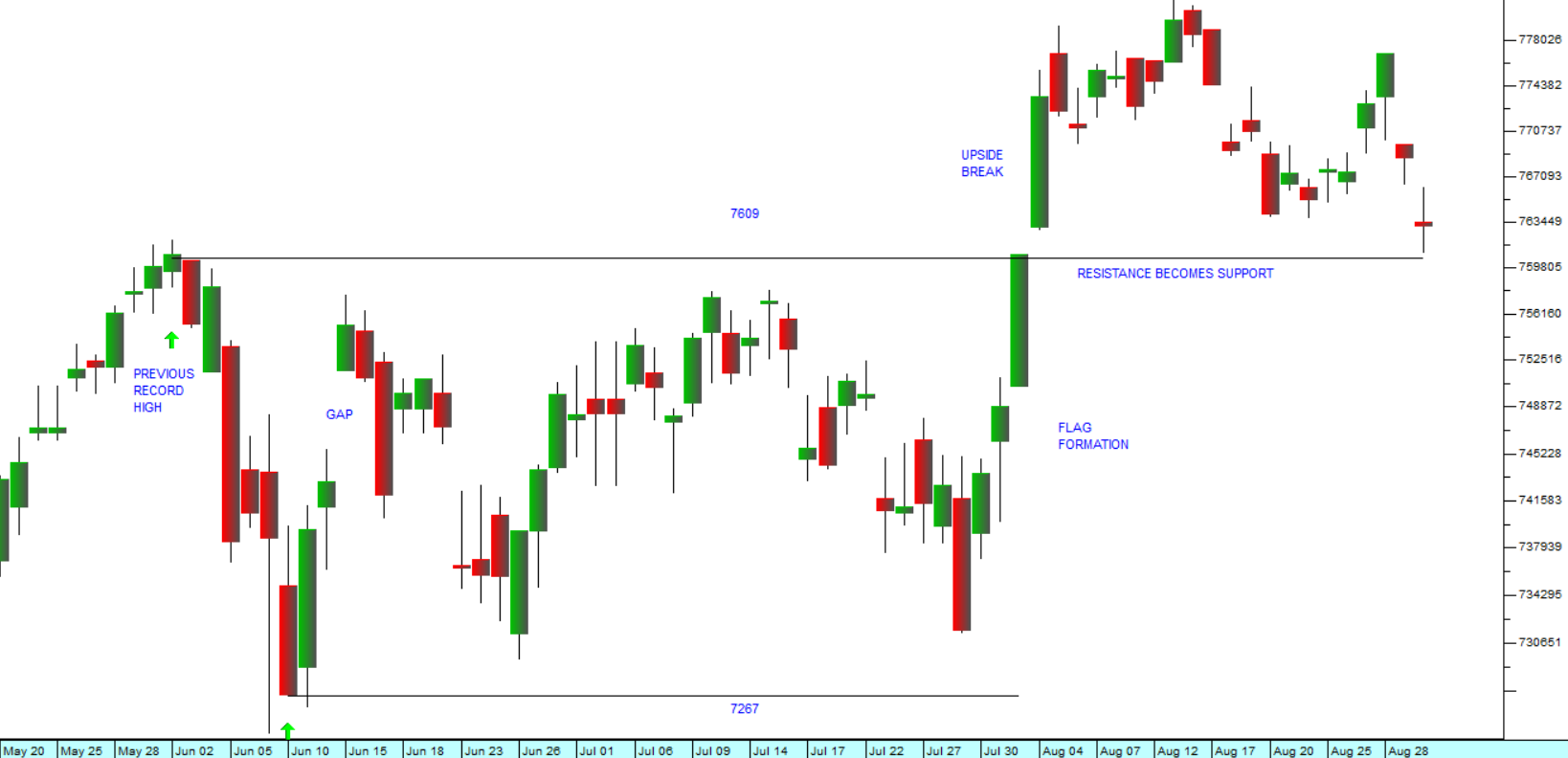
Technically, you can see the upside break out of the flag formation which we drew your attention to in last month’s Confidential Report. This has been followed by a new all-time record high, but the market has basically been moving sideways again with the 7609 level of the previous record high transforming now from a resistance level into a support level. There is no doubt that the average price of petrol in America at $4,09 per gallon is having a dampening effect on sentiment and has clearly prevented a much stronger upward move on the S&P500. Despite this, investors have continued to be focused on the earnings coming out of AI and its potential to spread to the rest of the economy.
The initial public offer (IPO) and listing of Anthropic on Wall Street is now scheduled for October 2026, although the precise date has not yet been settled. This is the second major tech company listing this year after SpaceX. Analysts are having difficulty evaluating the company which reported a turnover of $47bn in the most recent financial year but which is projecting a turnover of between $190bn and $200bn in 2028. SpaceX listed on a multiple of 94 times its trailing revenue so Anthropic’s listing is relatively conservative by comparison. Notably both companies are not making profits yet. Investors are forced to use a revenue multiple when valuing high tech companies that are not yet profitable. Palantir is another such company which is already listed and which currently trades at 53 times its annual revenue. Based on its most recent profits, Palantir is on a P:E ratio of 148, which shows the blue sky potential which investors are discounting into its share price. Basically, Wall Street is in the throes of a high tech listing boom where executives of high tech companies are seeking to exploit the extraordinary popularity of technology stocks.
Trump applied 50% tariffs to a range of Canadian products on 22nd August 2026 as the relationship between the two countries broke down. The tariffs only impact about 6% of Canadian exports to America and have the overall effect of increasing US tariffs to 7% from 5% on all Canadian exports. Canada was America’s largest importer last year so there is plenty of scope for retaliation and the move could result in the collapse of the US-Mexico-Canada trade agreement. Trump says he doesn’t care about the agreement because Canada and Mexico need America rather than the other way around. However, tariffs always result in higher inflation for all countries involved and Trump is already facing the prospect of losing the mid-term elections because of rising prices.
In the meantime, Trump’s administration has run into dozens of roadblocks in his desperate attempts to seize control of federal elections.
The Department of Justice has lost more than 20 court cases in its attempts to vacuum up voter data. Federal courts have repeatedly struck down his executive orders restricting mail-in ballots and implementing national voter ID policies. Congress can’t get behind his sweeping SAVE America Act. Nothing has come from the FBI’s seizure of election materials in Georgia except tired conspiracy theories.
Trump’s 2024 presidential campaign was fuelled by a false narrative that the previous election was rigged against him, vowing retribution for his supporters who believe the entire process of election administration is corrupted by fraud, immigrants, foreign adversaries and Democratic officials. That long-term project — eroding trust in elections and the people who run them to then take control of the process — has opened the door for Trump and his allies to launch a bad-faith campaign in pursuit of “election integrity” that has taken root across the Republican Party.
Trump, now desperate, is staring down the final days before midterm elections with the prospect of Republicans losing control of Congress and, with it, his final years in office. Democrats are floating plans to investigate and impeach him and his Cabinet. He’s running out of time and options to do what he has failed to do in court and in Congress over the last decade. In our view, Trump will almost certainly lose the House and may well lose the Senate as well.
Iran
Trump is busy backing down on Iran as the latest effort to resume talks collapse. Iran is taking advantage of Trump’s weak position with the November mid-term elections looming. He simply cannot afford the price of fuel to continue above $4 per gallon before the election but nothing we have seen looks likely to change that position before the election. Increasing prices across the board have already resulted in the loss of much of his MAGA base. His most recent tirades and threats against Iran have had the effect of keeping the oil price up. In our view, when the Iran war finally comes to a halt, however that is achieved, the oil price will fall below the $72 support level that it was at before the conflict began. In fact, we see it falling to as little as $20 eventually as renewables are beginning to dominate the world energy market. In the meantime, the war is proving to be the undoing of Trump and the Republicans.
Trump is now threatening economic sanctions, but Iran has been successfully weathering various economic sanctions since the Islamic Revolution of 1979. Trump’s economic warfare rings hollow even among his supporters. He is threatening any country that does business with Iran that they too will have to face sanctions. Most of those countries are completely unfazed by this. Iran has responded to Trump’s tirade with scorn saying that it shows how desperate he is. China is the largest buyer of Iranian oil so is first in line for Trump’s proposed new sanctions – but China also supplies America with thousands of products. In our view Trump’s latest rant is very unconvincing and unlikely to have any significant impact. Public approval of the war in Iran has dropped to 31% in late August 2026 - down from 37% in March.
Ukraine
Long queues at petrol stations in Russia and the destruction of 20 Wildberries warehouses and now 3 Ozon warehouses has brought the war home to ordinary Russians across the country. Using its new long-range drones, Ukraine has been keeping up its pressure on Russia’s oil infrastructure and is now targeting other areas to make the war real for Russian civilians. Russia has been forced to import refined petrol products and release strategic reserves to meet demand, but even that has not been sufficient to prevent shortages across the country. Putin has responded to the pressure by increasing missile attacks on civilian targets in Ukrainian cities and other infrastructure. The coming winter is looking particularly bleak as Russia once again targets Ukraine’s energy infrastructure.
After Russia’s parliamentary elections on 18th to 20th September this year, Ukraine expects them to conduct a conscription of at least a further 300 000 troops, mainly from the outlying areas. Ukraine is at the moment powerless to stop Russian missiles coming in to the country to target energy infrastructure and civilian residential buildings because of a lack of the US-made Patriot interceptors. In effect, both sides are ramping up the drone and missile war while the frontline remains virtually stagnant. Ukraine continues to be heavily subsidised by its European allies, while Russia is clearly running out of funds. For example, Norway has just pledged to give Ukraine a further $9,2bn in aid to keep the war effort going.
Calls by the dismissed Ukrainian Minister of Defence, Mykhailo Fedorov, for wartime elections have been largely ignored by President Zelensky as having the potential to destroy the country. Zelensky’s approval rating remains high around 57% according to recent polling. He says that elections will only take place when the war is over. In our view, Zelensky appears to have survived a very dangerous moment when his control over Ukraine was brought into question following the firing of Fedorov. It is clearly not a good idea for Ukraine to consider changing their leader at a time when their very existence is under threat.
Political
With the November municipal elections approaching, the ANC and President Ramaphosa appear to have changed direction on the issue of illegal immigration. After the 30th June 2026 deadline crisis which saw as many as 100 000 illegal immigrants leave the country or get deported, Ramaphosa now says that immigration is part of the economy’s strength. At the Southern African Development Community (SADC) summit where he took over from Zimbabwe’s president as Chairman, Ramaphosa tried to reverse the antagonism which the recent anti-immigrant sentiment in South Africa has created.
It is ironical that after more than 30 years in power the ANC is now promising to cut the municipalities’ debt to Eskom and the Water Boards by 30% and to get more than half of them with clean audits over the next five years. The current terrible situation was undoubtedly brought about by ANC negligence, incompetence and corruption. By the end of last year, the municipalities owed more than R160bn to the Water Boards and Eskom and only 39 had clean audits out of 257. So, the ANC’s election manifesto is to partially fix a massive problem which they themselves created. The humblest unemployed person living in a squatter camp knows that the ANC is hopeless at service delivery and is itself systemically corrupt. The President’s display over last weekend of dancing and toy-toying will not change that.
Economy
The Reserve Bank’s leading indicator fell by 1,4% in June 2026 – its third monthly decline in a row. This shows the decline in commodity prices and the growth of the money supply. Five of the seven components in the indicator were down. The indicator is designed to show an impending change in the business cycle ahead of time so that the Bank through its monetary policy committee (MPC) can take appropriate action. The three declining months in a row have had the effect of softening the MPC’s approach with regard to interest rates.
The consumer price index (CPI) fell to 4,3% in year to the end of July 2026 – down from June’s figure of 5%. The figure was far better than economists were expecting and may enable the monetary policy committee (MPC) to keep rates unchanged at their next meeting at the end of September. Obviously, the key component in the CPI was the price of fuel which has fallen back since its earlier peak in line with the oil price and the stronger rand. Food and non-alcoholic beverages were down 0,9% while petrol came off by 7% and diesel by 11,6%. We expect fuel prices to remain more-or-less where they are until the end of the year. In the longer term the oil price should resume the downward trend that it was on before the war in Iran began.
The sharp drop in the price of fuel in July 2026 had the effect of reducing the producer price inflation (PPI) rate to 5,7% from 7,5% in June. Petrol was down R2,01 per litre while diesel fell by R3,59. Food and beverages rose by only 1,9% year-on-year while the metals and machinery category was up 3,8%. Over the month itself the PPI fell by 1% compared with a 0,1% fall in the previous month. Fuel prices are still higher than they were before Trump’s war in Iran began and second-round inflationary pressures are being experienced. The situation may be normalising after the shocks of April and May and the economy should benefit from that.
The most significant impact on the South African economy of Trump’s war in Iran has been to increase the cost of fuel through the jump in the oil price. At the time that the war began, inflation in this country was hovering around 3% after successful efforts by the Reserve Bank and the monetary policy committee (MPC) to slowly squeeze inflationary expectations out of the economy over the last few years. By May this year the consumer price index (CPI) had accelerated from that low point to 4,5% and in June the figure was 5%. Inflation is now expected to fall back to around 4,5% in July reflecting the fall in the price of petrol. Food inflation has been kept under control by the excellent agricultural season which the country enjoyed due to good rains in the most recent season.
Payinc's take-home pay index for the year to July 2026 increased 2,2% to R21642. The index measures the take-home pay of 2,1m salary earners in South Africa. Month-on-month the index rose by 0,2% which was just sufficient to cover last month’s reduced inflation rate of 4,3%. Obviously, fuel prices had stabilised and were even beginning to fall while food and beverage prices were lower. Real after-inflation salaries are starting to grow again after the shock of Trump’s war in Iran. So far in 2026 real salaries are still down 2,1%. Renewed tensions in the Middle East may push fuel prices up again, depending on exactly what Trump does and where the rand goes, but for moment things are looking very slightly better. Payinc’s economic activity index also increased slightly in July 2026 as fuel prices came off their highs. Over the year to 31st July 2026 the index was 0,9% higher at 102,7%. The report comes immediately after the announcement that the unemployment rate in South Africa had increased to 33,6% in the second quarter of this year. After the shocks of May and June, the figures were relatively positive, mainly because of the country’s low inflation rate. Hopefully, the oil price will continue to decline leading to further cuts in the prices of petrol and diesel.
The Pietermaritzburg Justice and Dignity organisation has created an index which tracks 44 food items typically consumed by lower income households. In August 2026 that index fell by almost 1% although it remains about 1,8% above where it was last year at the same time. Major factors in the index were the cost of fuel following the Iran war and Eskom’s 8,76% hike in electricity costs. The food basket assumes a family of 7, which is the average size of a low-income family in South Africa. The minimum wage in South Africa is R30.23 per hour or about R5080 per month and the cost of the food basket is R5480. Transport and electricity absorb about two thirds of the average poor family’s income. After paying for transport and electricity, workers are left with about R1600. If all remaining money went to buy food, it would leave the household well below the national food poverty line. These figures show that extreme poverty is still widespread in South Africa and that it is being exacerbated by the war in Iran and Eskom’s above-inflation price increases.
Tourist numbers were up in July month to 1,3m which is a 6% rise over July last year. Almost all the travellers were here on holiday with almost 80% coming from SADC countries. These figures show that the anti-immigrant sentiment, which came to a head with the protest action on 30th June 2026, has not had a significant impact on the tourism industry. Tourism is an important sector in the economy and generates thousands of jobs. It also contributes about 5% of gross domestic product (GDP).
Every year, South Africa creates about 300 000 new job seekers as young people complete their education and enter the job market. The economy has been growing at a snail’s pace of around 1% per annum and simply cannot generate sufficient jobs to absorb them - which results in rising unemployment. The Government Business Partnership is designed to address this problem by clearing bottlenecks and enabling stronger growth. Their goal is to reach 3% growth by 2030. In phase 3 of this partnership 4 new workstreams have been added with the objective of adding 1 million new jobs to the economy. The four new workstreams are agriculture, agricultural processing, tourism and mining. Each of these sectors has the potential to create substantial employment opportunities.
The National Energy Regulator (NERSA) has approved plans to build R120bn more in renewable energy projects than it did last year. There have now been 335 days without loadshedding, mainly because of the rapid growth of renewable energy installations. In the first quarter of this year, it registered 124 new projects with a value of about R20bn with the Northern Cape accounting for the lion’s share. The bottleneck is Eskom’s very slow unbundling of its transmission division. Transmission is obviously critical to the new projects, enabling them to get the power which they generate to users. Eskom’s board first approved the separation of its transmission assets in 2019 and is still dragging its feet. South Africa needs to build 14000km of new transmission lines at a cost of R440bn to bring its grid capacity up to speed.
Our esteemed Minister of Electricity, Kgosientsho Ramokgopa has proposed a new system for determining electricity tariffs. He quite rightly points out that current electricity costs are making South Africa uncompetitive on the world market and causing businesses to either move away from Eskom or go out of business. But the solution is not a new tariff system which favours heavy users like smelters. The solution is to look into Eskom’s costs, especially its employee costs. To pay these salaries, according to Ramokgopa, Eskom has had to increase the cost of electricity at six times the inflation rate for the past twenty years. This is clearly unsustainable – and yet he does not even touch on the issue of Eskom salaries in his latest discussion of the matter. With the elections in two months, the ANC cannot afford to attack the level of salaries in a key state-owned enterprise (SOE) for fear of alienating the unions.
In its report for the year to 31st March 2026 Transnet shows that it transported more than 910 000 new vehicles, 52% of which were exports and 42% were imports. The exports went mostly to Germany, the UK and France while imports came mainly from India, China and Japan. Cheap imported vehicles are dominating the South African market and making it difficult for local producers to compete. The average imported vehicle costs about half of a locally produced competitive model. South African ports are becoming steadily more efficient and able to handle greater volumes of traffic. Durban port has been ranked as the most improved port in the world. South African ports handled more than 300 million tonnes in the 2025/26 financial year. This was the best performance in 15 years. Port inefficiencies have been holding the economy back for some time.
The South African Chamber of Commerce’s confidence index rose 1,9 points since July 2026 – mainly because of the rise in new vehicle sales, merchandise exports and lower fuel costs. Since then, fuel prices have been stable but may go up again based on Trump’s inability to stop his war with Iran. In May, the South African monetary policy committee (MPC) was forced to increase rates by 25 basis points to obviate the inevitable impact on inflation. In our view, the cost of oil should continue to move downwards in the medium term as renewables take over, but in the short-term everything depends on Trump’s erratic and unpredictable decisions in the Middle East.
Mining production fell by 4,4% in June 2026 following a 5,1% decline in May and a 2,7% decline in the second quarter compared to the first. Platinum group metals (PGM) dropped 8,4% and coal was down 6,6% with iron down 10,2%. Manganese was up 13,3%, Chrome was up 8,6% and gold was up by 6,2%. South Africa remains primarily an exporter of raw materials and hence subject to the price fluctuations of those commodities on international markets. Obviously, the drop in mining production will have a negative impact on growth in the second quarter. It will also reduce government tax revenues.
The unemployment rate in the 3 months to 30th June 2026 jumped up to 33,6% - sharply higher than the 32,7% of the first quarter. This must be seen as a direct result of the war in Iran and the rise in fuel prices. With the municipal elections just a few months away, the opposition parties have been blaming the government of national unity (GNU) for the bad figures, but we believe that this blame is probably misplaced. The GNU has overseen some significant improvements in the management of the economy, but the pace of economic reform has been too slow according to critics. There are currently more than 5 million people unemployed between the ages of 15 and 34, a category which saw 264 000 jobs lost in the quarter.
Manufacturing production fell by 1,7% in the year to 30th June 2026 after shrinking 4,4% in the year to the end of May 2026. This can once again be attributed to lower business confidence following the start of the war in Iran and the sharp rise in fuel costs. The 25 basis point increase in interest rates was a further aggravating factor. It is becoming clear that fuel prices will probably remain high for the rest of the year as the Trump administration appears to be unable to bring the war to a satisfactory close. Production of food and beverages fell by 3,9% in the period while wood, paper products and publishing fell by almost 9%.
The ABSA Purchasing Managers Index (PMI) fell further in July 2026 – down to its lowest level (46,8) since December 2025. The decline is due to a drop in confidence levels due to higher fuel prices and the interest rate increase. It reflects weak export demand and inventory drawdowns as manufacturers continue to adjust to the new economic reality. Manufacturing used to comprise 23% of gross domestic product (GDP) in 1995 and now only accounts for about 13%. This shows the slow erosion of this important sector and the fall in its contribution to the economy.
Over the past three years roof-top solar installations have increased by 86% in South Africa as consumers and businesses sought to escape Eskom’s ever rising prices. The demand for Eskom electricity is declining steadily and in our view this state-owned enterprise (SOE) is in a terminal decline. Solar panels and batteries are becoming more efficient and cheaper every year making them affordable for a much larger group of consumers and businesses. The recent spike in fuel prices has accelerated the move towards renewable energy across the world and has resulted in far more electric vehicles and hybrids being sold in South Africa.
The S&P Global’s purchasing managers index (PMI) which recorded a reading of 51.6 in April and 49.6 in May. The figure for June was more encouraging at 50,3 showing a slight expansion of the private sector due to improvement in cost pressures, especially fuel prices. Input inflation edged down while output inflation was up slightly. This shows that the economy is beginning to recover, but that the recovery is still fragile. In our view, fuel prices should come down in September because of a lower oil price and stable or stronger rand.
Eskom’s electricity production fell by 8,1% in June 2026 compared to June 2025. Independent power producers (IPP) are now contributing between 10% and 15% to the national grid. The 8,76% increase this year in the cost of electricity has made it unaffordable for many households and businesses. In 2025 South Africa had 13 gigawatts of installed renewable energy. That is expected to reach almost 30 gigawatts by 2030. In 2025 coal had the capacity to create 45 gigawatts. President Ramaphosa said that roof-top solar power had increased by 86% in the past 3 years. The shift away from Eskom is gaining momentum, spurred by Eskom’s above-inflation price increases and the availability of relatively cheap alternatives.
The build-up of a super-el Nino weather event is now seen as a significant threat to South Africa’s agriculture in the rainy season of 2026/27. Reserve Bank Governor, Lesetja Kganyago, has warned that while the Iran war has not had much impact on South African agriculture, a period of severe drought could force food prices up. The recent hike in fuel prices came after our planting season and so did not really impact food prices. Next year could be different, but ground water and dam levels are good at the moment which helps.
The Rand
The rand has been performing very well since the war with Iran began in February 2026. After an initial sell-off which took it back over R17 to the US dollar it recovered very quickly to find resistance at R16.16. Over the last six months it has tested this level repeatedly before finally breaking to stronger levels below R16. Consider the chart: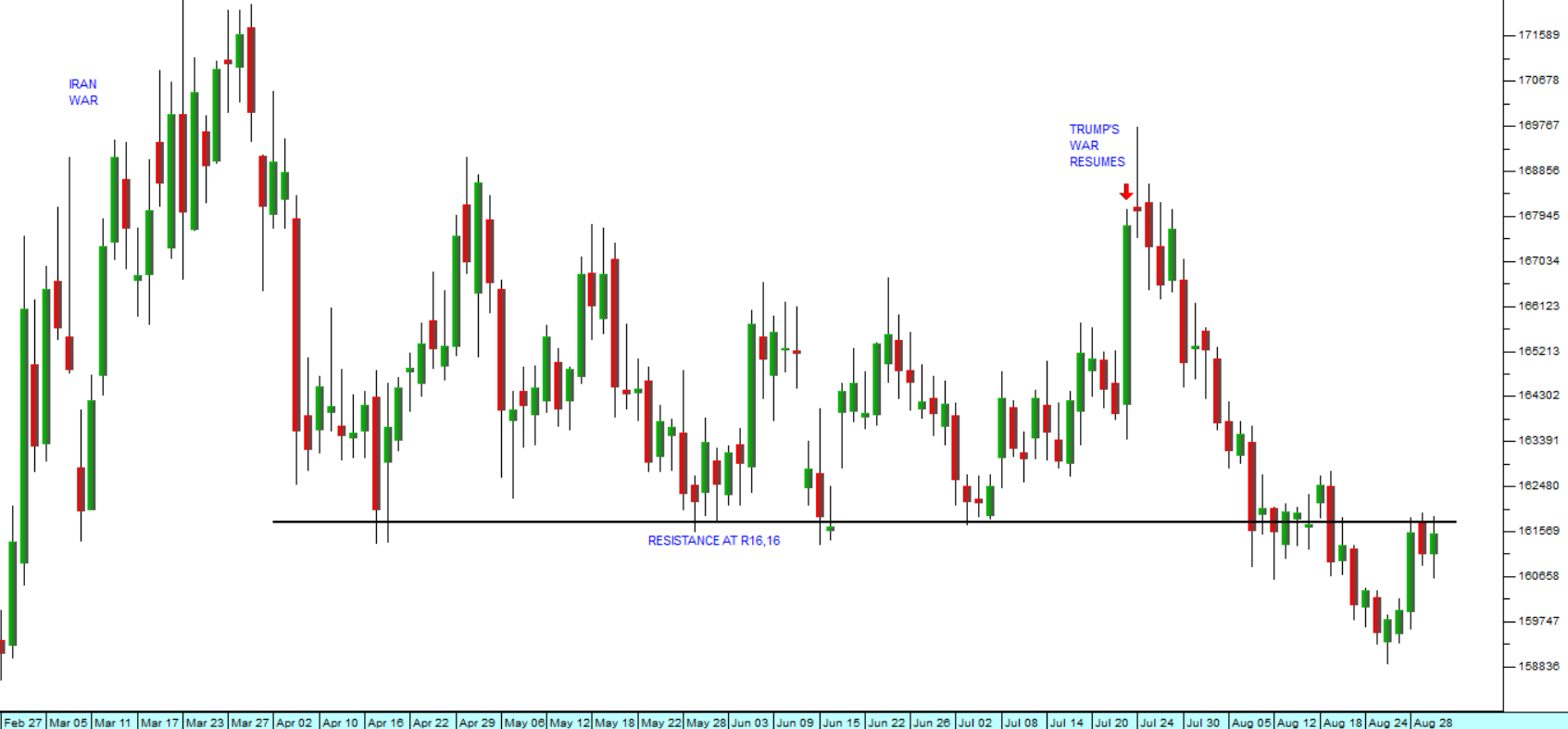
South African rand/US dollar : 27th of February 2026 - 1st of September 2026. Chart by ShareFriend Pro.
Here you can see that on Friday last week the rand weakened back above R16 as the North Sea Brent oil price spiked up on aggressive talk from both Iran and Trump. Note that the resistance level at R16.16 now appears to be becoming a support level. In our view the rand will continue to strengthen against the US dollar and to a lesser extent against other hard currencies in the months ahead. The price of petrol and diesel in South Africa have been strongly supported by the strength of the rand over this difficult time.
Commodities
COPPER
Since the last Confidential Report on 5th August 2026, the copper price has continued to rise. This is because of stockpiling in the US by traders seeking to get ahead of Trump’s latest round of tariffs and a general shortage of a metal which is integral to the AI boom. Consider the chart:
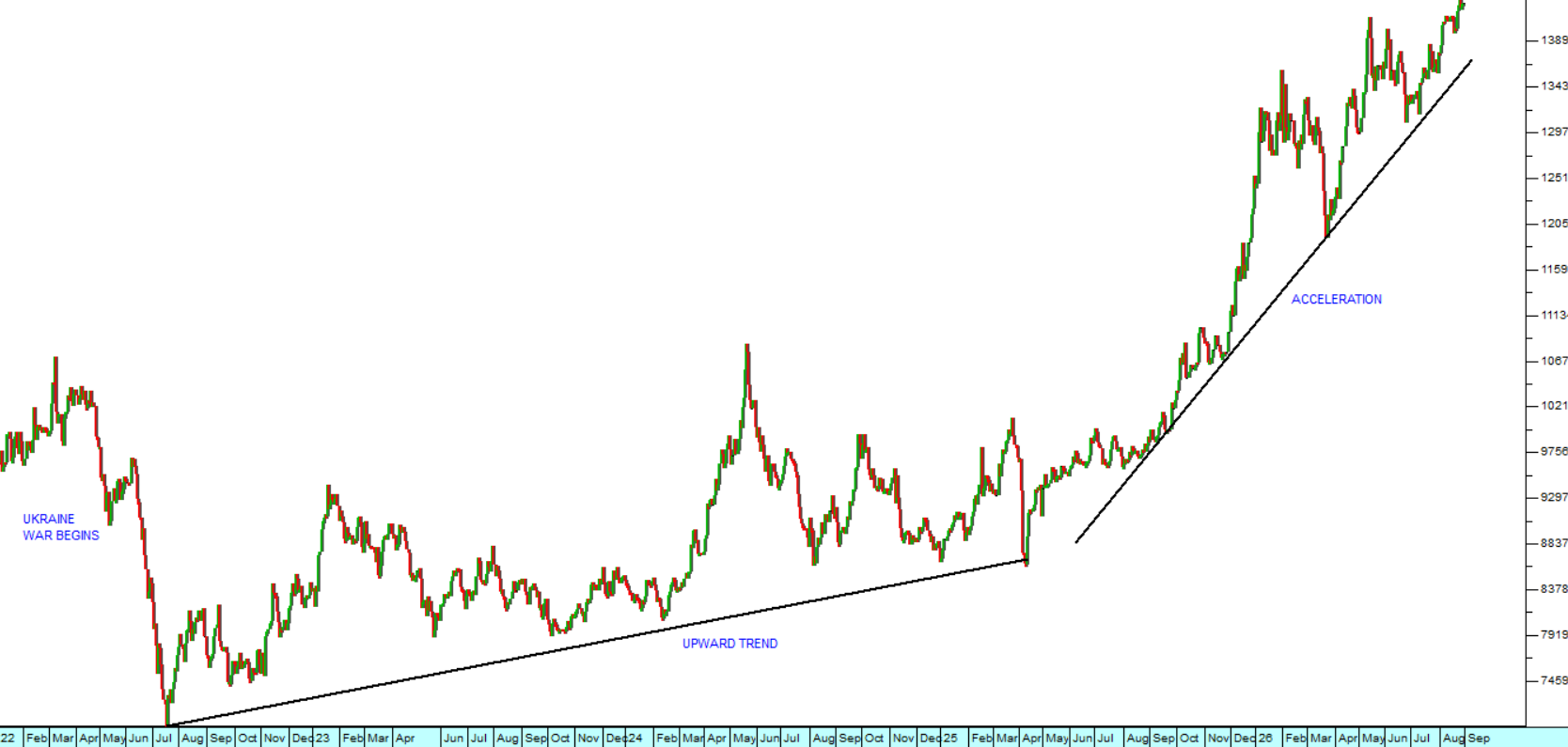
You can clearly see the acceleration of the copper price over the last year as the AI build-out really got going. We expect this upward trend in copper to continue because it is also vital to the worldwide move towards renewable energy. The JSE listed company which offers the best opportunity to capitalise this trend is Anglo American (AGL). The second-best option would be BHP.
GOLD
Gold has begun to perform again after a protracted correction which took the form of a downward sloping flag formation over the past seven months. The correction was a natural technical response to the seriously overbought position of gold at the end of January this year. There was considerable profit taking and switching into other so-called safe haven assets like long-term government treasuries. That pattern seems to have come to an end with gold breaking out of the flag formation on the upside.
To capitalise on the long-term run-up in the gold price we initially put Harmony on the Winning Shares List (WSL) back in the middle of November 2023. Harmony subsequently rose by 250% before falling back on the correction in the gold price. We judged that sooner or later gold would resume its upward trend and so we have kept Harmony on the WSL. Consider the chart:
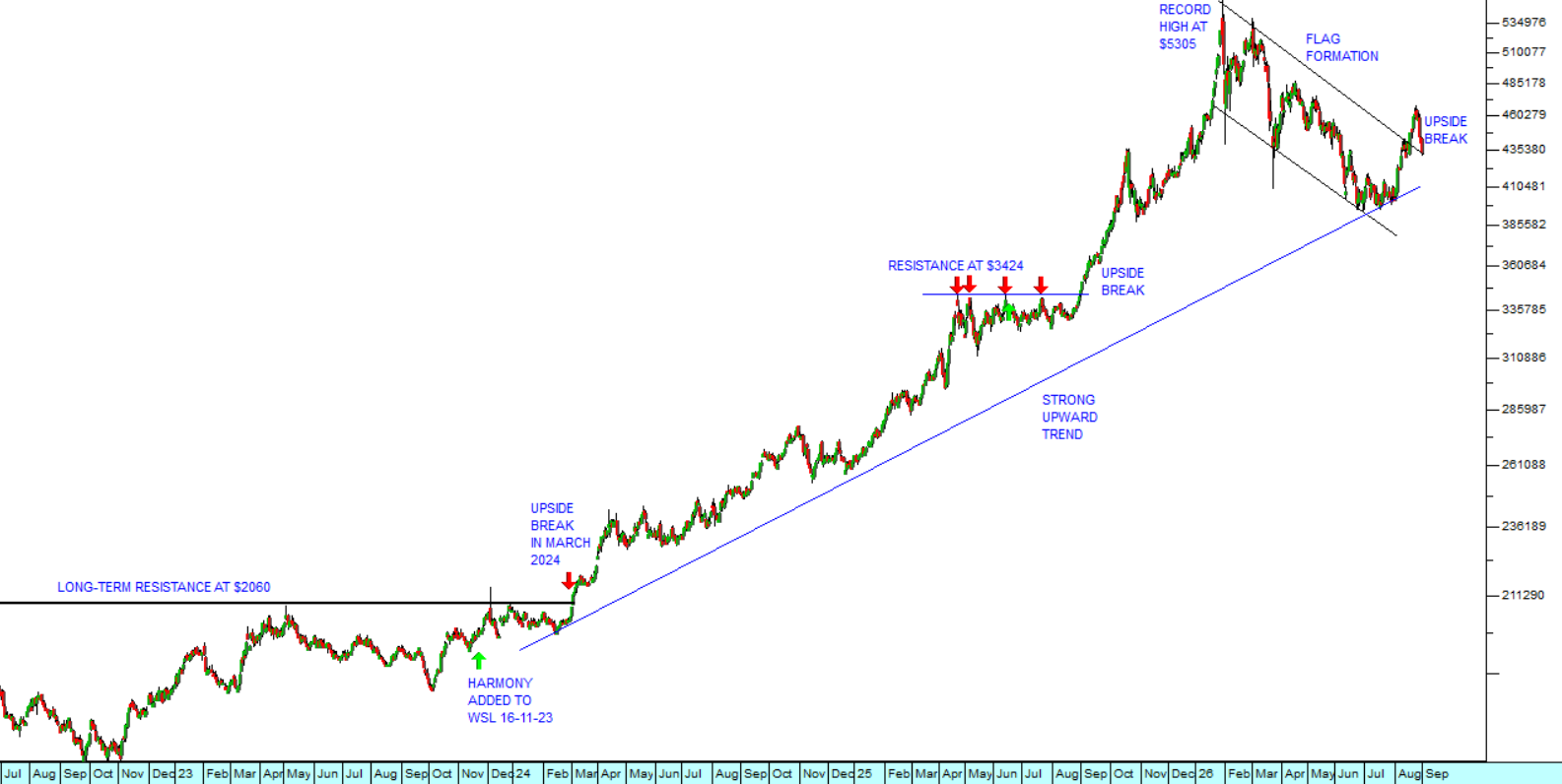
The chart shows the long-term resistance at $2060 which was finally broken in March 2024 and then the long upward trend which followed. The flag formation on the right hand end of the chart shows what has happened over the last 7 months as well as the recent upside breakout.
We expect gold to continue to perform well going forward.
OIL
The long-term trend in the oil price is down. This has been true for the past few years and was only interrupted by Trump’s absurd decision to go to war with Iran resulting in the closure of the Strait of Hormuz. So for the past seven months the oil price has become very volatile as Trump alternately blew hot and cold on the war which he thought would be over in a few weeks. Consider the chart:
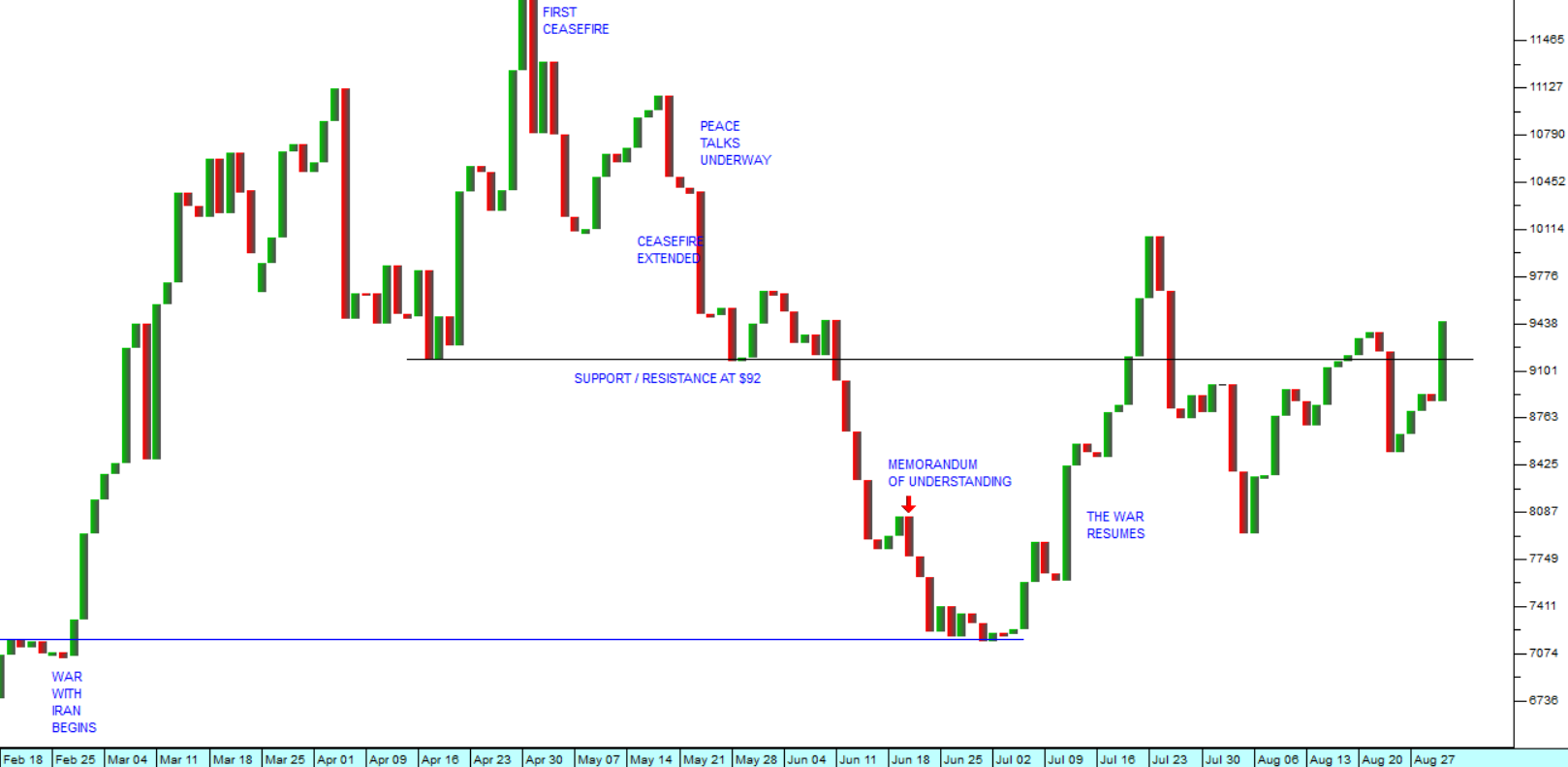
This chart has become familiar to most private investors this year as the oil price has become a critical element of the systematic risk in their portfolio. Over the last month, Brent appears to have settled into a range around $85 – which is a vast improvement on the prices above $100 earlier in the year. Essentially, investors are no longer paying close attention to oil as the world economy rapidly adjusts to the difficulties in getting takers through the Strait.
Our expectation is that oil will hover around current levels for the rest of this year and then when the crisis in the Middle East is finally resolved it will resume its long-term downward path.
Companies
The big story in equity markets around the world at the moment is the booming copper price. For South African private investors, the best way to take advantage of this has been to invest in the two massive international mining houses listed on the JSE whose earnings are dominated by copper.
ANGLO AMERICAN
At its peak in 1987 Anglo American controlled directly or indirectly as much as 60% of the JSE’s total market capitalisation. Since then, and especially since the ANC took over in 1994, it has systematically unbundled or sold all of these assets. Right now it is in the process of divesting itself of DeBeers, its steel-making coal business in Australia and its nickel business. At the same time, it is negotiating a merger with Teck to become the 5th largest copper producer in the world. Copper already accounts for more than 70% of its earnings before interest taxation, depreciation and amortisation (EBITDA). The merger will result in massive synergies, especially at the adjacent operations Collahuasi (Anglo) and Quebrada Blanca (Teck) in Chile. The focus on copper makes total sense given the rising copper price and importance as a metal which is greatly in demand for the roll-out of AI worldwide. Consider the chart:
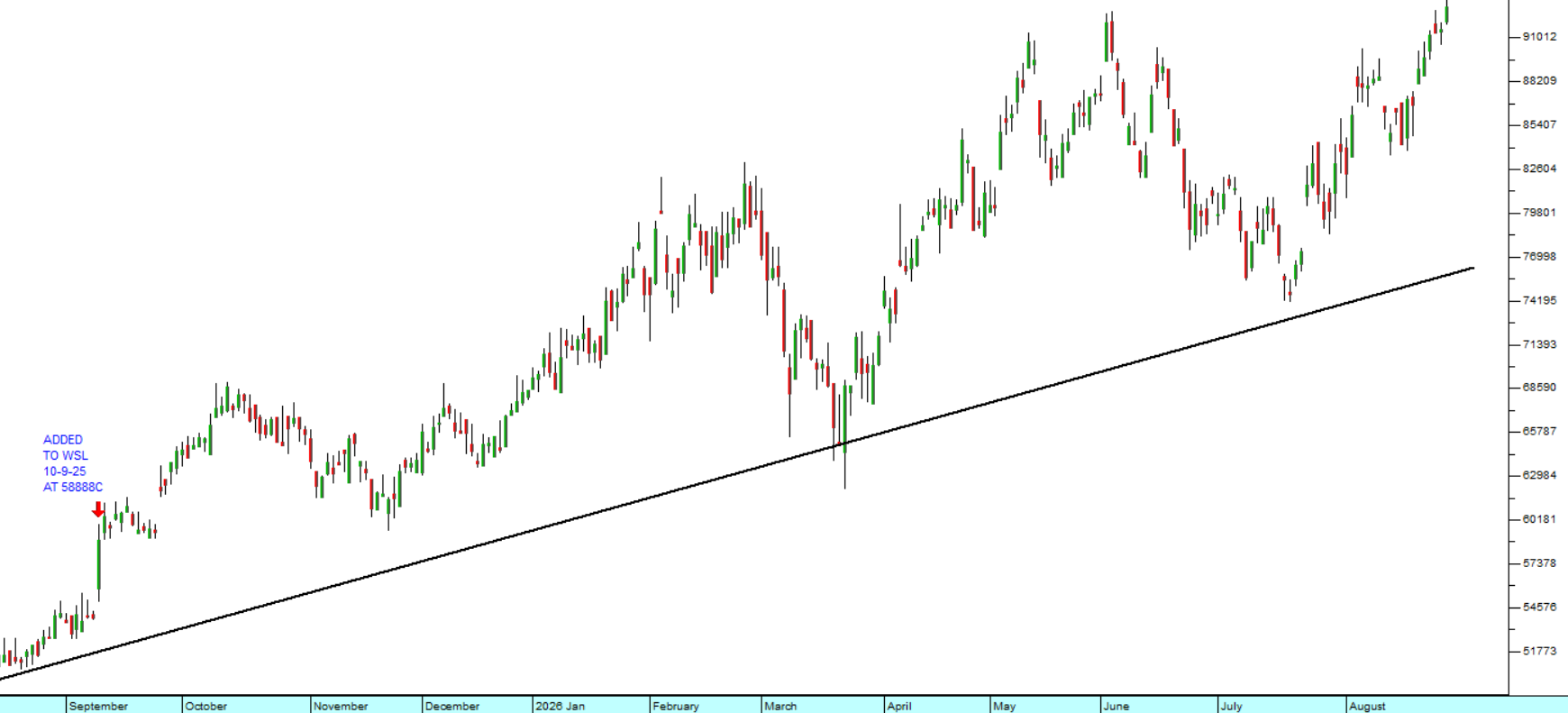
We first identified Anglo as a good prospective investment for private investors about a year ago and added it to the Winning Shares List (WSL) on 10th September 2025 at a price of 58888c. Since then, it has been climbing steadily, and it closed last week on Friday at 93150c – a gain of about 60%. We expect this share to continue tracking the international price of copper upwards. It remains a commodity share and hence volatile.
BHP
From a market capitalisation perspective, BHP is more than 3,5 times as big as Anglo America. It also receives about 54% of its earnings before interest, taxation, depreciation and amortisation (EBITDA) from copper, but, as an investment, Anglo is far more dependent on copper than BHP. BHP is a world-wide commodities company with its headquarters in Melbourne, Australia. It processes minerals, oil and gas and it has 62000 employees, mostly in the Americas and Australia. It produces copper, iron, coal, oil, and gas. BHP owns 57,5% of the Escondida mine in Chile which is one of the world's largest copper producers and also produces some gold and silver. It owns 33,75% of Antamina in Peru which produces copper and zinc. It owns 100% of Pampa Norte which produces copper cathode in the Atacama Desert in Northern Chile. It owns 50% of Samarco in Brazil which produces iron ore and a one third interest in Cerrejón in Colombia which produces coal from an open-cut coal mine. It owns mineral rights in Saskatchewan in Canada which contains one of the world's largest unexploited potash deposits. In Australia, BHP owns Olympic Dam which is one of the world's largest copper, uranium, and gold ore bodies. It also owns Western Australia Iron Ore. So it is a highly diversified international mining company – but it remains very dependent on the price of coal. Consider the chart:
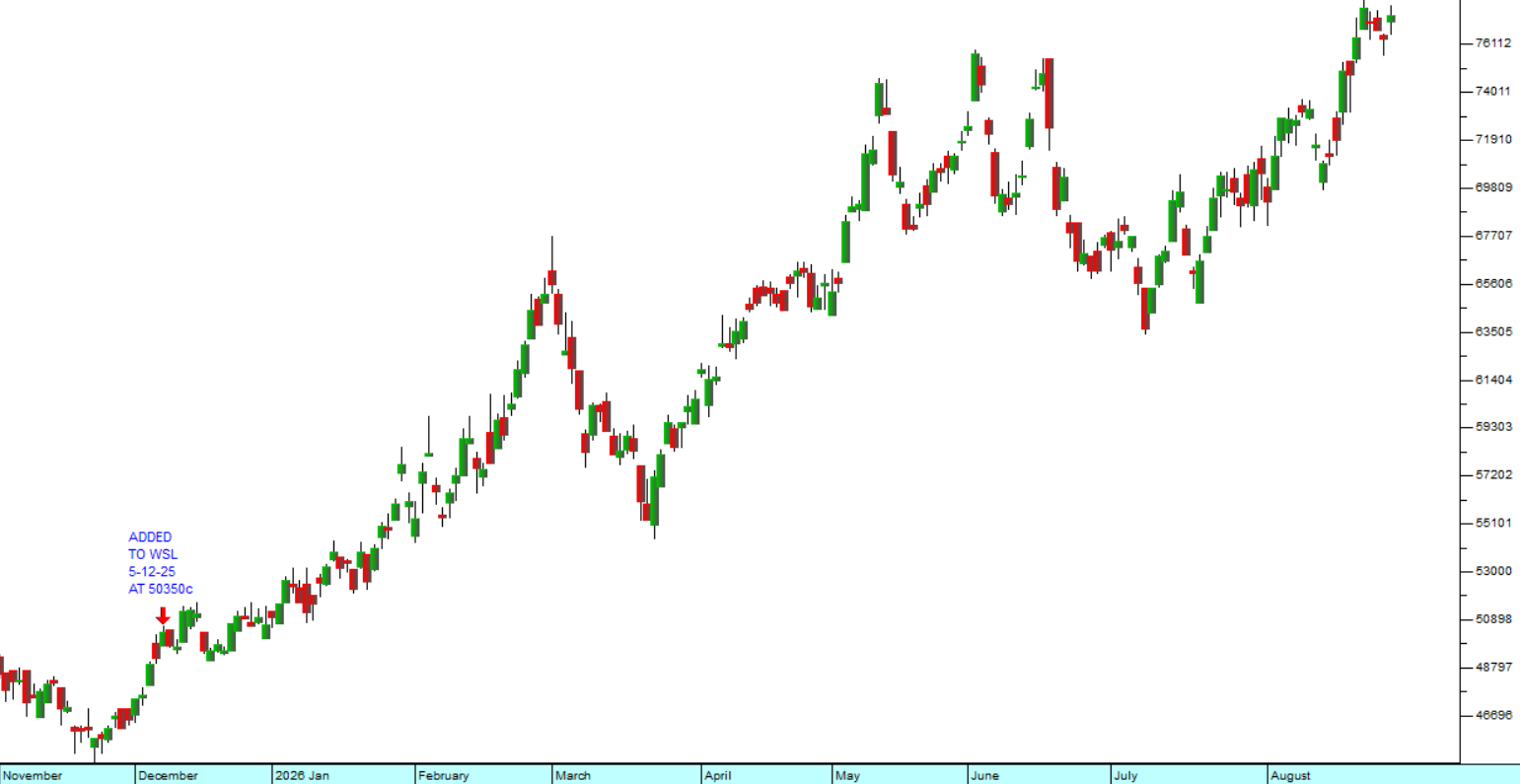
We added BHP to the Winning Shares List (WSL) on 5th December 2025 at a price of 50350c when it broke up out of an extended sideways pattern and began a new upward trend. It closed at 77500c on Friday last week – which is a gain of 73,7% in just under 9 months. We regard it a stable rand hedge institutional stock where diversity helps reduce the risks inherent in commodity shares. We believe it will continue to perform well in the future.
DATATEC
This is an IT company that operates in more than 50 countries throughout the world. It has become one of our favourite shares over the past year. We drew your attention to it two months ago in the July Confidential Report. Our interest was originally sparked when it broke up out of an extended sideways pattern, and we added it to the Winning Shares List (WSL) on 26th October 2025. At that time the share price was 3950c. Since then, it has performed very well, rising to a peak of 9958c on 29th June 2026 before falling back on profit taking.
In its results for the year to 28th February 2026 the company reported revenue up 3,3% and headline earnings per share (HEPS) up 56,5%. At the time the company said that AI infrastructure investment was driving demand for its products. So, this is a JSE-listed company that is benefiting directly from the massive move towards AI by companies across the world. The company is virtually ungeared with a net asset value of $540,3m and debt of $47,6m – which means it has plenty of headroom to take advantage of acquisition opportunities.
Consider the chart:
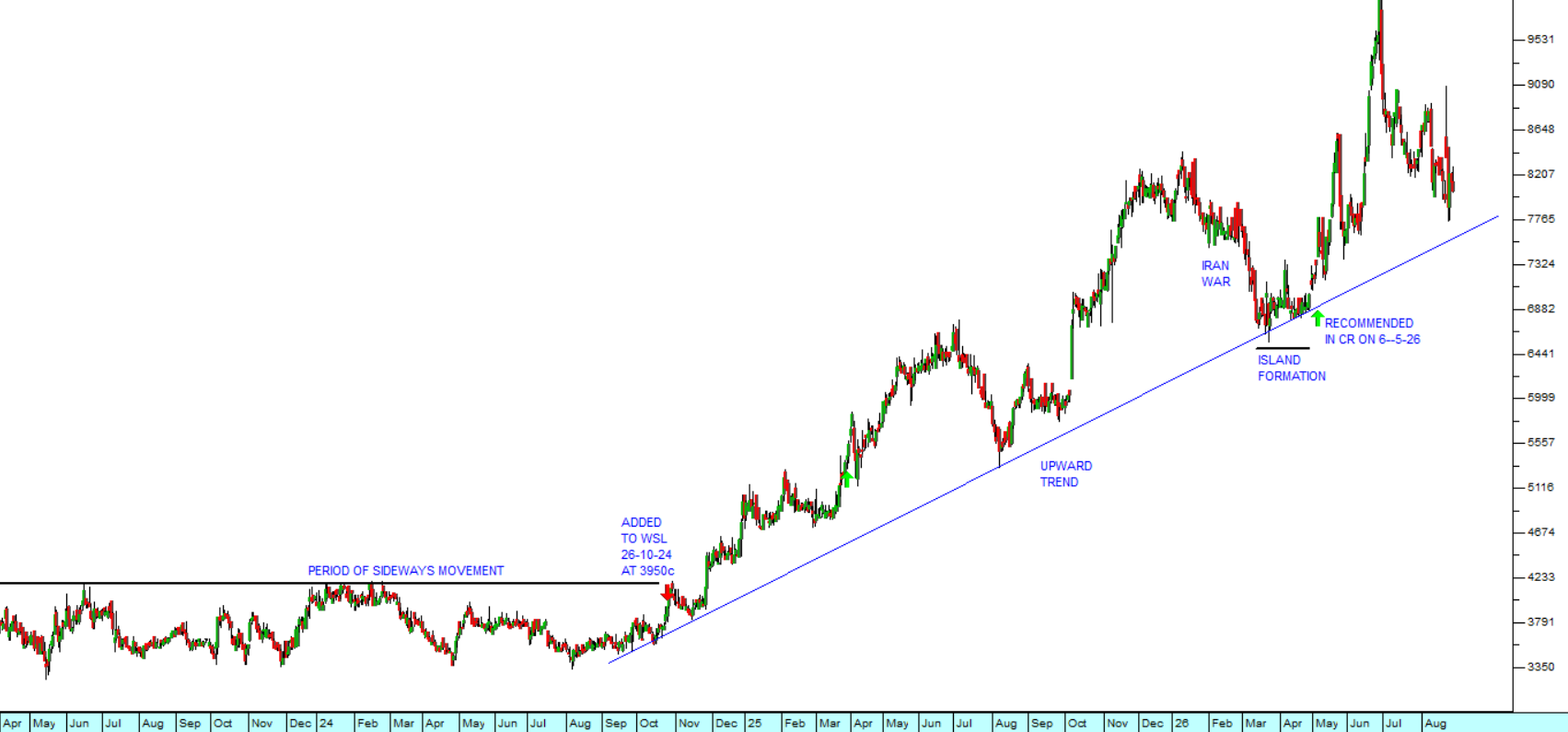
On Monday 24th August 2026, the company announced that it would be paying out a special dividend of 2320c per ordinary share (after the 20% dividend withholding tax) to all shareholders owning the shares at the close of trade on Friday 16th October 2026. This is over and above the 400c dividend that the company paid out for its 2026 financial year. So, if you buy the shares now for their price of around 8057c (28-8-26) in a month’s time you will get 2320c of that back in the form of a dividend. In other words, the shares will only have cost you about 5737c. At that price the company is on a historical dividend yield of almost 7%. We suggest that this is well worth considering. Of course, on the day that the share goes “ex-div” (17th October 2026) you should expect the share price to fall by roughly the amount of that special dividend.
DISCOVERY
Discovery has become the Woolworths of the financial services sector in South Africa offering A/B income group people a full range of services from medical aid to banking with incentives at every step offered by its Vitality program. Over the past 25 years Adrian Gore has built the company into a massive international conglomerate. In our view it is a share that should form part of every private investor’s portfolio. In a recent trading statement for the year to 30th June 2026 the company estimated that headline earnings per share (HEPS) would increase by between 31% and 36% - in other words, another year of exceptional growth. Consider the chart:
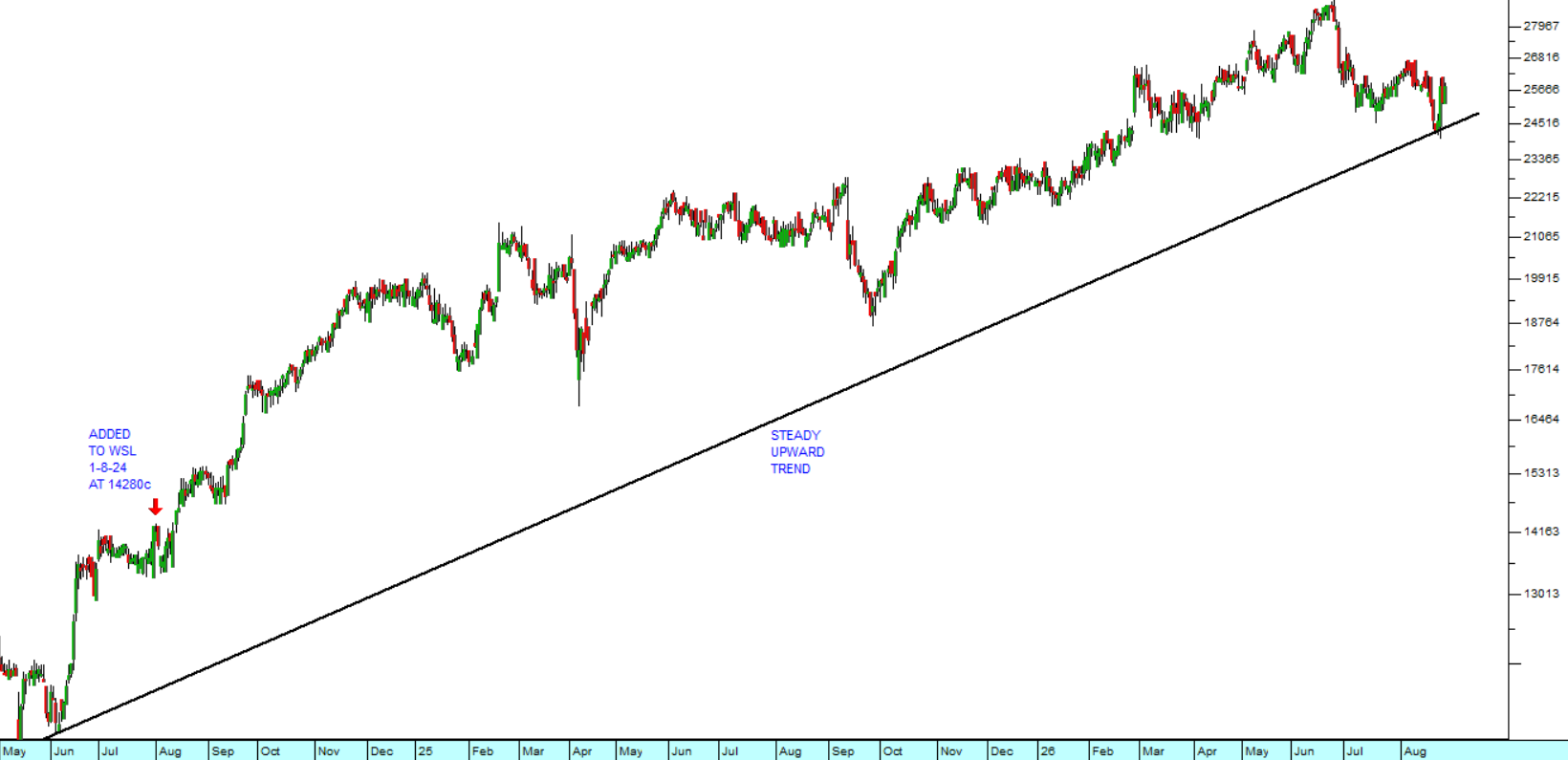
For the past two years the share has been climbing steadily, but in the last couple of months it has been in a correction which in our view offers a buying opportunity. We added the share to the Winning Shares List (WSL) on 1st August 2024 at a price of 14280c. It has since risen to 25847c – a gain of 81% in two years. In addition, in 2024 it paid out 217c in dividends and then in 2025 a further 288c. We expect an increased dividend this year again.
GOLD FIELDS
Gold Fields is an international gold mining house which has benefitted from the rise in the gold price since March 2024 and then fell back when gold began to correct in 2026. It is our view that gold has probably started a new upward trend and Gold Fields is once again producing exceptional profits. Originally, Gold Fields bought the South Deep mine (which is 3km deep) and has been pouring cash into it to make it viable. The late Brett Kebble once described this mine as “...the world’s most expensive long drop” because of its many technical problems, but it is also the world’s 2nd largest unmined gold resource hence Gold Fields’ persistence. That persistence is definitely beginning to pay off. In its results for the six months to 30th June 2026 the company reported attributable profit up 81% and headline earnings per share (HEPS) of 208c (US) compared with 115c in the previous period. The recent increase in the gold price has had a strong impact on the share price. Consider the chart:
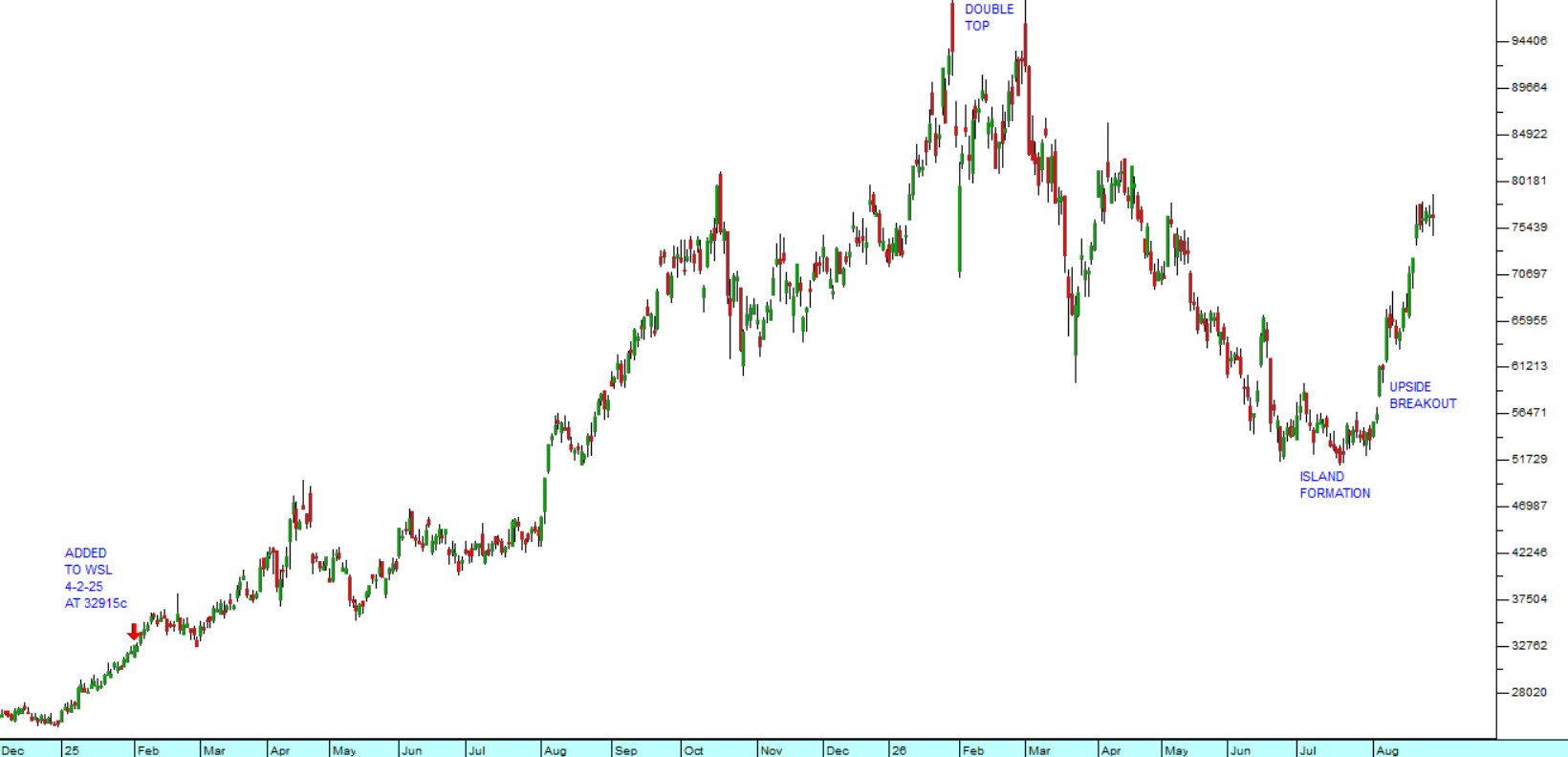
The chart shows the upward trend in Gold Fields and the point at which we added it to the Winning Shares List (WSL) at 32915c on 4th February 2025. Initially it went up strongly and reached a peak of around 93000c at the end of January 2026. There is made a double top and fell back – but we kept it on the WSL because we always believed that gold would bounce back in due course. That is now happening and Gold Fields is climbing again. Of course, it remains a commodity shares and hence volatile and risky.
← Back to Reports