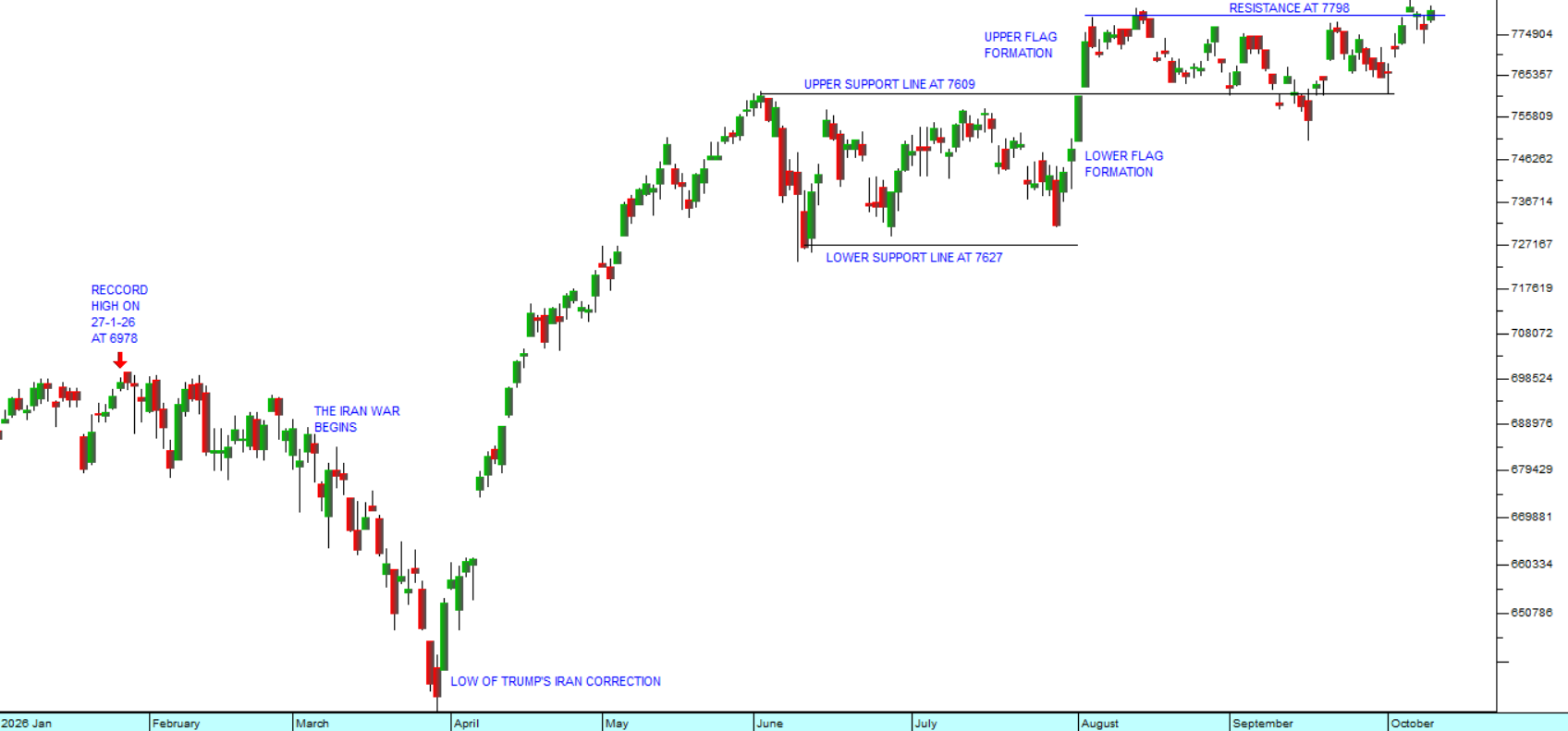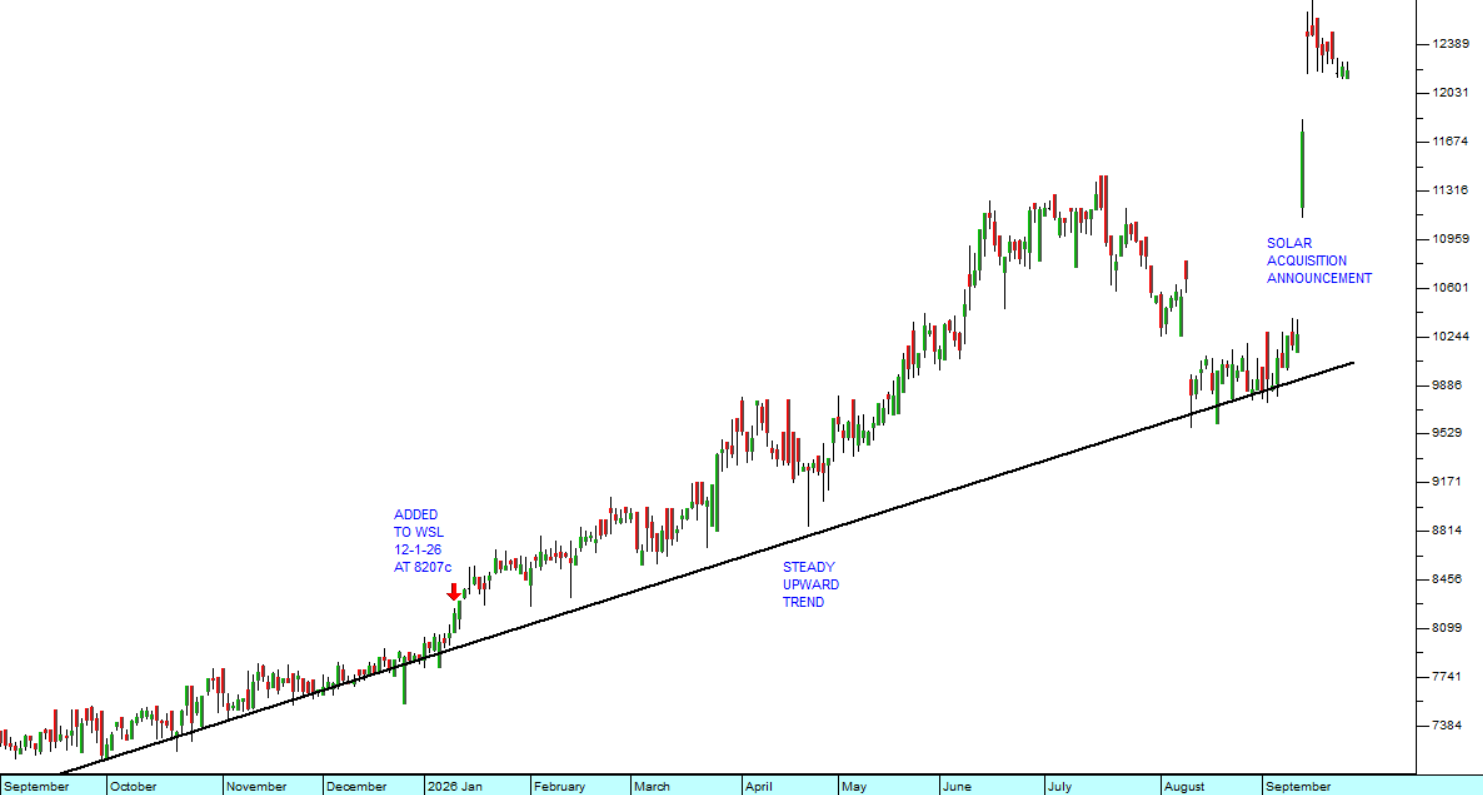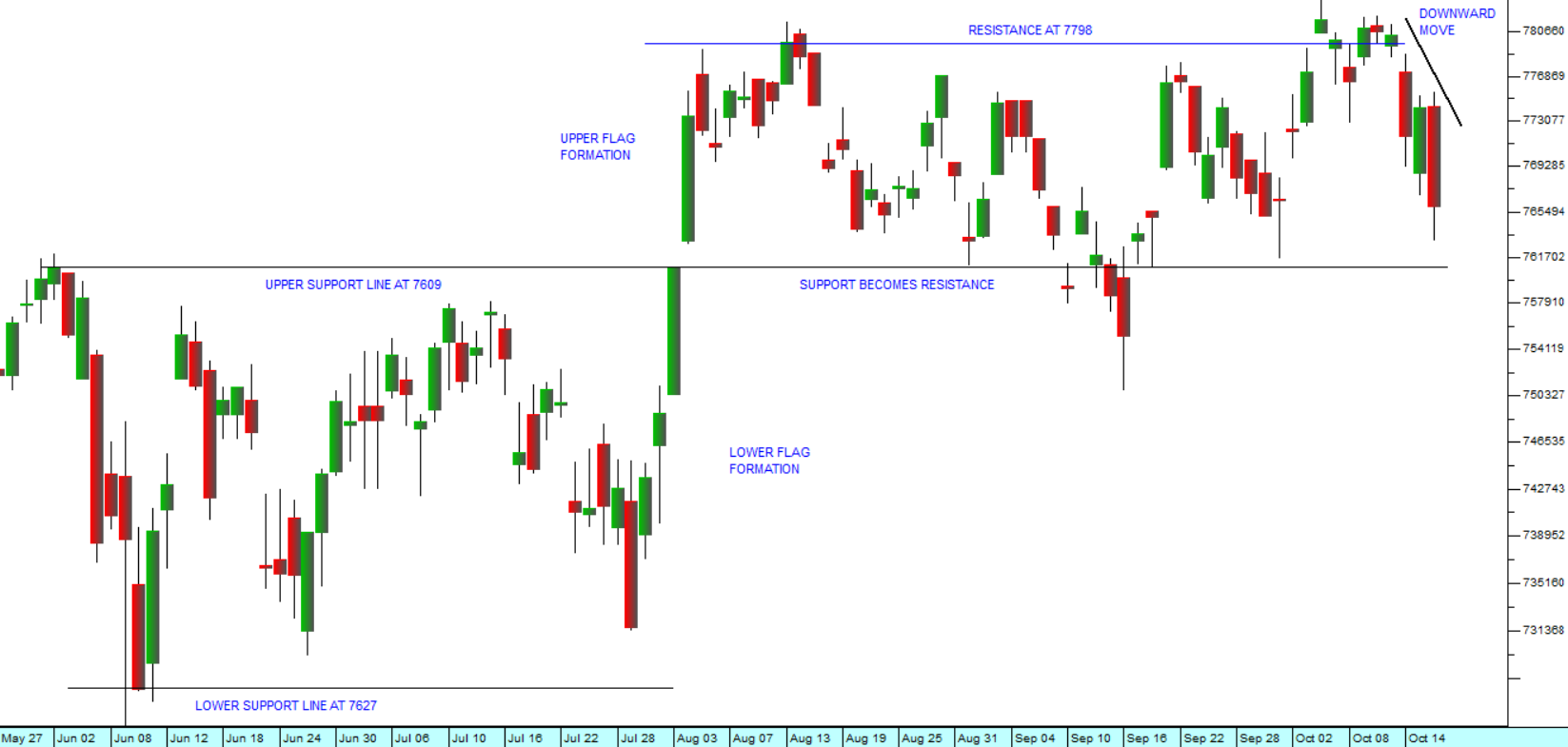
Market View
J200 110,928.00 -1.16% J203 118,903.00 -0.95% J210 132,419.00 -5.36% J211 133,937.00 +0.76% J212 26,076.00 +1.88% J213 144,808.00 +1.31%
Winning Shares (Top 5)
Code Name Added Price Latest % Gain % Gain/Year
SUR SPURCORP 2023-08-08 2488 4010 +61.17% +24.56%
ADH ADVTECH 2023-08-14 1975 3968 +100.91% +40.79%
CGR CALGRO-M3 2023-08-15 356 475 +33.43% +13.53%
CAA CA-SALES 2023-08-25 775 1550 +100.00% +40.92%
CPI CAPITEC 2023-11-04 185496 444810 +139.79% +62.15%
Opinions (Top 5)
Code Name Date Action
OAO OANDO 2026-02-03 View

Oando (OAO) is an oil and gas company located primarily in Nigeria. It has listings on both the JSE and the Nigerian stock exchange. The problem with a share like this from a private investor's perspective is that it is highly risky. Firstly, it is a commodity share whose fortunes are determined by the international price of oil.

Secondly, its business is located in Nigeria which tends to be politically unstable. Oando's shares are also very thinly traded. In its results for the year to 31st December 2024 the company reported revenue of N4bn compared with N2,8bn in the previous year. It made a headline loss of 3 cents per share compared with a profit of 1c in the previous period.

The auditors reported a material uncertainty about its ability to continue as a going concern considering that its current liabilities exceeded its current assets by N4bn and it had recorded a comprehensive loss of N83bn. In its results for the 3 months to 30th June 2025 the company reported revenue of N788,2bn compared with N1,1bn in the comparable period.

The company made a loss of N38,4bn. In an update on the 3 months to 30th September 2025 the company reported headline earnings per share (HEPS) of 1c (Niara) compared with 0c in the previous period. In the 3 months to 31st December 2025 the company reported HEPS of 1c compared to a loss of 3c in the equivalent previous quarter.

The share seldom trades, with only R11000 worth of shares changing hands each day on average. It is not practical for private investors.

PPH PEPKORH 2026-02-03 View

Pepkor Holdings (Pep) (PPH), previously known as Pep, is 71,01% owned by Steinhoff International. With the collapse of the Steinhoff group following admissions of "accounting irregularities", the directors of Pep decided to change their name back to Pepkor Holdings to avoid negative publicity.

The group includes Ackermans, PEP Stores and Bradlows and HiFi Corporation. Since the problem began in December 2017, and with the COVID-19 pandemic the share price fell as low as R10 per share in May 2020. Over the next year the share staged a remarkable recovery, more than doubling.

The company raised R1,9bn in an accelerated book-build. The proceeds have been used to reduce debt as a precautionary measure. On 3rd February 2022 the company announced that acquisition of 87% of the Brazilian clothing retailer Avenida. On 13th April 2022 the company announced that its Isipingo distribution center had suffered significant damage as a result of the flooding in the Natal area and had to be temporarily closed.

The company has adequate insurance to cover the damage. In its results for the six months to 30th September 2025 the company reported revenue up 12% and headline earnings per share (HEPS) up 14,8%. The company said, "The group further entrenched its position as a leading integrated retail and consumer platform, expanding its customer reach across both physical and digital channels, surpassing 6 000 retail stores and adding more than 10 million customers across its digital ecosystem this year." In an update on the 3 months to 31st December 2025 the company reported revenue from continuing operations up 12,9% and group sales up 10,6%.

The company said, "The recently acquired Legit, Swagga and Style businesses were successfully incorporated into the Speciality division during the quarter with Legit trading strongly in the period". Technically, the share was in a strong upward trend from May 2023, but has been moving sideways since it peak in December 2024. We see the upward trend continuing.

We see it as a good quality investment that is benefitting from better levels of consumer spending. On 25th March 2025 the company announced that it was acquiring Legit, Swagga, Style and Boardmans for cash from existing balances. The transaction is less than 2% of Pepkor's market capitalisation.

.

GML GEMFIELDS 2026-02-02 View

The Gemfields Group (GML) (previously Palinghurst Group) is a mining group that has two major projects: (1) Kagem, the world's largest producer of emeralds (in Zambia) and rubies (at Montepuez in Mozambique); (2) Jupiter Mines, a South African producer of manganese.

The group is led by Brian Gilbertson, previously the CEO of BHP Billiton. Gilbertson identified that the semi-precious stones market was under-developed and offered an opportunity for consolidation and professional management - hence the Gemfield's operation. Jupiter was listed on the Australian Stock Exchange (ASX) in April of 2018 and in the process, Gemfields disposed of 60% of that company in line with its decision to cease being a diversified mining company and to focus purely on gemstones.

The share is fairly well-traded with approximately R,5m worth of shares changing hands on average every day. Like all commodity shares it is risky and its fortunes depend on the prices of emeralds and rubies on the international market - as well as the risks associated with mining in third-world countries.

It appears to have found a niche for itself where there is very limited competition, and it should do well as the world economy recovers. On 24th October 2022 the company announced that operations have resumed at MRM and key personnel had returned following an insurgent attack on a mine about 12km away on 20th October 2022.

On 7th August 2023 the company announced that it would construct a new processing plant that would triple its output from the Montepuez ruby mine. In its results for the six months to 30th June 2025 the company reported revenue of $64,2m, down from $121,4m in the previous period.

The company made a headline loss of 1,5c  per share compared with a profit of 0,6c in the previous year. The company said, "MRM experienced lower premium ruby output while Kagem Mining ("Kagem") suspended mining altogether at the end of 2024, with limited operations resuming only in May 2025.

The beginning of the year was also marred by civil unrest in Mozambique following the disputed general election and the surprise implementation of the 15% export duty on emeralds in Zambia, a matter since resolved." In an operational update to 31st December 2025 the company reported total auction revenues of $128,5m and net debt of $39,2m. This share tends to be volatile for a variety of reasons, but mostly because of the volatile nature of the product which it sells.

Technically, the share has been falling since April 2023 and has yet to break above its long-term downward trendline. We recommend waiting until the downward trendline is broken - which has not yet happened. On the 10th of August 2025 the company announced that it had sold Faberge for $50m.

ACL ARCMITTAL 2026-02-02 View

ArcelorMittal (ACL) is South Africa's largest steel producing company. It has survived where companies like Highveld Steel have disappeared. Arguably, ArcelorMittal felt the impact of the sub-prime crisis more than any other South African company and has fallen from its high of R260 in June 2008 to as low as 25c in August 2020.

Since then, it has rallied strongly and now trades at 1052c. It has had to deal with the collapse of the construction industry locally, which was a major consumer of steel, and the massive imports of cheap Chinese steel which were dumped onto our market. Those imports have slowed down somewhat, and ArcelorMittal was successful in getting certain tariffs in place to discourage imports.

We believe that this company came close to closure in July 2020 when the share price reached 25c. It has been rescued by the rising steel price combined with severe cost cutting. On 6th January 2025 the company announced that it had taken the decision to wind down and close its Longs steel division - leading to a sharp drop in the share price.

On 19th March 2025 the company announced that the government will provide funds to keep the long steel plant open by paying the wages at the plant for the next year. This has caused the share price to rise, but will probably not prevent the eventual closure of the plant in time. ACL said that in 2024 it paid R3,2bn to Eskom for electricity - up 14% on the previous year and that electricity costs had risen by more than 800% since 2007.

In its results for the six months to 30th June 2025 the company reported revenue down 16,5% and a headline loss per share of 91c compared to a loss of 100c in the previous period. The company said, "International and domestic steel markets remained under pressure, with some recent price improvements internationally • EBITDA loss (before exceptional items) after R1 075 million of IDC funding support to neutralise the Longs Business operational losses." In a trading statement for the year to 31st December 2025 the company estimated that HEPS would increase by between 31% and 41%.

In our view this is not a good investment because it is heavily dependent on government assistance and tariffs. On 29th August the company announced that it would be winding down its long steel business because it had been unable to obtain government support.

ORN ORIONMIN 2026-02-02 View

Orion Minerals (ORN) is an Australian exploration company which is listed on the JSE (September 2017) and on the Australian Stock Exchange in Sydney. It is trying to find funding for its copper and zinc mine in Prieska. The Prieska mine was previously operated by Anglovaal, but stopped operating in 1990 after 20 years during which it extracted more than 1 million tons of zinc and 430 000 tons of copper concentrate.

The main problem with the mine is flooding. Orion hopes to exploit this resource with a mechanised approach and minimum labour. Vedanta Resources which runs the Gamsberg mine next to Orion's resource is looking at building a smelter that could service all the mines in the area and even resources from Namibia.

Once construction begins on the Prieska mine, they will need to pump out nearly 9 million cubic meters of water from the existing structure. Production is expected to begin in 2024. Mining exploration is probably one of the riskiest investments on the JSE. At 30th September 2023 the company had $15,74m in cash.

On 17th April 2024 the company asked for a halt on the trading in its shares because of a "...material announcement on exploration results at Okiep copper mine." On 22nd April 2024 the company announced a "Spectacular High-Grade Copper Intercept at Okiep Copper Project, Flat Mines Area 49m at 4.89% Cu including 10.23m at 12.47% Cu." This caused the share price to jump from 19c to 24c. Investors should be very careful of this loss-making penny stock and maintain a strict stop-loss level.

On 25th June 2024 the company requested an immediate stop to trading in its shares pending an announcement. On 28th August 2024 the company announced that it had been granted a key water use licence for the Okiep copper mine. In its results for the six months to 31st December 2024 the company reported a headline loss per share of 0,01c compared with 0,07c in the previous period (AUD).

The company said, "The operating loss for the previous corresponding period reflected an unrealised foreign exchange loss of AUD0.51 million and exploration expenditure of AUD6.73 million." In an update on the 3 months to 31st December 2025 the company reported, "The Company is advancing from developer to operating status, targeting first copper and zinc production by late 2026/early 2027". On 8th July 2025 the company announced that it had issued 522m shares at 1,1c each to raise R67m.

In our view, this is a volatile penny stock engaged in a particularly risky venture, but it has speculative potential. On 3rd April 2025 the company announced that Errol Smart would step down as CEO and be replaced by Anthony Lennox with immediate effect. 

Winning Share: ADH
Opinion: PPH
Clicks Oversold  (2026-01-26)

Technical analysis is the study of investor perceptions as they are reflected in the price and volume patterns of a security. It is also true that shares move in cycles which take them from being overbought to being oversold and back again. This is especially true of the blue chip shares which are…

Technical analysis is the study of investor perceptions as they are reflected in the price and volume patterns of a security. It is also true that shares move in cycles which take them from being overbought to being oversold and back again. This is especially true of the blue chip shares which are heavily traded and patronised by the big institutions (pension funds, unit trusts and insurance companies).  The fund managers who manage the institutional portfolios account for about 90% of all trades on the JSE.

In our opinion, Clicks (CLS) is a high-quality share which should be part of every private investor’s portfolio. The problem is that it is generally very popular with the big institutions who are always buying it, which tends to make it very expensive – most of the time. But there are occasions when it goes out of fashion with the fund managers for some reason and at those moments it can represent excellent value and a great buying opportunity. In our opinion, right now is just such a moment.

A few days ago on 22nd January 2026, Clicks published a trading update for the 20 weeks up to 11th January 2026. In that update it said that group turnover was up 7,4% and that pharmacy sales had gained 9%. They also commented that they had record Black Friday sales and robust customer demand for their Christmas gift range.

Consider the diagram below.

Clicks (CSL) : February 2016 - 23rd of January 2026. Chart by ShareFriend Pro.

The top chart in the diagram below shows the share price of Clicks over the last ten years. The lower chart shows the 200-day overbought/oversold (OB/OS) of Clicks over the same period.

On the OB/OS I have drawn in a -10% buy line and you can see that over the ten-year period there have been just 5 occasions (the green arrows) on which the OB/OS has fallen below -10%. Then considering the top chart you can see that, on each of those occasions, Clicks represented an excellent buying opportunity (the red circles).

On Friday last week, the Clicks OB/OS ended the week at –10,64%. And you will observe that historically it generally does not spend a great deal of time below that minus 10% buy line. Inevitably, the fund managers become aware that it is heavily over-sold and begin buying it, driving the price up again.

Of course, the fact that Clicks is heavily oversold right now does not guarantee that it will not fall further and you should always maintain a stop-loss strategy. But, if you are buying, it does give you a good indication of your probability of being right. In my estimation, the share has spent about 2% of its time over the last ten years below that -10% buy line. That means that your statistical probability of being wrong in buying it at that level is therefore extremely low.

And you will have one great satisfaction – you are not buying it at +24% - but somebody did! Otherwise, the chart would not have gone there.  It is amazing to consider that, less than 4 months ago on 25th September 2025, there were institutional fund managers buying Clicks at an OB/OS level of over +24% (the red arrow). If you buy now at -10,64%, you are certainly doing a lot better than them!

The Collapse of Choppies  (2026-01-19)

The fall in the Choppies share price from 795c on 2nd January 2026 to last Friday’s close at 290c is a great example of the volatility of markets, especially in shares which are relatively thinly traded. It demonstrates the importance of investor sentiment and the potential for popular shares to…

The fall in the Choppies share price from 795c on 2nd January 2026 to last Friday’s close at 290c is a great example of the volatility of markets, especially in shares which are relatively thinly traded. It demonstrates the importance of investor sentiment and the potential for popular shares to rapidly become over-priced once they attract the investing public’s imagination.

Choppies represents an unusual investment opportunity on the JSE, because it is a supermarket chain which is apparently highly successful in Africa outside of South Africa. This made it unique and a potential take-over prospect on the JSE. Most of the larger grocery retailers like Shoprite and Pick ‘n Pay have made an effort to establish themselves in other African countries with varying degrees of success. Those markets tend to be characterised by high levels of inflation and political instability. Choppies, on the other hand, was demonstrably successful in the rest of Africa, but found the South African market too competitive.

This made the Choppies story unique. We first recognised Choppies potential when it broke up out of an extended period of sideways movement in March last year. We added it to the Winning Shares List (WSL) on 6th March 2025 at a price of 85c and its performance was nothing short of meteoric. Eventually, by the beginning of 2026 it was trading on a price:earnings ratio (PE) of over 100. Consider the chart:

Choppies (CHP) : September 2024  - 16th of January 2026. Chart by ShareFriend Pro.

The chart shows the extraordinary climb in Choppies share price last year and then its subsequent collapse in 2026.

So, what happened? The answer to this question is that we really do not know. There have been no explanations or even comment given by the company itself in Stock Exchange News Service (SENS). There is some speculation that there was an offer from one of the other South African supermarket giants that was then abandoned, but again the company itself has said nothing.

In our view, the Choppies business proposition gained momentum leading up to the publication of its financials on 22nd September 2025 causing its share price to run up too quickly – accompanied by rising volumes. Investors felt that the company had suddenly caught the attention of institutional investors.

On 8th January 2026, probably a single investor decided to take profits and gave a market order to his broker to sell a million shares “at best”. The investor concerned was almost certainly a beneficiary of the Choppies “Long-term Investment Scheme” (LTI) and a member of the company’s senior management. The trade demonstrated his ignorance of the share market because he dumped a huge amount of shares into a relatively thinly traded market in a single day. A more experienced investor would have dribbled the shares into the market over a number of days thus giving time for the market to adjust. The problem is that 89% of the shares in issue are held by just two investors – which means that the “free float” is relatively small.  

So, how should you have handled this situation as a private investor? The answer is to strictly apply your stop-loss strategy. On the day after the share fell (Friday 9th January 2026) you should have sold out your holding on stop-loss. You would have got prices of at least 400c per share. If you bought the shares when we put them on the WSL on 6th March 2025, you would still more than quadrupled your initial investment. The lesson is never ignore your stop-loss.

And what should you do now? Well, when a share falls heavily like this, we always advise applying a 65-day exponential moving average (MA) and then waiting for the price to break up through that MA. There may still be some bad news which has not come out so you don’t want to buy prematurely. Wait for the share to settle down at these lower levels and then buy when it begins to move up again.

Notably, Choppies, at its current price (290c), is now on a P:E of 41 – which is far more attractive than its peak of over 113, but still very fully priced when compared to other grocery retailers on the JSE. Shoprite is on a PE 19.6 of and Spar is at 18,41.  

Thoughts on 2026  (2026-01-12)

At the start of a new year, we always give our view of what we think is to come. Since our last article, published on 22nd December 2025, there have been some notable developments in the international arena which are potentially important for South African investors. (1) As expected, the rand has…

At the start of a new year, we always give our view of what we think is to come. Since our last article, published on 22nd December 2025, there have been some notable developments in the international arena which are potentially important for South African investors.

(1) As expected, the rand has strengthened further, continuing the trend of the last nine months and breaking convincingly below R16.50 to the US dollar. What is notable is that the rand has also strengthened against other hard currencies, like the euro and the British pound. We have long considered the rand to be under-valued and we expect it to continue strengthen, especially against the US dollar which has itself been weakening against other hard currencies. Consider the chart:

South African rand/US dollar : March 2025 - 9th of December 2026. Chart by ShareFriend Pro.

The rand broke below the key R17.50 level in September and then that level became a support level. But now it has moved down to R16.50 and looks set to stabilise at that level. The strengthening currency reflects a growing local and internation optimism about South Africa’s future.

(2) Gold and platinum continue to perform well bolstering South Africa’s economy and providing jobs for thousands of miners. Gold reached a new all-time record high on Friday last week closing above $4500 for the first time ever. I bought my first Krugerrand for R600 in 1985 and last week that same coin was worth a new record high value of R75 000. We reiterate our view that, because of the political risk in this country, South Africans should hold 10% of their total wealth in Krugerrands. Gold may correct from these levels on profit-taking, but the long-term trend will continue to be up – so make sure you have some of these internationally accepted, highly transportable assets in your portfolio.

(3) The unexpected invasion of Venezuela and the capture of Maduro marks a new direction for the Trump administration. The attack was executed with surgical precision and, while it sets a dangerous precedent, it has definitely boosted Trump’s dictatorial confidence. One effect is that he has suddenly become less afraid of Putin and has been willing to put in motion various measures which are good for Ukraine and bad for Russia. The first was capturing two oil tankers in Putin’s “shadow Fleet” and the second approving a Bill which will result in tariffs of up to 500% on any country which buys oil from Russia.

At the same time, the Ukrainians have been very effective in their management of the drone war, increasing their production of drones dramatically and innovating new technologies which have given them a definite edge over Russia. This can be seen in their recent use of a land drone, packed with 12 anti-tank mines, to completely wipe out an entire Russian stronghold.

We never expected the war in Ukraine to last as long as it has, mainly because we thought that, with Europe and America’s backing, Ukraine ultimately had far more resources at its disposal than Russia. We still believe firmly in Ukraine’s superiority, but this year we expect that advantage to finally force Putin to the negotiating table.  The Russian economy is crumbling under sanctions; the Urals oil price has collapsed and Russia’s performance on the battlefield has been abysmal.  

(4) The South African economy is definitely improving. There is, of course, still a great deal of room for further improvement and we remain light years away from being a first world country – but our economy is in far better shape than most third world or emerging market countries, especially most of those in Africa to the North and many of those in South America and Asia. The improvements can be traced back to the monetary discipline exercised by the Reserve Bank which has brought our inflation rate close to or even better than many first world countries. Low inflation has increased the level of real take-home pay and that, in turn, is impacting consumer spending. We expect the economy to continue improving this year, provided that there are no material external shocks. The Municipal elections towards the end of the year should be significant in consolidating our new direction.

(5) The Great Bull Market, which began in March 2009, remains intact, with the S&P500 closing on Friday last week at another new all-time record high. The productivity impact of AI and the steady move towards solar and other alternative power sources is raising the performance and prospects of S&P500 companies. Consider the chart:

S&P500 Index : 1st August 2025 - 9th of January 2026. Chart by ShareFriend Pro.

The stage is set for another strong year featuring rising profits stimulated by further advances in technology and lower oil prices.

As a private investor you should be close to fully invested in this market. Just make sure that you maintain a strict stop-loss strategy. Remember, being successful in the share market is not so much about making money as it is about not losing it.    

JSE Top 40

110,928.00 (-1.16%)

All Share

118,903.00 (-0.95%)

Financial 15

26,076.00 (+1.88%)

J200
J203
J212
Top Gainers
# Code Name Close (c) % move
1 XII NUMERAL 20 +122.22%
2 MDI MASTDRILL 1920 +9.09%
3 SSU SSU 1083 +6.70%
Top Losers
# Code Name Close (c) % move
1 ISO ASPI 10211 -10.94%
2 MTU MANTENGU 42 -10.64%
3 SDL SOUTH-PD 2200 -10.20%

Top Movers – Charts

Top Gainer: XII
Top Loser: ISO