The Confidential Report - July 2026
America
Having made an all-time record high at 7609,78 on 2nd June 2026, the S&P500 Index has been moving sideways and consolidating as investors tried to digest the rapidly evolving situation in the Middle East and its impact on the oil price. Sentiment among investors is still apparently strongly optimistic but tainted with some concern about effectiveness of the Memorandum of Understanding between Iran and America together with the durability of their 60-day ceasefire. Continued hostilities by Israel in Lebanon are not helping the situation.
The drop in the oil price back to levels last seen before the conflict began in February shows that the world economy has adjusted to the situation and is not as oil dependent as it used to be. Consider the chart:
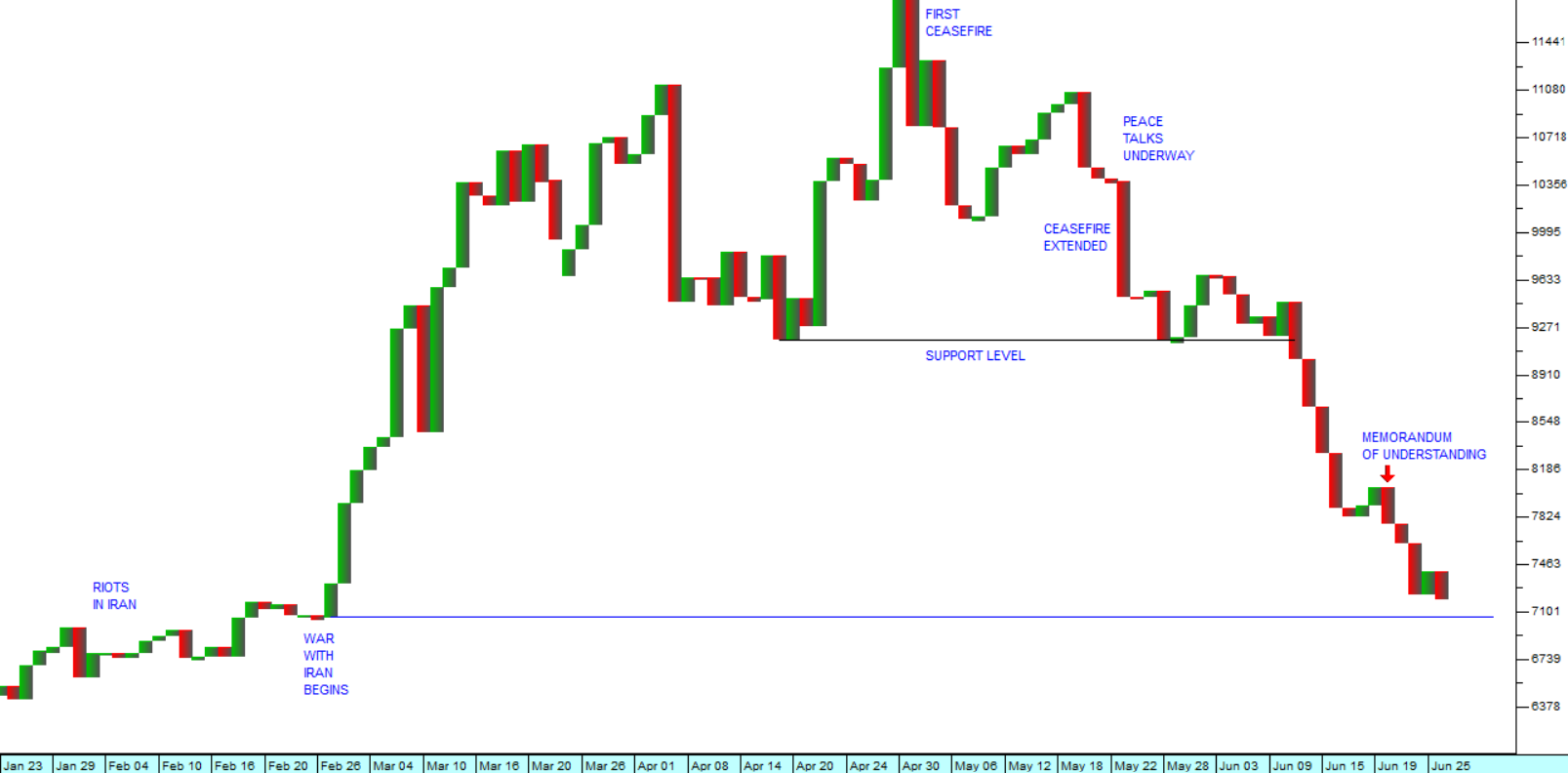
OPEC has agreed to increase oil output targets for the fourth time since the start of the Iran war and the closing of the Strait of Hormuz. The targets have been raised by 188000 barrels per day, from July. Seven main members of OPEC+, which groups OPEC and Allied producers including Russia, have increased their output quotas from April to June by almost 600,000 barrels per day (bpd). Overall, the closure of the Strait has reduced output from 42,8m bpd in February 2026 to 33,2m bpd in April. The increase in quotas is part of a widespread and generalised reaction to oil exports that has seen a significant shift away from fossil fuels by many countries. In our view, the war in Iran has accelerated the downward trend in oil consumption and that was already in place before the war began. Recent US negotiations with Iran appear to be bearing fruit with the North Sea Brent oil price falling back to $72. This is very close to the level it was at before the war in Iran began. We see it continuing to fall and to break below support at $60 in due course.
Following the successful listing of SpaceX there has been some considerable short-term profit taking and stagging, but the share appears to be holding its own based on strong belief in its future blue sky potential. There has been a sell-off of the Magnificent Seven, but that has not been drastic – just what we consider to be a normal market adjustment. What is clear is that the market now appears to be more concerned about the future path of interest rates and inflation in the US than it is about the oil price.
US inflation jumped to 4,2% for the year to the end of May 2026 as higher fuel prices began to bite. Core inflation was stable at 2,9%, but this is the highest level for inflation in more than three years and has increased fears of interest rate hikes. It is also a sharp increase from April’s figure of 3,8%. In the month of May itself prices increased by 0,5% - which was in line with economists’ expectations. Obviously, rising prices generally are the opposite of Trump’s campaign promises and have been steadily eroding his support base, especially among lower income MAGA people. With the mid-term elections coming up in five months, Trump has been under great pressure to bring the war in Iran to a conclusion. There are even some signs that Republican senators are beginning to abandon him.
The successful listing of SpaceX on America’s National Association of Securities Dealers Automated Quotation (NASDAQ) market shows the depth and extent of the current bull trend. SpaceX remains unprofitable, as do the two other companies (Open AI and Anthropic) expecting to list their shares on the American market later this year. This shows that the bull trend is maturing. Investors are willing to commit massive amounts of capital to companies which have no track record of generating a return. The relationship between profitability and share prices, especially in the tech sector, is steadily breaking down. From Musk’s perspective, the listing is very astute. He is capitalizing on investors’ excessive enthusiasm for tech to raise a massive amount ($75bn) of permanent capital. This is now interest-free capital which he controls totally. No doubt many other smaller tech companies, seeing his success, will follow suit. What we have is a listings boom. In this scenario you should expect more new listings, firstly on the US markets, but later probably on our market. Just be aware that listings booms have generally ended badly in the past. Many of the companies that listed in the 1998 dot-com listings boom collapsed completely or lost 90% of their market capitalization. Because it is not yet profitable, we cannot calculate a P:E ratio for SpaceX – so the next best thing is a Price-to-Revenue ratio. At the end of the day’s trade Space X was valued at 112 times its annual revenue – which, in our opinion, is simply crazy. Notably, 4400 SpaceX employees became instant paper millionaires because of the listing.
Wells Fargo, Goldman Sachs, Oppenheimer, and Yardeni Research all lifted their forecasts for the S&P500’s year-end level to as much as 8250. The higher targets are a result of many S&P companies increasing their quarterly earnings and future forecasts as well as improved prospects of a resolution to the conflict in Iran. In our view they are probably correct. We believe that the S&P500 will indeed be higher by the end of this year, despite that fact that it is already historically high. The continuing impact of AI combined with the lower oil price is likely to swing the world economy back into the boom phase that it was in before the war in Iran began.
The billionaire investor, Jeremy Grantham, who is famous for predicting the 2007/8 sub-prime crash, is now saying that a new crash is already in progress and that he is selling out of US stocks. He is advising everyone to sell their US shares and get into cash. Of course, as the market goes higher there will always be those “experts” who call the top and advise investors to get out of the market. Then, usually after a few months when the market has moved to new record highs and the investors who followed their advice have lost money, they are relegated to the scrap heap of disproved experts. Eventually, a point can be reached where no one is willing to call the top and the supply of bears dries up – and that perhaps is the point where you should become very concerned. There can be little doubt that Wall Street is very high at the moment, on an average P:E of over 25, but that does mean that it cannot go higher. The Impact of AI has been over-discounted in perhaps much the same way as the impact of the Internet was over-discounted in 1998. We just believe it can still go higher before it experiences a major correction. We can be wrong. Our advice is simply to strictly monitor and maintain your stop-loss levels. They will protect you against almost all downward trends if you act on them.
The JSE, over the medium- to long-term will always tend to follow Wall Street’s lead, but in the short-term it often anticipates what is going to happen on Wall Street, probably because there is a group of relatively astute investors who are interested in emerging market shares and bonds and who accurately predict what is about to happen. For example, consider the following chart of the JSE Overall index since the beginning of February (i.e. before Trump began his war in Iran):
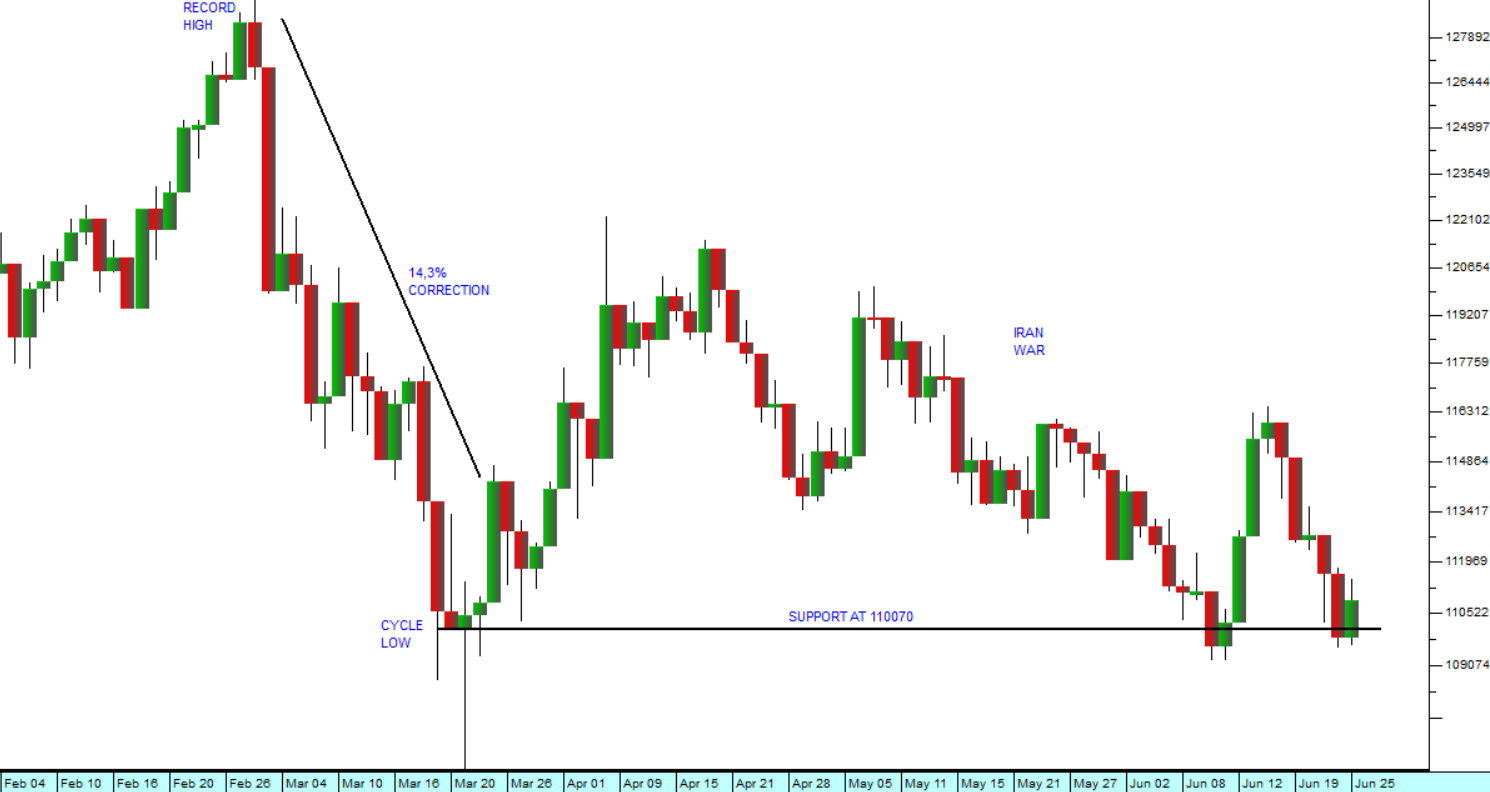
What is immediately apparent from this chart is that our market was already correcting before that war began. Our record high was on 27th February 2026 while the S&P500 only reached its record high on 2nd June 2026 – four months later. Clearly, emerging market investors perceived the potential impact of the Iran war more clearly than the average US investor.
Now you can see that after having off-loaded more than 14% our market began moving sideways with clear support at an index level of 110070. That support was tested on 10th June 2026 and is again being tested now. In our view it will probably hold and then in time move up from current levels – but we say again, we can be wrong.
Now look at the chart of the S&P500 over the same time period:
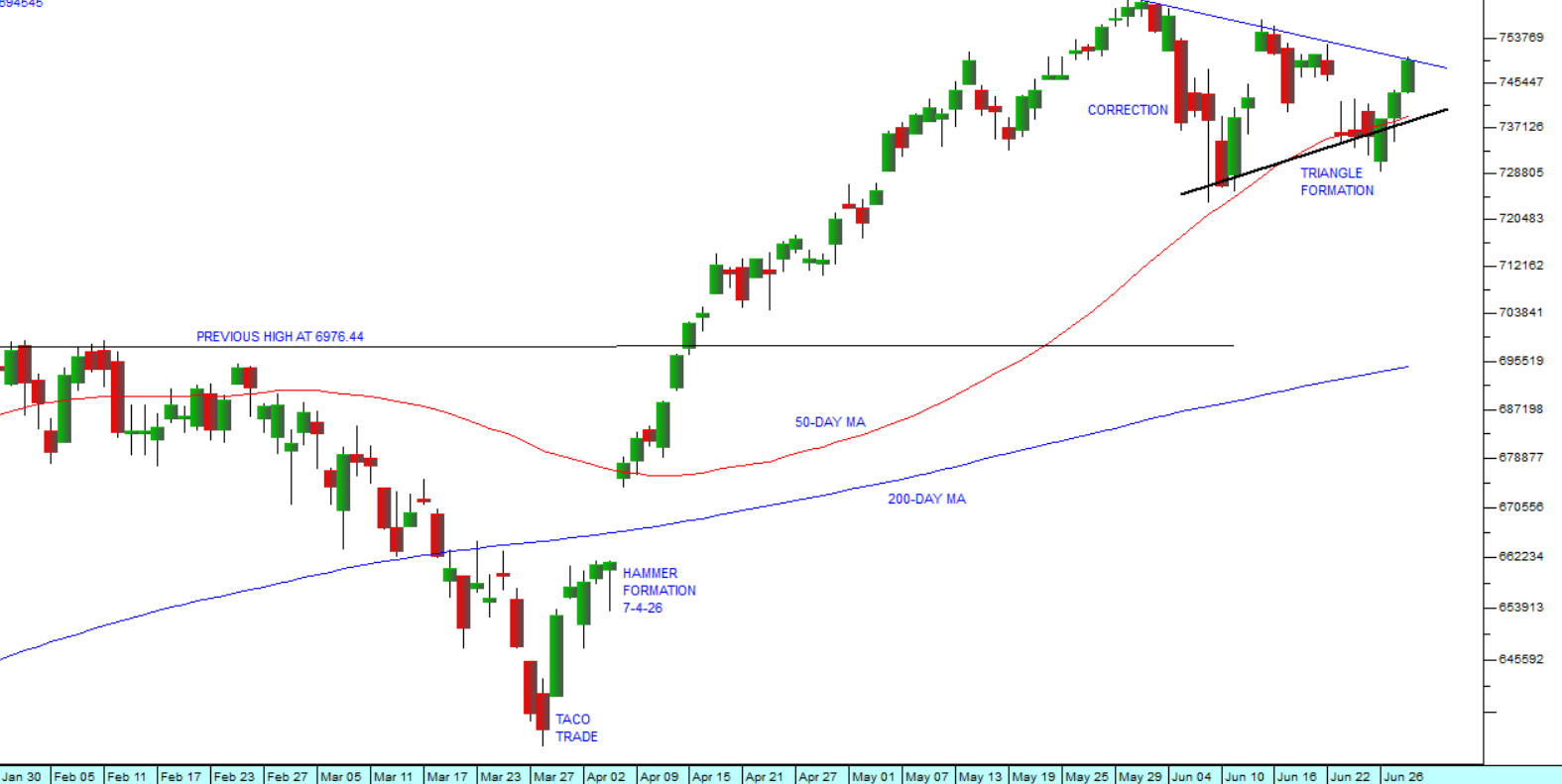
For the last few days, Wall Street has been moving sideways with the S&P at around 7350. A triangle has formed which is usually an indication of uncertainty about the future direction and it is narrowing as the uncertainty is resolved. Sooner or later, the index will break out of the triangle and that will show the future direction. In our view it will break to the upside and then enter a new period of successive record highs. From a purely technical perspective, the key support level to watch will be 6976.44 – the level of the previous cycle high on 2nd February 2026. If that level is broken, then we are in for a more serious correction. Again, we believe that is unlikely.
The Memorandum of Understanding between Iran and the US says that the two sides will have a 60-day ceasefire while talks continue to settle the matter and arrive at a peace treaty. This has had the effect of increasing the number of ships passing through the Strait of Hormuz. From 18th to 26th June 284 ships passed through the Strait. This is still well below the normal traffic of roughly 135 ships per day. The effect has been for the oil price (North Sea brent) to drop back to $72 per barrel which is roughly where it was before the conflict began. In our view, if there is a formal signed peace treaty, the oil price will collapse back to below $60 because the world economy has spent the last four months moving away from oil and particularly oil going through the Strait. We believe that oil will resume the downward trend that it was on before the war began. Ultimately, we see oil falling to as little as $20 per barrel or even lower. The simple fact is that the world was already moving away from oil and the war in Iran has simply accelerated that process.
Trump’s approval rating has been falling as more of his supporters blame him directly for the war in Iran and the high price of petrol. On 10th June 2026 Iran managed to shoot down an American helicopter showing that they are still in this war and able to damage US forces. It is important to note that Israel is going to have elections before October 2026 and that there is a possibility that Netanyahu will be removed from office at that time. This would leave Trump on his own in the Middle East.
Ukraine
President Zelensky has ordered a 40-day “blitz” on Russia to change their perspective on the war and hopefully force them to the negotiating table. Part of this was the attack on a semi-conductor factory in Voronezh on 22nd June 2026 which was destroyed with scalp or storm-shadow bunker-busting missiles supplied to Ukraine by the UK and France. This clearly erodes Russia’s industrial base and hence its military capabilities. In our view, this “blitz” sets the stage for a turning point in the war where Ukraine has effectively taken the initiative and is now bringing the war home to Russian citizens all over the country. The idea is to force Putin and his inner circle to sue for peace.
At the same time, Zelensky gave Belarus a week to stop assisting Russian drones with its relay stations located on the border with Ukraine. President Lukashenko has complied rather than have Ukrainian drones attack his oil infrastructure and other targets inside Belarus. This shows how Putin’s influence is declining. Obviously, Zelensky remains concerned about the potential for Belarus to open a new Northern front in the war along its border with Ukraine. That would force Ukraine to re-direct troops to that area and could have a serious negative impact on the rest of the front line. Lukashenko is already very unpopular in Belarus and getting into the war could quite easily cause him to lose power.
The Russian Central Bank has printed 5 trillion rubles ($68bn) and used the money to buy back government bonds. This is effectively debasing the Russian ruble and will result in higher inflation in due course. It is what the Americans have called quantitative easing (Q/E). It is a strategy which they used extensively to get the US economy out of the recession following the sub-prime crisis of 2008. The difference of course is that, at the time, the US dollar was a massive international currency which could absorb the debasement with minimal consequences. The Russian economy is about the same size as that of the state of Texas and the ruble is not an international currency. The only reason that the Russian Central Bank would agree to something like this is because they are under direct pressure from Putin to continue financing the war in Ukraine, no matter the consequences. Because the Russian economy is so small, it will not be able to absorb this kind of expansion of the money supply, and we can expect the medium-term results to be catastrophic. In our view this development is highly significant because it means that Russia no longer has any further reserves to draw on and is now forced to tax their people by debasing their currency. This is leading to the rapid destruction of the ruble’s purchasing power.
Using data released by the Russian Ministry of Finance it can now be shown that in the first three months of 2026, Russia spent $75bn on defence which equates to roughly 46% of all Federal budget spending. This shows that defence spending is now completely dominating the Russian budget and there is almost nothing left for other issues. In our view, this rate of spending is unsustainable and is distorting the Russian economy badly. Almost every second ruble is going on military spending now. The current rate of spending is 30% above what it was in the same quarter of 2025. Total spending was up 38% on last year. Putin is under pressure to end the war before it completely destroys the Russian economy.
As the Russian economy deteriorates and Ukraine’s long-range drone attacks on its oil infrastructure and export industry gain momentum, Putin is retaliating by increasing his strikes on Ukrainian cities and civilians. The number of civilian deaths in Ukraine has risen sharply from about 750 in February month to current levels around 1900 in May. Ukraine manages to shoot down many of the incoming drones, but several missiles and drones always get through. New technologies may be able to stem the tide, but for the moment the Ukrainian civilian population are bearing the brunt. With winter coming, the rumour is that Putin is again planning a massive attack on the country’s energy infrastructure.
Ukraine has effectively isolated Crimea by destroying the land bridges connecting it to the mainland and destroying all the energy infrastructure. People living on the peninsula have no power, water or fuel and thousands are using the Kerch bridge to leave. In our view, Putin is in the process of losing Crimea and this is a major blow to him. In our opinion, if he loses Crimea, he will almost certainly lose his leadership position in Russia. Basically, Ukraine’s dominance of the drone war is steadily making the situation in Russia worse. It is simply a matter of time before Putin is forced into some kind of humiliating ceasefire – which could well result in him being deposed.
The damage done to the Kapotnya refinery in Moscow means that it cannot be repaired until next year. It is one of Russia’s largest refineries and the result will certainly be further fuel shortages. The fires are also very visible to people living in Moscow who have had to deal with oil rain falling from the sky. Russia is now being forced to import fuel from Kazakhstan and India which shows how desperate the fuel situation has become. Fuel sales are now being restricted in 22 regions inside Russia and petrol now costs about R30 per litre – more than twice the cost of fuel in the US. Ukraine has used a drone to plant a flag on the Kinburn spit – which may show their intention to put boots on the ground in Crimea for the first time. The symbolism and morale boost to the Ukrainians of hitting the Kapotnya refinery in Moscow is massive.
Political
The surge in anti-immigrant sentiment in South Africa has come to a head with illegal immigrants being given until 30th June by various groups to leave the country. Many have left already, but millions remain. Various provincial leaders, especially in Natal have been concerned that there might be an outbreak of violence against illegal immigrants on 30th June and the days thereafter. It could be similar to what happened in July 2021 when Jacob Zuma was incarcerated. The negative sentiment towards immigrants is said to become a major factor in the upcoming municipal elections in November this year. Obviously, retailers and the authorities are keen to avoid another day of riots and looting which could damage foreign direct investment (FDI) coming into South Africa. In our view, while there will probably be some protests in various places around the country, the anti-immigrant sentiment will die down in due course.
It is interesting to note that the total prison population of South Africa is about 170 000 inmates of whom about 28 000 or about 16,5% are foreigners. These are split about evenly between those who have already been sentenced and those who are still awaiting the outcome of their trial. It is also interesting to note that our prisons are only designed to hold about 107 000 prisoners – so they are heavily over-crowded. Each prisoner costs the government roughly R460 for each day that they are in prison. In other words, South Africa spends roughly R78m per day on its prison service – or R28,5bn per annum. Efforts are now underway to repatriate some of those foreign nationals who are in prison to reduce the prison population.
Geordin Hill-Lewis, now leader of the DA and mayor of Cape Town, is taking the coming elections seriously. The DA has a strong majority in Cape Town and usually gets about 58% of the vote in that province. Cape Town has shown steady growth over the past five years creating 450 000 jobs – or about half of all job creation in the country. Roughly 100 000 families have relocated to the Cape Town in that period, especially from Gauteng. The DA has a reputation for being honest and good at service delivery while the ANC has a reputation for being corrupt and is generally regarded as being very bad at service delivery. At this point the ANC’s support is expected to drop to around 34% of the vote while the DA may be able to increase its support to somewhere close to 25% in the coming election. If this is correct, then the DA will gain control over more government departments and be able to implement further reforms.
Economy
The Consumer Price Index (CPI) increased to 4,5% in May 2026, up from April’s figure of 4% and March’s figure of 3,1%. The increase was at the lower end of economists’ forecasts. Some economists were predicting a figure as high as 5,2% so the actual print is a considerable relief. The low figure is partly a result of the oil price which has come down from its highs and partly because of the relative strength of the rand against the US dollar. During the month (May), transport inflation came in at 9,3% and accounted for 1,3% of the increase in the CPI. The low figure might enable the Monetary Policy Committee to avoid a further rate hike when it meets in July, especially if the rand continues to be strong and the oil price continues to fall. However, we do not have much confidence in the latest peace initiative between Iran and the US. It has brought the oil price back down to where it was, but there is strong possibility of further problems with the peace negotiations.
The Producer Price Index (PPI) increased sharply to 7,8% in the year to the end of May 2026 – above economists’ predictions. This is a full 3% above the figure for April of 4,8% and mainly due to the jump in the price of fuel as a result of the war in Iran. In the month of May itself, prices at the factory gate (i.e. the PPI) rose by 2,6%. The PPI number will be taken into account by the Monetary Policy Committee (MPC) when they meet this month to consider what to do with interest rates. They have already put rates up by 25 basis points and will probably pass through a further 0,25% increase this month. In the meantime, the oil price (North Sea Brent) has returned to the level that it was at before the Iran war began and fuel prices are beginning to fall. So, it is looking more and more likely that the PPI and the CPI will also begin falling soon. Luckily the South African economy was very well positioned to absorb this shock when it happened because our inflation rate was very low and growth was beginning to increase.
Most of the big banks are expecting the inflation rate to climb sharply in June. Their predictions vary from ABSA’s optimistic 4,6% to Nedbank’s pessimistic 5,1%. What seems likely however is that interest rates will go up again when the Monetary Policy Committee (MPC) meets in July. The petrol price rose by more than 14% in May month and that is increasing costs for all companies, some more than others. Of course, as we have predicted, the oil price has fallen back towards more reasonable levels. At the same time the rand has maintained exceptional strength against various hard currencies, most notably the US dollar. In time we can expect that these factors will bring the fuel price back down again and with it the CPI, but the effect of four months of higher fuel costs cannot simply be set aside. The effects will continue to work their way through the economy for at least the rest of this year.
The Payinc salary index shows that the average salary increased very slightly in May month to R21510. This figure is nearly 1% higher than it was a year ago. The index measures the salaries of about 2,1m salary-earners throughout the country. Obviously, the increase does not cover the effect of inflation which means that these people are worse off in terms of the purchasing power of their take-home pay. Much of the erosion is due to the sharp increase in the price of fuel over the past few months. In real terms (i.e. given the 4,5% inflation rate in May) salaries are down about 1,7% since the start of this year. The fuel price has almost certainly peaked and likely to decline steadily through to the end of the year. This will put some money back into the hands of consumers and should result in a recovery of retail spending.
The Reserve Bank’s leading indicator fell by 1,8% in April 2025, but is up 4,1% for the year so far. The April figure represents a sharp slow-down. 8 of the 10 elements of the index were down in April as a direct result of the jump in the fuel price since the start of the Iran war and the closing of the Strait of Hormuz. Economic activity has slowed down rapidly, but there is some evidence that it may be recovering as the fuel price stabilises and begins to fall back to more normal levels. Companies and individuals have been delaying key purchases due to the uncertainty and that has affected demand.
Manufacturing production fell by 2,7% in April 2026 according to Stats SA and electricity production fell by 1,3%. The declines were at least partly due to the sharp rise in the price of fuel. Due to the ineffectiveness of our rail system in South Africa, about 80% of goods are now being transported by road which makes many industries vulnerable to the price of diesel. Before Trump began his war against Iran, the South African economy was poised to show some solid growth with low inflation, falling interest rates and a falling price of fuel. That has all changed and manufacturing and other sectors (like agriculture) are being directly affected. Our opinion has always been, however, that fuel prices would not remain high for very long because the world economy would quickly adjust to the closure of the Strait of Hormuz in a variety of ways. The peak price of North Sea Brent oil was $125 and it has been falling ever since.
The ABSA Purchasing Managers Index fell back to 50,8 in May, down from April’s figure of 52,6. The April figure benefited from companies buying in ahead of the hike in fuel prices. The business activity sub-index collapsed from 52,8 to 43,5. The employment sub-index rose to 48,4 from April’s 43,8 showing that there still is some improvement. Obviously, the figures have been affected by the sharp hike in the petrol price and will be further affected as the inflationary ramifications spread through the economy.
The Business Confidence index compiled by the Bureau of Economic Research has fallen due to the shock increase in the cost of fuel. Their index dropped 8 points to 39, reversing two quarters of gains. The business environment deteriorated sharply with the rise in the oil price and the weakness of the rand. Business people expected second-round inflation to begin being felt before the end of the year. The fact that the Monetary Policy Committee raised rates by 25 basis points also did not help. The new vehicle market and the construction industry saw the largest declines in confidence.
The South African Chamber of Commerce and Industry (SACCI) also maintains a business confidence index which has been rising steadily since the low point following the COVID-19 pandemic in 2020. The latest figures also now show that confidence is beginning to recover from the fuel price shock as prices stabilise and even begin to come down. The April 2026 figure was down 7,7 points, but in May the figure is just slightly up on better new vehicle sales and merchandise exports. In April a drop in overseas tourists and higher inflation caused the index to fall. In our view, South African business has responded well to the crisis and is adapting to higher fuel prices and interest rates.
Gross Domestic Product (GDP) grew by just 0,5% in the first quarter of 2026 – slightly better that the 4th quarter of last year when it grew by 0,4%. The growth was better than the 0,2% that economists were predicting and was obviously brought down by the spike in fuel prices as a result of the Iran war. Factory production was down 0,8% while finance, business services and real estate were up 0,9%. The growth for the rest of the year will be negatively affected by the war in Iran and higher fuel costs. Consumer spending is expected to be lower as consumers are forced to divert funds to fuel and as interest rates go up again.
The economy recorded a trade surplus of R438bn in the first quarter of 2026 mainly because of a surge in gold exports and lower imports. Merchandise exports increased while merchandise imports decreased. The first quarter, however, does not fully reflect the impact of the war in Iran and the figures are expected to be worse in the second quarter. The trade surplus in April month was half of that in March so the trade surplus is now expected to shrink quite dramatically. The figures are notable because the first quarter’s trade surplus is the highest since the second quarter of 2022. For the last three-and-a-half years the country has been running continuous trade deficits every month.
Bank of America says that South Africa is not going to regain its investment grade rating any time soon. The biggest problem appears to be the level of government borrowing which is running at around 80% of GDP – up from 50% just ten years ago. The shift in the target for inflation is positive and should result in a reduction in the government debt over time. Given the economic reforms being implemented by the government of national unity (GNU) and the probability that the DA will gain a stronger grip on the government after the November elections, reforms can be expected to continue and even gain momentum.
General
Illegal foreign gambling websites drained billions from the South African economy in 2025. Legal online gambling only generated R75bn in revenue. The illegal sites do not pay South African tax and are invariably located in another country. Many online gamblers are using funds which should be used for food, rent or other critical expenses. Some are even using the proceeds of SASSA government grants for gambling. The National Gambling Board has been working with the authorities to shut down some of the sites. This requires the cooperation of the countries where those sites originate. Online gambling has drawn money away from retail spending in South Africa and even traditional casino gambling.
The agricultural sector is facing difficult times. The jump in the fuel price combined with the increase in fertilizer costs as a result of the Iran war have significantly impacted their cost base. They also have to face the prosect of a “super El Nino” weather phenomenon which could throw South Africa into drought conditions for several years. Prices for sugar and wheat have also come under pressure. In a recent survey of confidence, the sector reflected these potential problems, falling to 45 – well below the neutral level of 50. When and if the Iran war is resolved, the fuel and fertilizer prices might stabilise and come down, but the sector still faces a tough 25/26 year and food prices will probably rise as a result.
One of the great positive effects of the jump in the price of fuel is the switch to electric vehicles (EV). A year ago, these vehicles were a really hard sell, today, especially with the range of relatively cheap options coming in from China and India, they are a very serious choice. Sales of various types of EVs have jumped 120% from last year. Sales for the first quarter of 2026 have already exceeded sales for whole of 2025. One of the limiting factors is the number of charging stations in South Africa, but Zero Carbon Charge is building a network of solar-powered charging stations across the country with support from the Development Bank of Southern Africa. This scenario is being repeated in every country in the world – so one of the unintended consequences of Trump’s foolish attack on Iran has been to move the world rapidly away from fossil fuels. The oil industry, which he has been a strong patron of, is being irrevocably displaced. They are making short-term profits now, but will soon be producing a lake of oil that nobody wants.
Electricity generation in South Africa is falling steadily. In the year to the end of April it was down 9% and that was the 11th month of decline. The figures do not fully account for renewable energy created by households and businesses, especially solar power installations. The Independent Power Producers (IPP) are included, so the figures show that South Africans are steadily moving away from Eskom and making their own installations to meet their power needs where ever possible. Eskom’s domestic electricity consumption fell 5% from a year ago. The primary cause is undoubtedly Eskom’s pricing policy which has seen consistent above-inflation increases for many years.
The heat wave in Europe is clearly linked to climate change and the rapid increase in temperatures around the world. Dozens of people have died of heat stroke as record temperatures were reached in parts of France and Spain. 16 cities in Italy recorded their hottest day on record on 24th June 2026, schools were closed and framers were forced to harvest grain at night. In coastal areas temperatures are expected to reach as high as 45 degrees Celsius. The development of the super El Nino weather system across the Pacific Ocean is a likely cause of drought conditions in Southern Africa and could result in rising food prices. What is clear is that climate change is becoming a major factor in share assessment.
Gold
The gold price has been in a natural correction after being significantly over-priced for some time. The gold price in US dollars has fallen back almost 25% since its high at $5305 on 28th January 2026. Consider the chart:
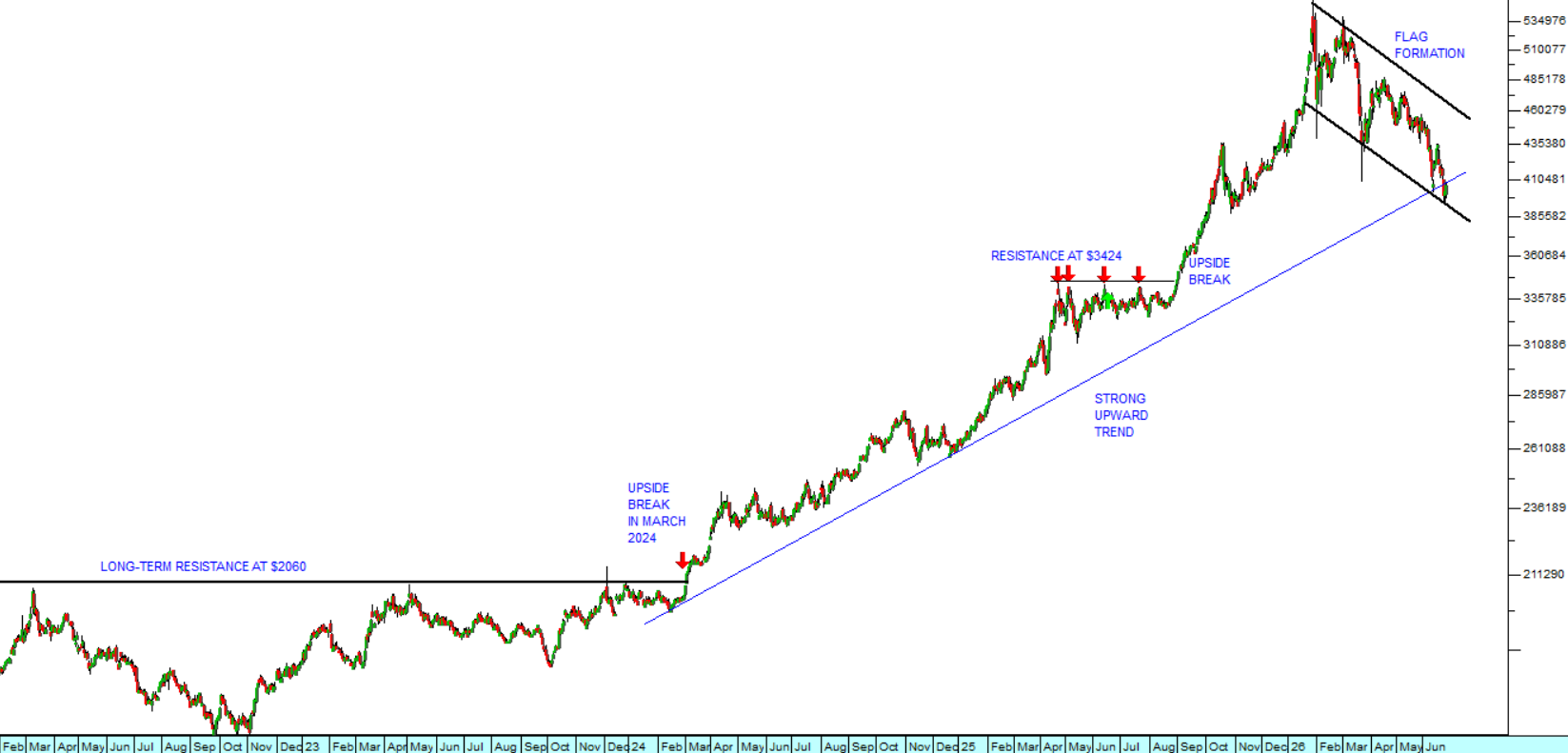
The extraordinary upward trend since March 2024 has seen gold increase in price by 157,5% in just 30 months. Clearly from just a purely technical perspective, some kind of correction was inevitable. Most of the gold buying over the past two years has come from Central Banks around the world. They were concerned about the stability of the US dollar and the potential for it to weaken significantly. There has been much talk about the dollar being replaced by some other currency as the preferred medium of exchange for international transactions and the US national debt, which is now rapidly approaching $40 trillion, continues to make investors in US Treasury Bills nervous.
Obviously, the enduring problem with gold is that it does not generate a return. It pays no interest, dividends or rent. The only advantage it has is that it is very secure. It is the ultimate store of value in troubled times. Central banks and investors generally would always prefer to have an asset which is paying an above-inflation return, but when they are scared, they are prepared to forgo that return just to keep their capital safe.
In our view, US dollar assets such as the 10-year T-bill are vulnerable to a major sell-off because of the country’s extreme indebtedness and apparent inability under any administration to curtail government spending. The last president who managed to reduce the budget deficit was the Democrat Bill Clinton 25 years ago. Since then every president has overseen a massive escalation in the deficit. Obviously, at some point the “piper must be paid” and that will almost certainly take the form of some kind of debasement of the US currency and dollar-denominated assets.
So, gold will almost certainly continue to rise and the current sell-off offers investors an opportunity to buy into the metal. In our view, private investors living in South Africa should keep roughly 10% of their wealth in gold – preferably Krugerrands. The Krugerrand is the most widely circulated and accepted gold coin in the world. Since their first minting in 1967 more than 60 million Krugerrands of various types have been struck – more than all the other gold coins in the world (such as the American Eagle, the Canadian Maple Leaf etc.) combined and they are universally known and accepted in every major commercial centre world-wide. Consider the long-term chart of the Krugerrand over 31 years:
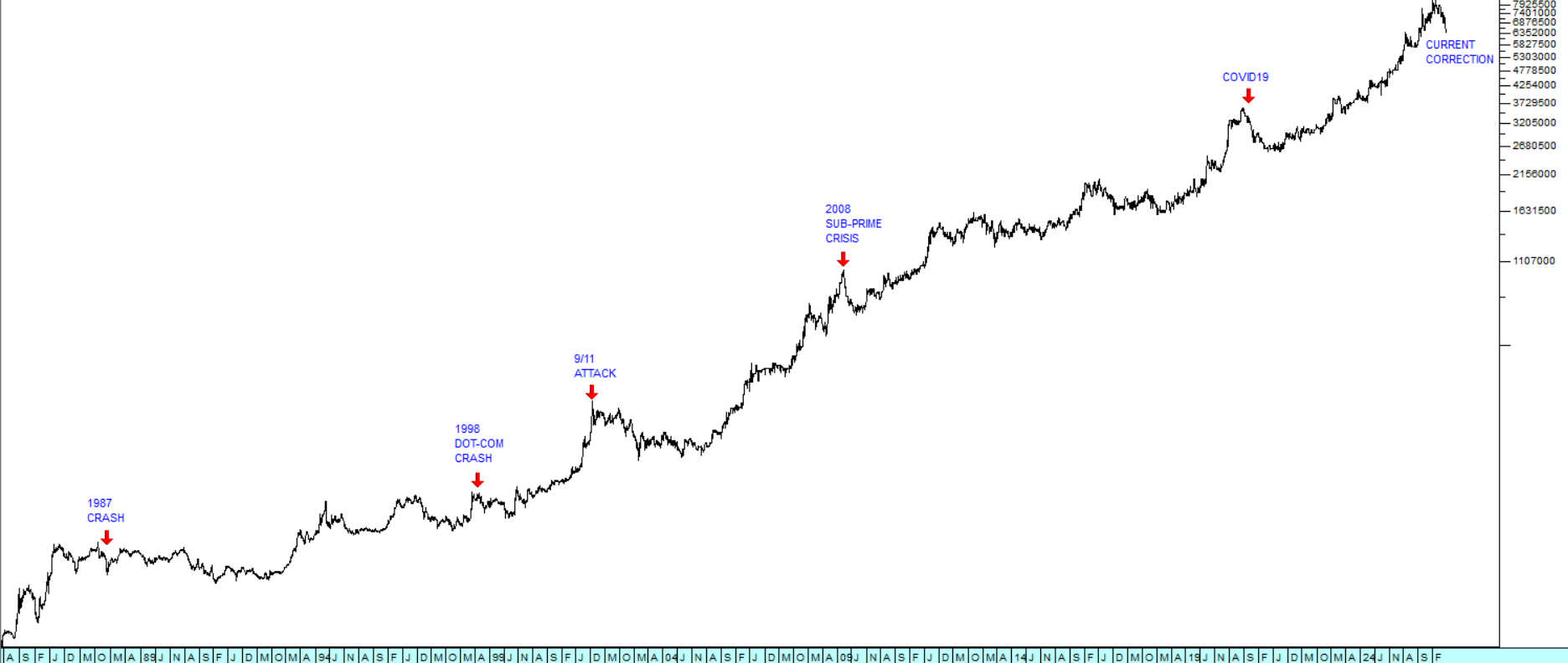
I bought my first Krugerrand in February 1985 for just R600. That same coin was valued at R85 000 in March this year and I am confident that it will continue to appreciate in the decades to come. I fully expect it to be worth more than R100 000 in the next few years.
Companies
PPC
On 16th July 2007, 19 years ago, PPC’s share closed on the JSE at 5210c. It was a favourite share of the institutions and regarded as powerful blue chip. Then came the sub-prime crisis of 2008 and that was followed by the presidency of Jacob Zuma from 2009 to 2018, with the ANC’s relentless efforts to destroy the South African construction industry. Then in 2020 came COVID-19 and PPC fell further. At the end of all that, PPC finally reached a low point closing at just 45c on 4th November 2020. In the following years the company battled with increased competition, particularly from cheap cement imports from Pakistan. It seems that the Pakistanis were able to manufacture this high-bulk, low-value product and ship it to South Africa for less than PPC and other local cement producers could make it. At the time the industry focused its attention with some success on trying to get the government to implement tariffs on imported cement – but the real problem was one of efficiency and productivity. Logically it just should not be possible for Pakistani cement producers to be competitive.
Beginning two years ago, under a new management team, PPC finally began to focus inwards on its internal efficiencies and productivity levels. The results have been nothing short of amazing. For the last two years the company has been cutting costs and driving up margins. In the year to 31st March 2026 the company’s revenue was up by just 3,9% - but its earnings before interest, taxation, depreciation and amortisation (EBITDA) was up an amazing 31% and headline earnings per share (HEPS) was up 25%. Consider the chart:
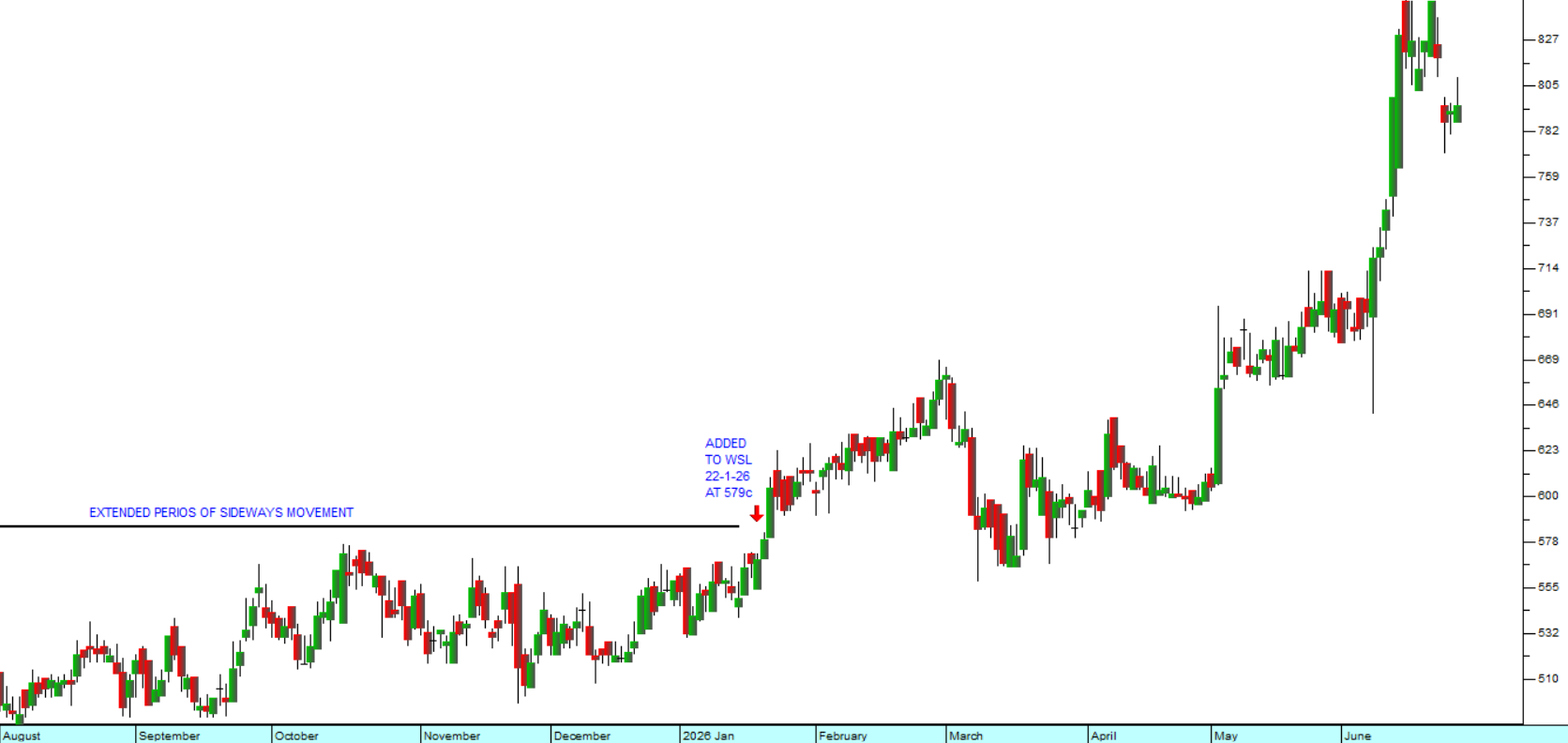
We added it to the Winning Shares List (WSL) on 22nd January 2026 when it broke up out of an extended period of sideways movement. Since then it has reached as high as 848c (22-6-26). We see it as continuing to progress going forward.
OMNIA
We suggested that you look at Omnia in last month’s Confidential Report when it was trading for 10296c. Over the month that followed it has gone up a further 8,5% to 11178c. This is mainly due to the publication of its financial results. Omnia is a producer of chemicals. It has three primary markets – fertilizers for agriculture, chemicals for industry and explosives for the mining industry. In the year to the 31st March 2026 the company’s agriculture division increased revenue by 13% and operating profit by 28%. Mining revenue was up 8% while operating profit rose by just 1%. The operating profit of the mining division was hurt by the volatility of the Zambian currency. The chemicals division saw revenue down 38% and operating profit up over 100%. Overall, revenue was up 6% and headline earnings per share (HEPS) rose by 21%. The company has benefited from the war in Iran because, amongst other things, it had the effect of raising fertilizer prices worldwide.
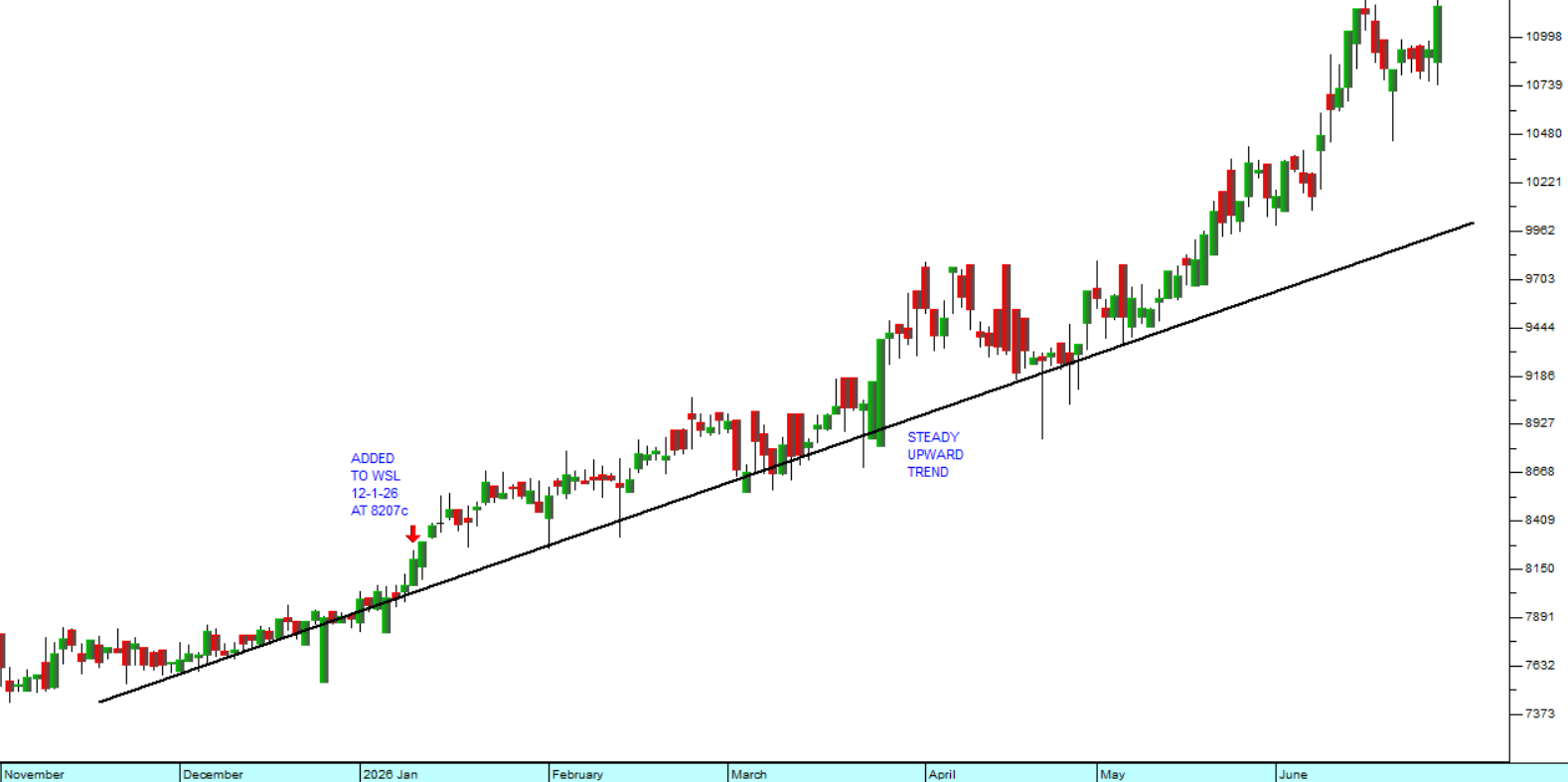
This is a company that is directly linked to the growth of the South African economy. For this reason, the reforms which have been taking place since the advent of the government of national unity (GNU) are a strong positive influence.
We believe that Omnia will continue to perform well, especially after the November municipal elections when the ANC is expected to lose further support to the DA.
MTN
The shares of this dominant African provider of data and cellular services lost considerable ground after the start of the Ukraine war in February 2022. Its shares fell from a high of 20808 on 2nd March 2022 to a low of 7270c on 6th August 2024. Then, as Ukraine began to gain the upper hand in that war the share went through an almost perfect reverse head-and-shoulders formation to start a new upward trend. For reasons which we are unable to explain, its share price appears to be linked directly to those of Ukraine. Perhaps that correlation is just a coincidence. Consider the chart:
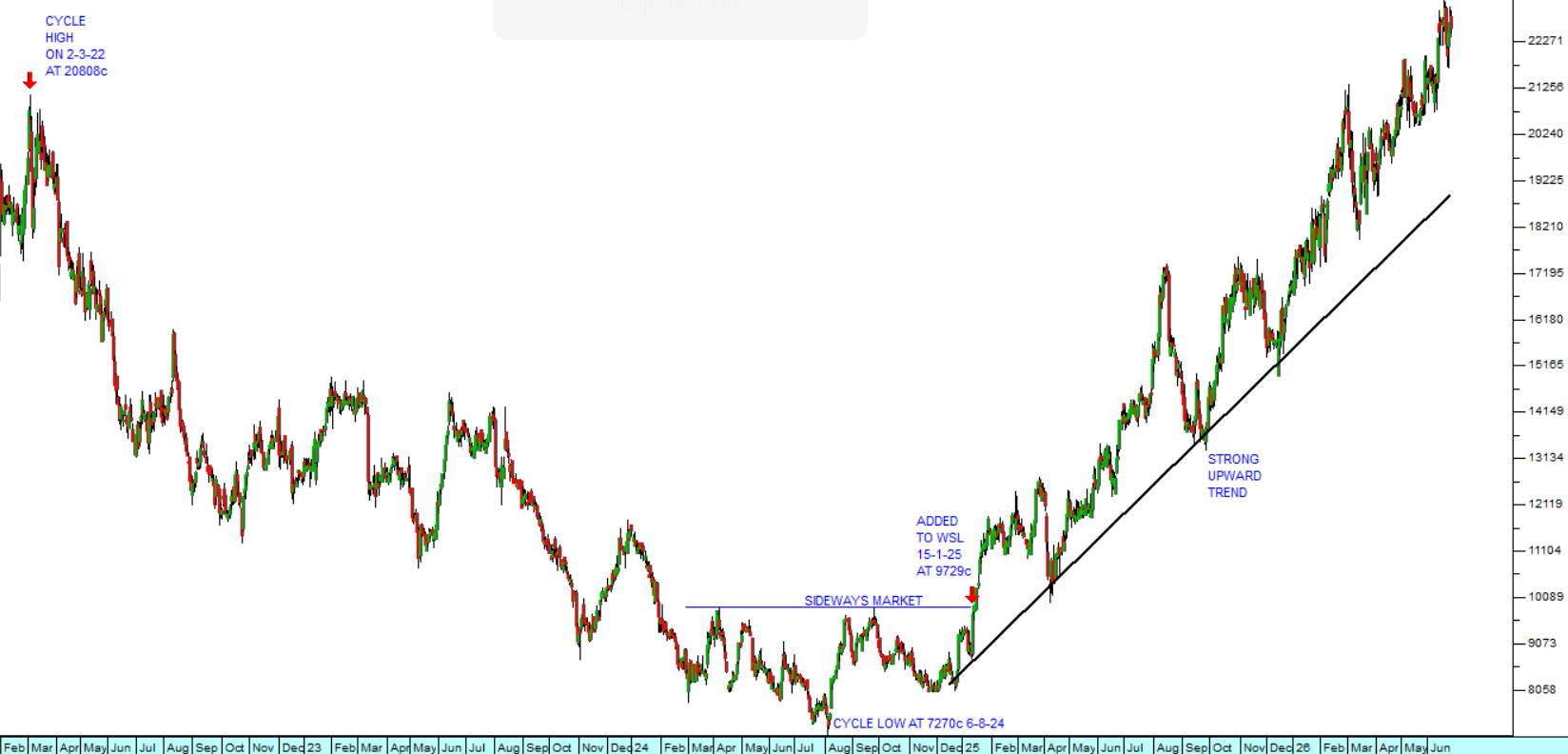
As Russia’s performance on the battlefield began to stagnate and Ukraine began to dominate the development of long-range drones, so MTN’s shares have been climbing to new record highs.
In its results for the three months to 31st March 2026 the company reported data revenue up 36,1% and fintech revenue up 20%. The subscriber base increased by 5,4% to 312,7m. We believe that the growth of MTN’s subscriber base will continue and that it will continue to diversify its product offering into new areas. Obviously, the political uncertainty in many of the countries where it operates is a risk, but is some ways increased use of smart phones across Africa is beginning to mitigate that risk.
We added MTN to the Winning Shares List (WSL) on 15th January 2025 at 9729c. It has since moved up to 22597c – a gain of 91,26% in just over a year.
PREMIER
Premier is primarily a food company that is now diversifying into personal care products. It is very dependent on the price of agricultural raw materials such as maize, rice and wheat. In the current year it performance has been boosted by the drop in the price of maize due to the good rains that farmers enjoyed. For example, the spot price of white maize dropped by 31% during the year to 31st March 2026. Among other factors this enabled Premier to report a 6,6% increase in revenue and a 27,7% increase in headline earnings per share (HEPS). The sharp increase in HEPS on the back of a relatively small increase in revenue points to substantial improvements in efficiency and management. During the year the company acquired Rhodes Food Group (RFG) for R6,5bn which will greatly increase the diversity of its product range and add new overseas markets. In our view this is a solid company that is growing both by acquisition and organically. Consider the chart:
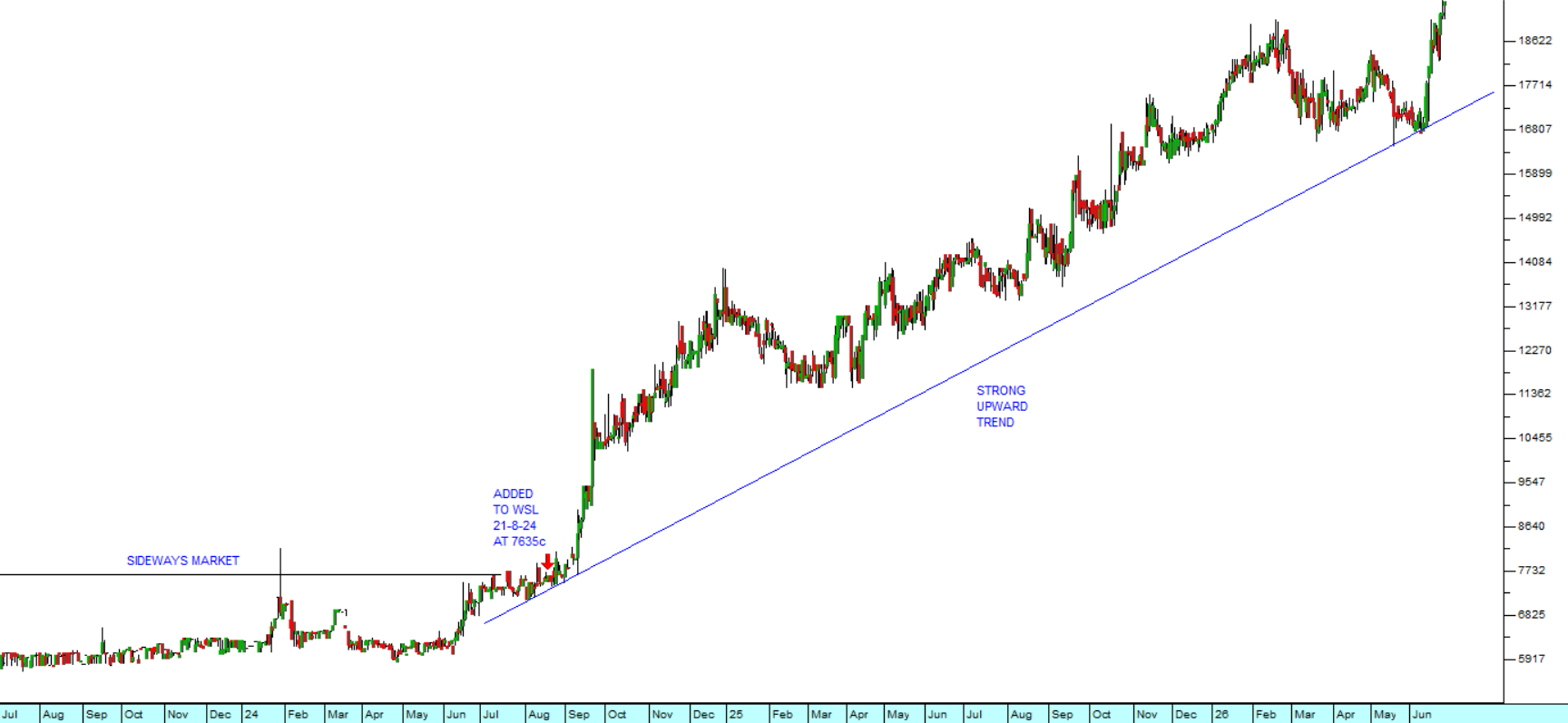
We added Premier to the Winning Shares List (WSL) on 21st August 2024 at 7635c. We did this because it had finally broken up out of a protracted sideways market and was set for a strong upward trend. It has subsequently risen to 19500c – a gain of 155,4% in 21 months.
DATATEC
Two months ago, in the Confidential Report of 6th May 2026 we suggested that you consider Datatec (DTC). It was then trading for 7350c and had just broken up out of an island formation. We believed that it was set to begin climbing again. Since then the share has climbed more than 30% to 9598c mostly because of the excitement which has gripped the investment world concerning AI and the technologies which are flowing from it. We hope that you acted on our suggestion. Consider the chart:
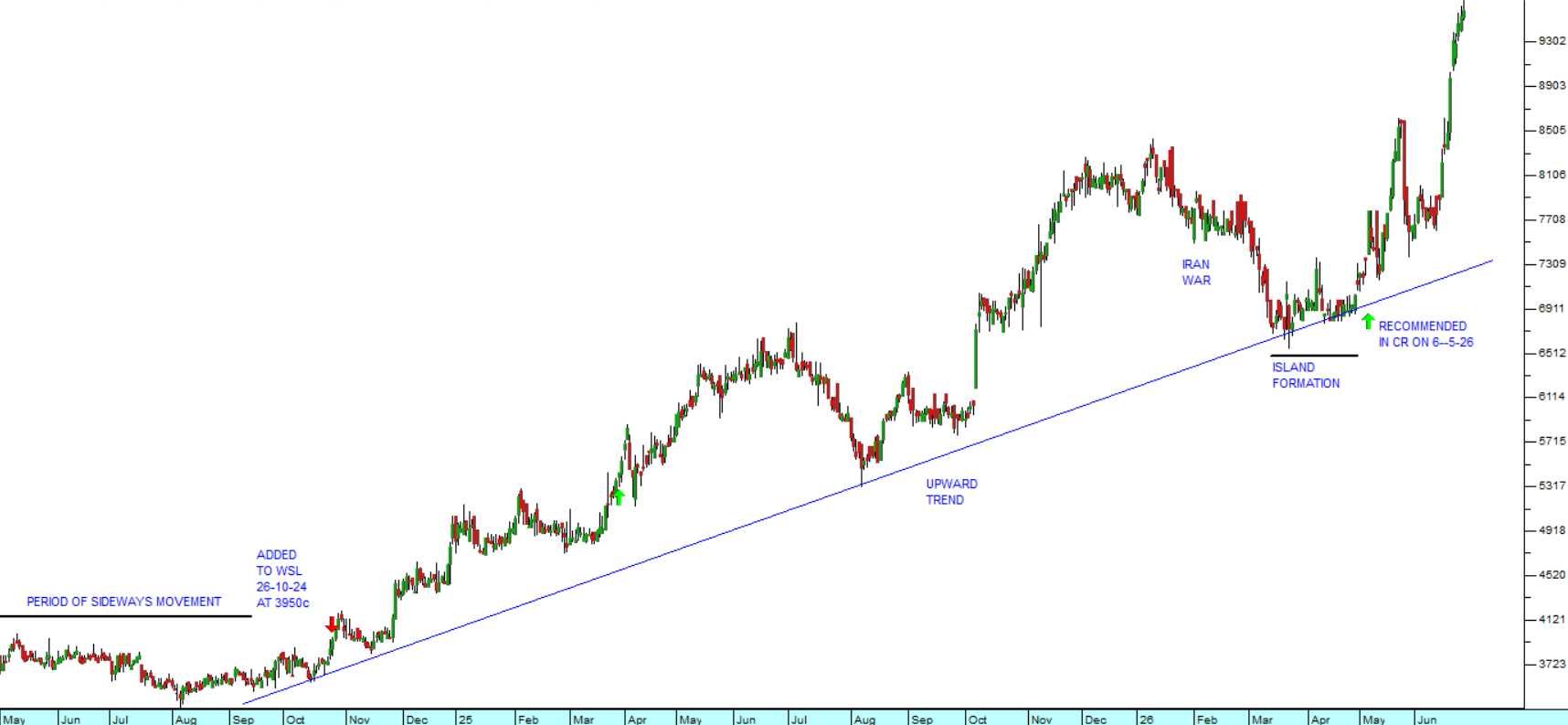
We originally added DTC to the WSL on 26-10-24 at 3950c – so it is up over 85% since then.
← Back to Reports