The Confidential Report - August 2026
America
The S&P 500 index rose almost 11% this year to reach its then all-time closing high of 7,609 on 2 June 2026. After recovering from the correction which followed President Trump's decision to go to war with Iran in March, the index traded sideways for almost three months as variable news from the Middle East offset strong quarterly earnings from the major AI-related technology companies. Amazon and Microsoft delivered particularly impressive results, helping to compensate for softer numbers from Apple. On the 4th of August, however, the market broke decisively out of that consolidation phase, with the S&P 500 surging 1.8% to a new record closing high of 7,736.52. The rally was driven by another round of better-than-expected corporate earnings, continued confidence that heavy investment in artificial intelligence is translating into stronger profits, and easing concerns over the Middle East as oil prices fell.
Microsoft, especially, beat analyst’s expectations by producing revenue in the 3 months to 30th June 2026 of $90bn – a full 18% increase on the same quarter last year. Net Income was $35.77 billion bolstered by a $3.2 billion gain from an investment in Anthropic. Amazon’s results for the quarter were also outstanding with revenue up 20% to over $200bn. Amazon’s web services sales jumped 37% and its operating profit was 43% above the same quarter in 2025. Together these two companies have reassured investors that the bull trend on the S&P500 index remains intact and likely to continue. Consider the chart:
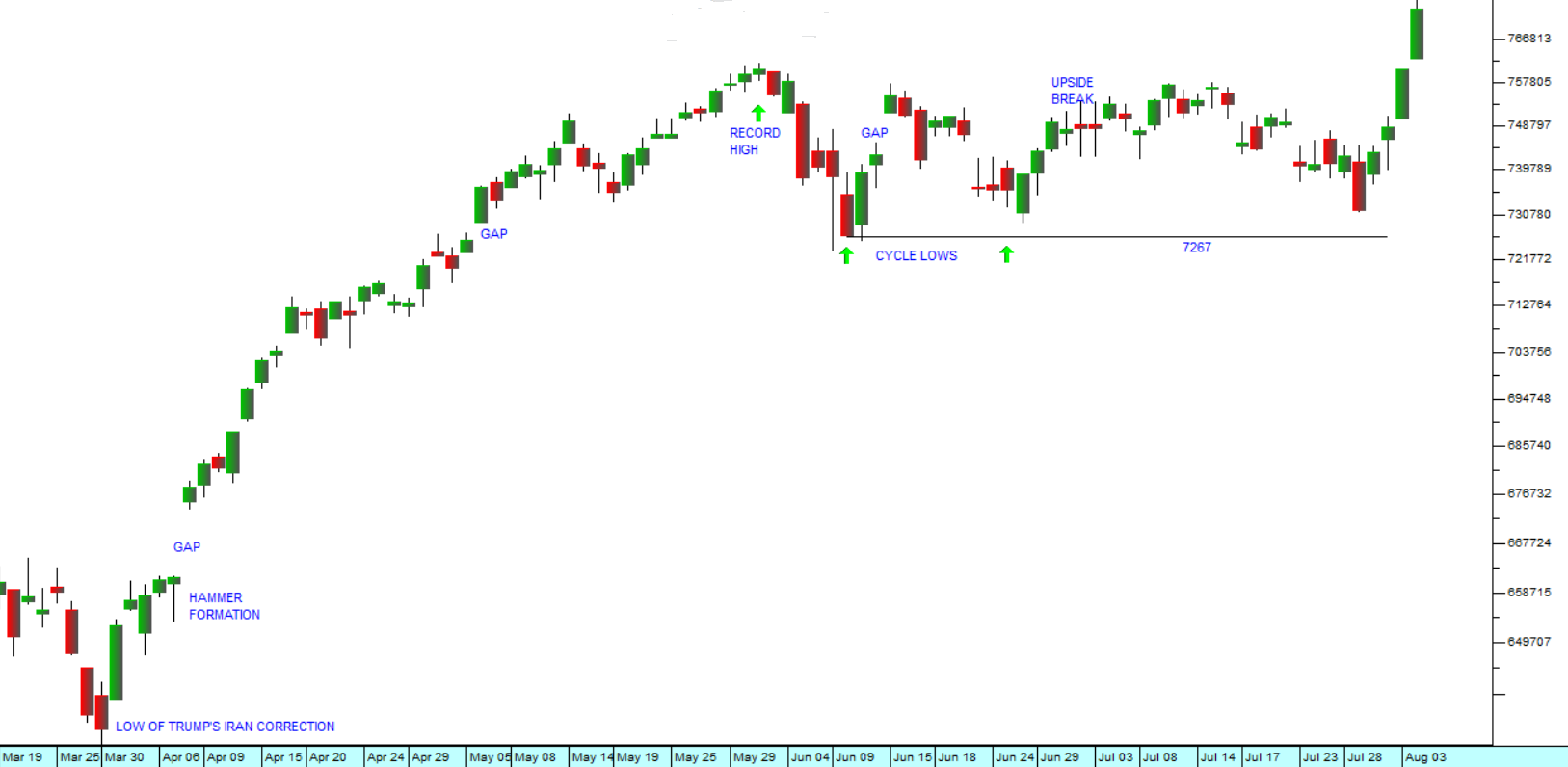
As we suggested in last week’s article, we believe that the sideways pattern in the S&P will ultimately break to the upside, and that when it does there will be a period of “catch-up” as investors try to price in the growth that has taken place over the past three months.
The cycle low at 7267 is the critical point to watch. Any break below that level will signal a more protracted correction. We think that is unlikely because of the steady stream of good news coming out of the AI sector, but it is a definite possibility, especially if Trump tries another hair-brained idea like invading Greenland or nuking Iran. There has been a rotation out of the tech shares and into other sectors over the past three months. The best performing sectors over this time have actually been health care and financials.
Of course, the rise in the price of fuel has negatively impacted the inflation rate in America as it has worldwide. In May 2026 the CPI spiked up to 4,2% - well above the monetary policy committee’s (MPC) target of 2%. Then in June it fell back to 3,5%, but the second-round inflationary effects are still being evaluated and the fact that interest rates were not raised at the conclusion of the MPC’s meeting on 29th July 2026 offered scant relief. Trump’s newly appointed Governor of the Federal Reserve Bank, Kevin Warsh, held the line in a split decision, but the MPC may take a different attitude at its next meeting, especially now that shipping is heavily restricted through both the Strait of Hormuz and the Strait of Bab-el-Mandeb.
The problem is that the inflation rate (consumer price index or CPI) has been rising sharply since the start of the Iran war and the hike in fuel prices. Most investors now believe that there will definitely be a rate hike when the MPC meets in September. There is also a concern that the AI companies are burning cash in their efforts to build out AI infrastructure. For example, Meta has said that it expects to spend between $130bn and $145bn next year on capex. The S&P is now approaching its cycle low of 7267 made on 9th June 2026.
The US economy created 57 000 jobs in June 2026, well below economists’ predictions of 110 000. The unemployment rate edged down to 4,2% and average hourly earnings increased by 3,5%. The lower number of jobs created enabled the MPC to keep rates unchanged in July, especially given the fact that the oil price has been falling. Most economists are now concerned that interest rates will be increased at the MPC’s next meeting of 15th and 16th of September 2026. In our opinion, the US economy will resume its strong growth path now that oil prices have fallen back to around $83 per barrel. The US gross domestic product (GDP) grew by 1,5% in the 2nd quarter of 2026 – somewhat slower than the 2,1% of the 1st quarter.
Mid-Term Elections
The resumption of the war in Iran is having a significant effect on Trump’s support as the mid-term elections draw nearer. There are distinct rumblings from Republicans who will have to fight for their positions in the House and the Senate. Most of Trump’s MAGA support base is against indefinite involvement in war and Trump did promise them that this war, which has now been going on for nearly 6 months, would be over in 6 weeks. The death of Senator Lindsay Graham makes Trump’s control over the Senate razor thin, and Republicans could well lose control of both houses in November. If that happens, Trump may have to face an impeachment hearing.
As the mid-term elections draw closer the polls are becoming more negative. An American Research Group poll conducted recently found that only 30% of Americans now approve of Trump’s performance as President while 66% disapprove. This is a sharp decline from the mid-June 2023 NPR/PBS News/Marist poll which had him with a 36% approval rating and an AP-NORC at the same time which showed a 37% approval. Among Republicans he still has a 67% approval rating while only 1% of Democrats approve. Among independents 25% approve and 69% disapprove. These figures are becoming very important with the November mid-term elections are now less than 100 days away. The resumption of the war in Iran and the fact that petrol (“gas”) now costs around $4 per gallon in America are causing Trump’s approval to fall. He is certainly in a far worse position now than he was at the same time in his first term as President.
The very latest YouGov poll shows that Trump’s job approval rating has dropped to 34%. The survey was conducted between 25th and 17th July 2026 and canvassed 1559 US adults. 62% said that they disapproved of Trump’s job performance – which takes his job approval rating to minus 28 – which is a record low for Trump. In his first term at this stage he was only at minus 9 and his rating is now much worse that Joe Biden’s was at the same point. Disapproval has risen especially among older Americans (between 45 and 64 years old). His only support seems to be from white Americans without a college degree but even within that group more disapprove than approve. Independents have moved from a rating of minus 4 to minus 71 during his second term.
According to a recent Daily Mail/JL Partners poll about 65% of Americans believe that the economy is weakening and that inflation is rising. This is not a good number for Trump and the Republicans. In the middle of May 2026 the Pentagon already said that the cost of the war had increased to $29 billion, and then the White House last month asked Congress for an additional $88 billion to continue funding the war. The price of petrol (“gas”) is still hovering close to $4 per gallon, an uncomfortable number for most Americans making it difficult for working-class families to survive. Trump’s “America Frist” slogan is sounding increasingly hollow. There is now even a possibility that Trump will consider authorising putting “boots on the ground” in Iran, a step that will entrench the war and result in a steady flow of body bags coming back to American families.
Oil
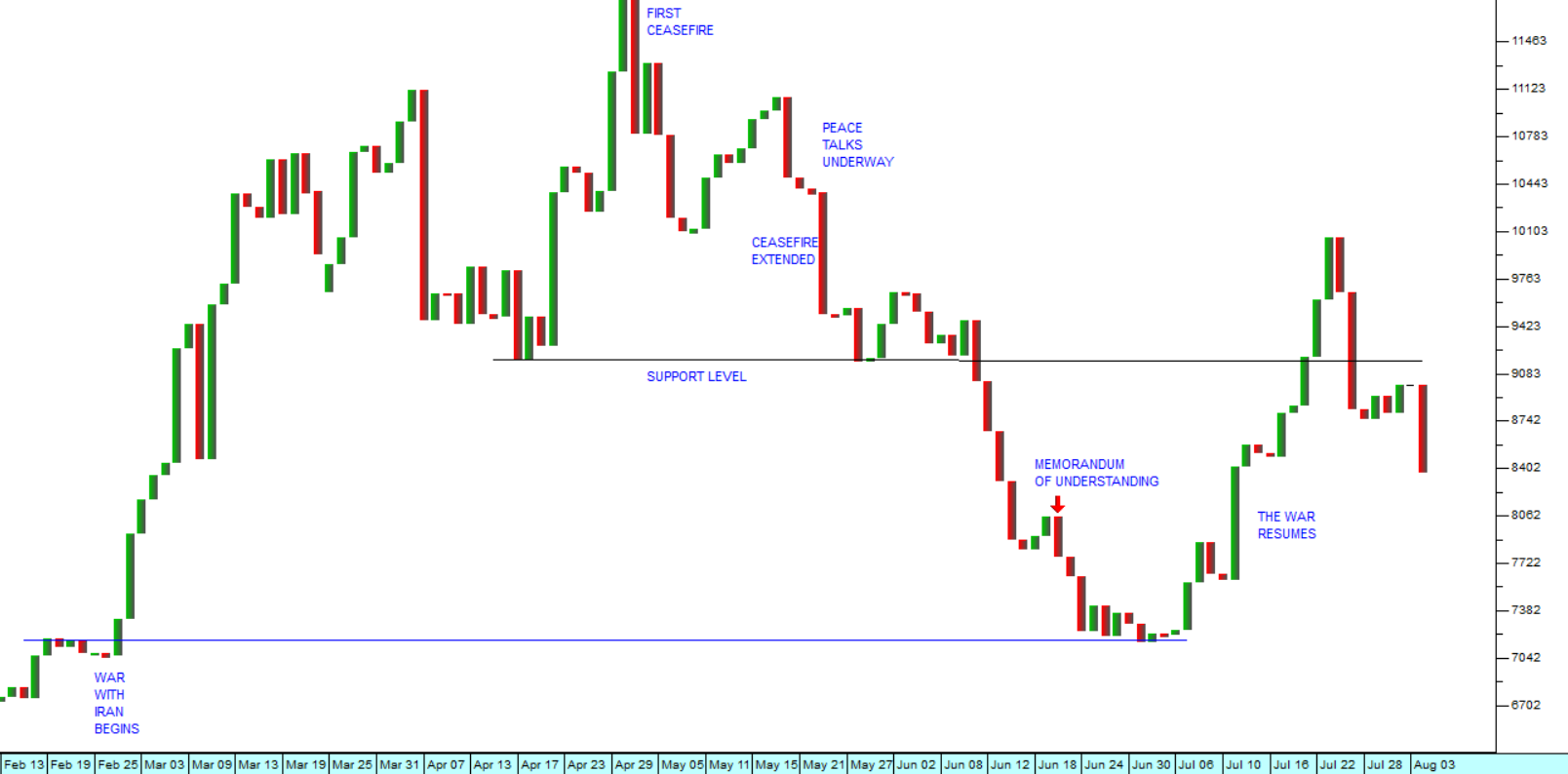
The breakdown in talks between Iran and the US caused the price of Brent to spike above $100 briefly on 23rd July 2026. Efforts to resume the talks, together with the ongoing adjustments being made to the difficulties of transporting oil out of the Middle East, subsequently brought it back into the mid-$80s. On the 4th of August, however, Brent fell by more than 5% to below $80 per barrel, its lowest level in almost four weeks, after renewed optimism that the US and Iran could reach an agreement to reopen the Strait of Hormuz and reduce the risk of further supply disruptions. This is a much more comfortable level for the world economy and particularly for oil-importing countries such as South Africa, although the situation remains highly fluid and geopolitical uncertainty is still elevated. The outlook remains heavily dependent on political and military developments in the region, making oil prices likely to remain volatile over the coming weeks.
Consider the chart:
Ukraine
In general, the war with Russia has been going well for Ukraine. The deep strikes against Russia’s oil infrastructure and more recently against Wildberries warehouses has brought the war home to most Russians.
On 17th July 2026, Ukraine’s President announced that Ukraine had hit one million targets in the year to date and that the country was now producing 10 million drones per annum. About 90% of all Ukrainian strikes are now being done by drones. At the same time Russia has been losing 8 soldiers for every Ukrainian soldier lost. These figures are clearly unsustainable for Russia. President Zelensky said that the country was making plans to increase drone production to 20 million. The fuel shortages across Russia are now beginning to affect the agricultural sector with its grain harvest in danger.
The Crimean Peninsula is effectively under siege with Russia unable to resupply the estimated 150 000 troops stationed there. On the 11th and 12th July 2026, Ukraine struck 105 Russian ships in the Sea of Azov using drones. These ships were engaged in ferrying oil and other provisions to Crimea. This effectively cuts the peninsula off from resupply by sea. During the first week of July 2026 Ukraine destroyed 240 trucks trying to resupply Crimea. That is 34 per day on average.
Russia recently increased its air defence systems around Moscow and published a map of air shelters in the area, especially to the Southeast of the city. Wildberries is taking enormous strain and may be forced into liquidation. This, in turn could impact on the banking system in Russia which funds Wildberries operations. At the same time Russia has increased its attacks on civilian targets inside Ukraine. Six members of a family were killed in a single strike using a missile which President Zelensky says was probably produced in North Korea. This shows that Russia is now relying on outside production of weapons. All of this shows that the tempo of the drone and missile war is increasing.
In our view, the frontline in the Ukraine war has more-or-less stabilized and Putin is unable to make any further significant gains. This sets the stage for Ukraine to begin taking territory back using its superior drone technology and the intense degradation of the Russian army’s supply lines. The isolation of Crimea has effectively cut it off from the rest of Russia making it almost impossible to get food, fuel and ammunition onto the Peninsula. We believe that the next logical target is the Kerch bridge which is the remaining access point. At this time, it does not look like Ukraine will attempt to retake Crimea, but it has certainly become a possibility. We have always believed that if Putin loses Crimea, he will also be forced out of office because such a loss would be viewed by Russians as a complete failure of his “Special Military Operation” which began in February 2022.
Economy
The Monetary Policy Committee’s (MPC) decision to keep interest rates unchanged at their meeting in July 2026 shows their concern for the impact of rising fuel prices on consumers and the economy. With inflation now at 5% and expected to go higher and the war in Iran intensifying and potentially escalating, the expectation was that rates would be raised by a further 25 basis points. But the Reserve Bank Governor, Lesetja Kganyago, said that the inflationary outlook had actually improved slightly, while growth was weak. Of course, this decision was made before the Houthi’s began attacking shipping in the Bab el-Mandeb Strait signalling a widening of the conflict in the Middle East. The price of oil remains a critical factor for petrol and diesel prices here in SA. Notably, the MPC decision was split with two members voting for an increase in rates.
The Consumer price index (CPI) rose to 5% in June from May’s figure of 4,5%. The primary cause of the jump was transport costs which surged by 12,7%. The change made a further hike in interest rates almost inevitable, especially given the resumption of hostilities in the US/Iran war which has pushed the price of North Sea Brent back above $90 per barrel. Fuel prices are expected to rise again in August because of rising international oil prices. Food inflation actually came down in the year to end-June helping consumers to keep costs under control. Prices fell for grains, meat, fruit and vegetables. South Africa is now expecting a record crop in the 2025/26 year of 21,5 million tons. What is significant is that the sharp rise in inflation has completely wiped out any gains that workers may have got from salary and wage increase this year. This will have a negative effect on consumer spending.
Producer price inflation (PPI) was slightly lower in June 2026 at 7,5% than May’s 7,8% with fuel prices slightly lower as the oil price came down over the month and the rand remained relatively strong. Paper and printing products were up 8,5%, but, overall, the picture was stable. The PPI tends to feed through to the consumer price index (CPI) over time, especially when fuel prices change. The oil price has been coming down recently as fighting in the Middle East cooled. The price of North Sea Brent is still well above $80 per barrel which remains a problem but is a far cry from the $118 that it reached at the end of April 2026.
As you would expect, inflationary expectations for 2026 have increased sharply. The Bureau for Economic Research (BER) has found that the average expectation is now 4,4% in the 2nd quarter of 2026 – up from the 1st quarter’s 3,6% and clearly well above the government’s target of 3%. This may result in the monetary policy committee (MPC) increasing rates when they meet later this year. Household inflation expectations rose to 6%, but wages were expected to increase by only 4,8% making consumers worse off. In our opinion, the MPC’s conservative approach is correct. The fact that our inflation rate was 3% when the Iran war began means that we were extremely well positioned to absorb the temporary shock of higher fuel costs. We believe that now the fuel prices have settled back down to below $100 (North Sea brent) the SA economy will probably stabilize.
The Reserve Bank’s leading indicator decreased by 0,3% in May 2026 but increased by 4,2% over the year to the end of May. The slight downward move in the month is actually positive given the war in Iran and the impact that it has had on fuel prices. Most of the decline came from a sharp drop in business confidence, but there was also a decrease in the number of building plans passed. Five of the ten component indicators were lower and five were higher. The rise in interest rates and the price of fuel has not had as great an impact as expected. This shows the relative resilience of the economy in the face of external shocks.
According to a recent survey by Old Mutual, South African consumers are finding the current economic climate very difficult. The number saying that they are considerably financially distressed has risen to 40% this year - up from 38% last year. Lower income groups (earning less than R30 000 a month) have been particularly badly affected. People are borrowing money from loan sharks to get through the month and there has been a sharp increase in the number of people gambling in a desperate attempt to get cash to reduce their debts. More than 60% of South Africans now hold down more than one job in an effort to bring in sufficient income. These issues are worst among those families earning between R8000 and R15000. Obviously, the rising cost of transport since the Iran war is a major problem for most families and those with mortgage bonds are now paying higher interest rates. The high oil price continues to put pressure on consumers and to cut back on non-essential consumer spending of all types.
Every year since 2022, Debt Busters does an extensive survey of more than 18000 South African respondents to ascertain their level of financial stress. This year 72% of respondents said that they were experiencing stress – down from the highest level of 78% in 2023 but still up on last year’s reading. Over half of the respondents said debt repayments were absorbing 40% or more of their take-home pay. Younger respondents had the highest debt-to-income levels. Of course, since Trump began his absurd war with Iran, financial stress levels in South Africa have been directly impacted by the higher cost of fuel and the higher level of interest rates. We expect that the fuel price will gradually come down again and that interest rates will follow it down – but probably only next year.
The ABSA purchasing managers index (PMI) fell to 47,3 in June month – well below the neutral level of 50. The fall was due to the increased level of interest rates and the higher fuel prices. We can expect some recovery now that fuel prices are moving down again. Demand was lower right across the manufacturing sector as customers delayed placing large orders because of uncertainty over the outcome of the Iran war and the closure of the Strait of Hormuz. The employment sub-index fell to 41,4 from 48,4 – a massive decline indicating that the sector was cutting back on staff. In our view the manufacturing sector will improve towards the end of the year as soon as the oil price comes down and interest rates resume their downward trend.
Manufacturing production shrank by 4,3% in May 2026 – which is about what you would expect given the shock increase in fuel prices. The figure could easily take gross domestic product (GDP) into negative territory in the second quarter after the first quarter’s measly 0,5% growth. The biggest slump was in food and beverages which fell by 6,4% over the year, but 7 out of 10 manufacturing sectors were negative. Obviously, the rising cost of electricity in South Africa also remains a problem. In our view manufacturing should rebound as soon as the oil price comes back down and local fuel prices begin to fall.
In many ways the construction sector is a microcosm of the South African economy. It has been through some torrid times in recent years and is smaller today than it was in 2017. In that year it employed 592 000 people while today it employs only 539 000. It is also significant because today almost 80% of the sector is dominated by small, medium and micro businesses. In the past the sector was dominated by massive listed companies which employed hundreds of thousands of workers. In 2024, the sector’s income rose 9% to R605bn – but represented a slightly smaller share of the total economy. Following the boom of the World Cup in 2010, the industry effectively shrank and split up into much smaller enterprises. Construction employs hundreds of thousands of semi-skilled and unskilled workers and supports many families. How it performs has a major impact on consumer spending and the level of poverty in South Africa.
54400 new vehicles were sold in South Africa in June 2026 – the highest level of sales for 18 months and more than 15% higher than June 2025. A major factor was government fleet purchases, but passenger vehicle sales were up 22% and commercial vehicles up 42%. Vehicle exports, however, fell 7%. Some of the increased demand comes from the availability of relatively cheap Chinese and Indian imports, especially hybrids and electric vehicles, as consumers try to get away from high fuel prices. So far, year-to-date, passenger vehicle sales are up 14% and commercial vehicles are up 10%. Strong new vehicle sales indicate that the economy is growing somehow despite the Iran war.
The country’s trade balance swung into deficit in May month mainly because of the sharp increase in the cost of oil. Imports rocketed to over R180bn while exports were relatively depressed at R178,8bn (down 5,7%), leading to a small deficit. Precious metals shipments fell across the board from April month mainly as a result of falling prices. Motor vehicle export sales also fell in the month making the situation worse. We believe that the trade balance will return to surplus relatively quickly now that the oil price has returned to levels below $100 per barrel for North Sea Brent.
President Ramaphosa is being credited with averting a major problem on 30th June 2026 and “defusing” the radical sentiment which was aroused in the anti-immigrant marches which took place. In our view, this protest action was never going to be as effective as that which followed Zuma’s arrest in July 2021, but it always had the potential to get out of control. There were perhaps a dozen protest marches around the country and some sporadic looting, but nobody died and the protests were mostly peaceful. Ramaphosa says that the event was a deliberate attempt to destabilise the government – and he may well be right. But whatever it was supposed to be, it turned out to be ineffective and largely pointless, although many foreign workers in South Africa are trying now to legalize their status.
In general we agree with Sim Tshabalala, CEO of Standard Bank when he says that the move towards stricter immigrant control will cost the country economically. It is well known that immigrants bring new skills and ideas and usually work harder than locals because they are far from home and feel insecure. South Africa has been attracting the most talented people from the rest of Africa because its economy offers more opportunities. Local people feel threatened because they see immigrants taking jobs and other resources away from them and they do not want to compete. Illegal immigration is, however, definitely a problem and all immigrants should have to register with the local authorities and follow the correct procedures. The problem is that our government is corrupt and people wanting to come into the country often have to pay bribes to obtain the correct papers.
General
South Africa’s last manganese smelting plant, Transalloys, is teetering on the edge of closure – mainly because of Eskom’s absurd price increases which have finally made it unprofitable. The plant, together with many other companies, is hoping for a reprieve on the price it pays for electricity. The company ceased production on 1st July, putting as many as 7000 downstream jobs at risk. Eskom has already granted some relief to smelting operations at Samancor and Glencore who were given a 54% reduction in their electricity tariff. The pricing of electricity in South Africa has forced many companies out of business with others surviving only by finding alternative power sources.
Eskom risks undermining its traditional industrial and mining customer base through sustained above-inflation electricity price increases. Over the past two decades, electricity tariffs have risen by well over 1,000%, depending on the tariff category, while electricity sales have declined significantly as energy-intensive industries have contracted and many consumers have invested in alternative generation such as solar power. Eskom's approximately 40,000 employees have also received a series of above-inflation wage increases, contributing to pressure on operating costs. This year, NERSA approved a further average tariff increase of 8.76%, more than double the current inflation rate. South Africa's economy has grown only slowly over the past two decades, with real GDP per capita largely stagnating, raising concerns about the country's long-term economic competitiveness..
The population of South Africa has increased to 63,5m at 30th June 2026 according to Stats SA. This means that it grew by 1,2% in 2025, a slower rate than in the past. The average growth rate over the past twenty years has been 1,3% per annum. Gauteng had 1,4m migrants come into the area between 2021 and 2026 and the Western Cape had 500 000. More than 25% of the population is under the age of 15 and 10,7% is over the age of 60. The report shows that older people are gradually increasing as a percentage of the total population. 12,3% of the population is living with HIV.
According to Dawie Roodt, the country's roughly 2 million civil servants cost South Africa R1.36 trillion every single year. This figure covers employees across local government, national departments and state-owned enterprises. In our view, this is clearly excessive. Paying for the civil service is absorbing billions of rands which could be used for growth and development. It is a far cry from Adam Smith’s ideal of “the least government is the best government.” A substantial proportion of the civil service we know is both inefficient and corrupt which has the effect of slowing economic growth. The hope is that the DA will win the right to head up a greater number of government departments after the municipal elections in November and that these departments will follow the example of Home Affairs which has improved noticeably under DA control.
The Rand
At the last Confidential Report on 1st July 2026 the rand was trading inside a triangle with resistance at R16,16 to the US dollar. Since then, peace talks in the Iran war have broken down and the bombing has resumed, apparently only slowed by the fact that the US is running low on munitions. Trump has shown a signal inability to bring this war which he started to a satisfactory conclusion. The Iranian’s position looks stronger now than it was previously, especially given their liaison with the Houthis and the possible additional closure of the Strait of Bab-el-Mandeb.
When investors get nervous, they move into a state of risk-off where they are focused on preserving their capital rather than looking for good returns. They tend to pull out of emerging markets and focus on what they perceive as secure assets like US T-bills or gold. This has the effect of causing the rand to weaken against the US dollar. So, since Trump’s war resumed, the rand has weakened to just below R17 to the US dollar. Consider the chart: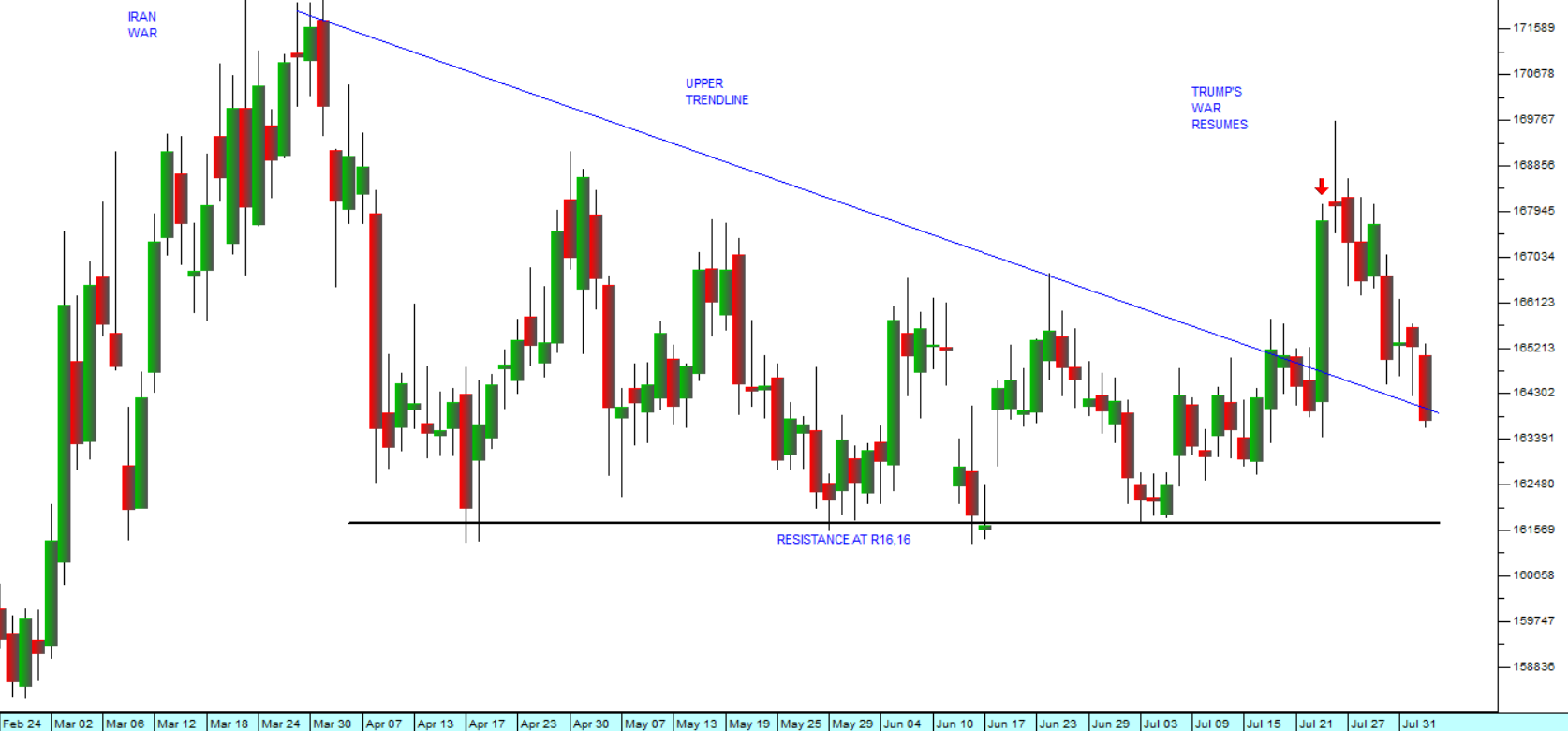
South African rand/US dollar : 24th of February - 4th of August 2026. Chart by ShareFriend Pro.
Beginning from its strongest point in this cycle at R15,79 to the US dollar on 29th January 2026, the rand fell back to a low of R17,16 at the end of March 2026. Then it began a process of steadily strengthening as international investors nervously tried to get back to “risk-on”. That process was then interrupted when Trump once again began bombing Iran on 23rd July 2026 cause the rand to spike down. Now we are again seeing a gradual improvement against the dollar. We believe that in time the rand will break to below the R16,16 resistance level and continue its long-term path of strength against the US dollar.
The relative strength of the rand has been South Africa’s saving grace during the current turbulent time. External shocks, like the sudden jump in the price of oil have had a much greater impact on those emerging economies with high inflation rates. We have to thank our Reserve Bank Governor, Lesetja Kganyago, for his determined and persistent efforts to bring inflation down to just 3% earlier this year. It is very easy and politically tempting to allow inflation to rise. Kganyago has stoically resisted all efforts to get him to debase the currency and has been squeezing inflationary expectations out of the economy. Real incomes are on the rise as is the national savings rate. In the long term this discipline will serve all South Africans well.
Bitcoin
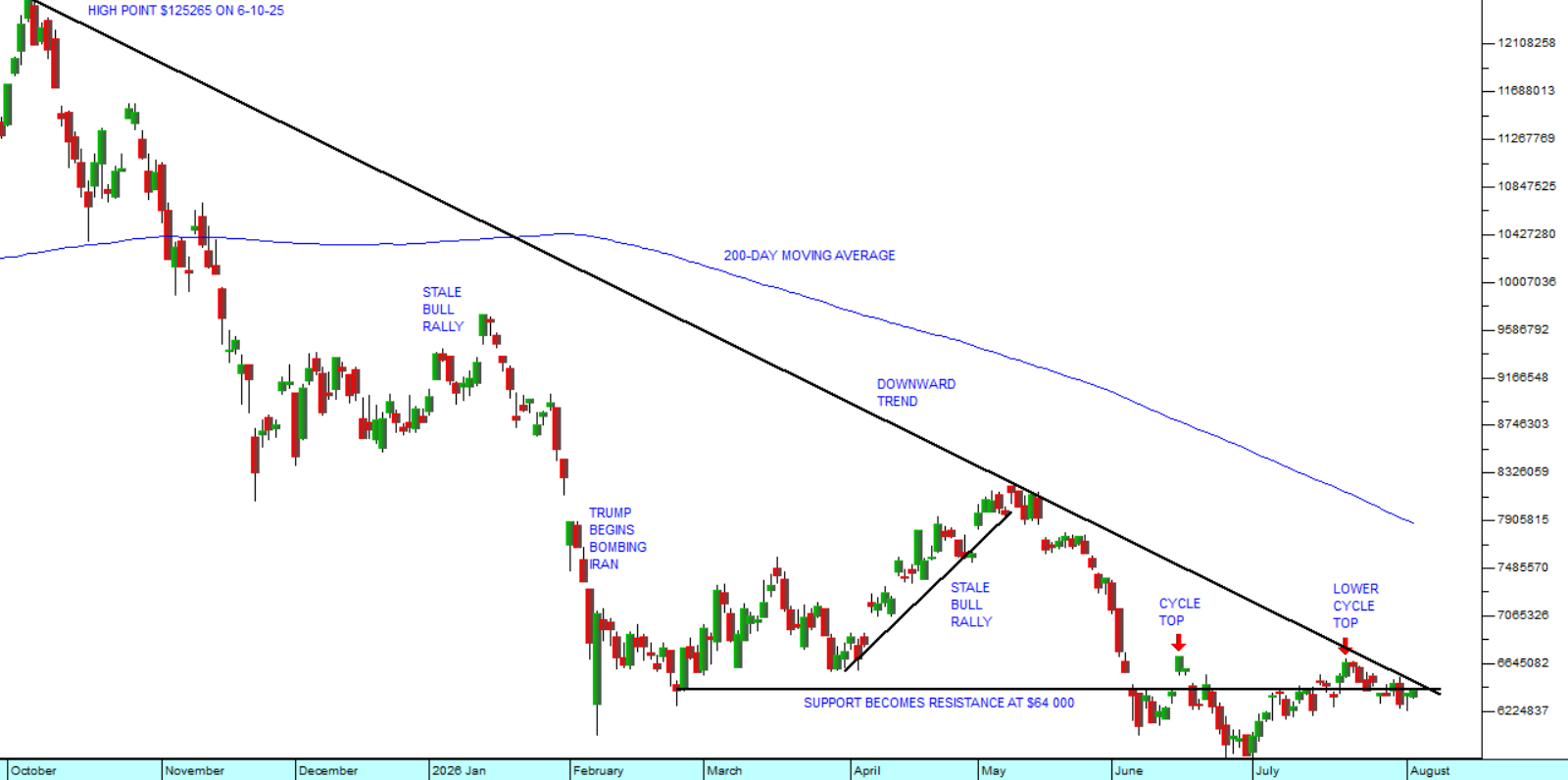
The price of Bitcoin is interesting because of the tenacity of its protagonists. It has been falling since its all-time record high of $125265 made on 6th October 2025. And is now trading for less than half of that. The downward trend has been characterized by a number of “stale bull” rallies and a strong support level at around $64000. Consider the chart:
None of the people who believe in Bitcoin can adequately explain its fall from grace. Perhaps the one who comes closest is Professor Paul Krugman who suggests that the price of Bitcoin mirrors Trump’s declining political influence and capacity. Certainly, since the start of the Iran war, Trump’s approval ratings have collapsed, and more and more American’s believe that he is not doing a good job of being President.
But perhaps the true problem is that Bitcoin has never been a real investment. It has always been just an idea which caught the imagination of a select group of people who saw it as the inevitable expression of the modern age of rapid technological advance. It represents no assets and no income stream and so must be regarded as a speculation based purely on sentiment. It cannot be analysed fundamentally because it has no fundamentals.
The chart shows it is well below its 200-day moving average and is now in the process of breaking down through the critical $64000 level. Whether or not it is somehow linked to Trump’s political fortunes can be argued, but its fall from grace is technically indisputable.
We see Bitcoin as continuing to fall in the future. Our opinion remains, as it has always been – If you have it, sell it. If you don’t have it, don’t buy it.
Companies
NEW LISTINGS
Pepkor is planning to separately list its fintech business on the JSE sometime in the next two years. This business will combine its recently acquired Shop2Shop business with its existing Flash payments business and other value-added businesses into a R21bn fintech company processing more than R200bn worth of transactions every year. The company is currently known as FintechCo and is one of Pepkor’s fastest growing areas. It will not however include Pepkor’s bank which has the name “Plus B”. We expect that such a listing will create a blue-chip institutional counter that should grow rapidly.
Coca Cola Hellenic Bottling company (HBC) is considering a secondary listing on the JSE later this year. The company recently bought 75% of Coca Cola Beverages Africa for $2,6bn. On the London Stock Exchange (LSE), HBC has a market capitalization of about GBP17,96bn (R393,5bn). When listed, HBC will become a massive institutional stock and a rand hedge. We expect it to be a solid blue-chip investment.
The companies which I have picked out for special comment this month are all big international businesses which are rand hedges to a greater or lesser degree and mostly have a secondary listing on the JSE. Companies like this are suitable for investors who are looking for long term steady growth and who may be concerned about the stability of the South African economy and government.
AB INBEV
This is the largest beer brewery company in the world. It acquired South Africa’s SA Breweries on 10th October 2016 for $107bn. Aside from the SA Breweries brands like Castle, the company owns brands like Budweiser, Corona and Becks. It is listed in New York (BUD) and Brussels (ABI) and on the JSE (ANH). It is four times as large as its nearest competitor which is Heineken. In the six months to 30th June 2026 the company reported revenue up 11,5% with a 27% increase coming from non-alcoholic beer. Headline earnings per share (HEPS) came in at 321c (US) up from the previous period’s 195c. We first became interested in this company when its share broke up out of an island formation in January 2026. Consider the chart:
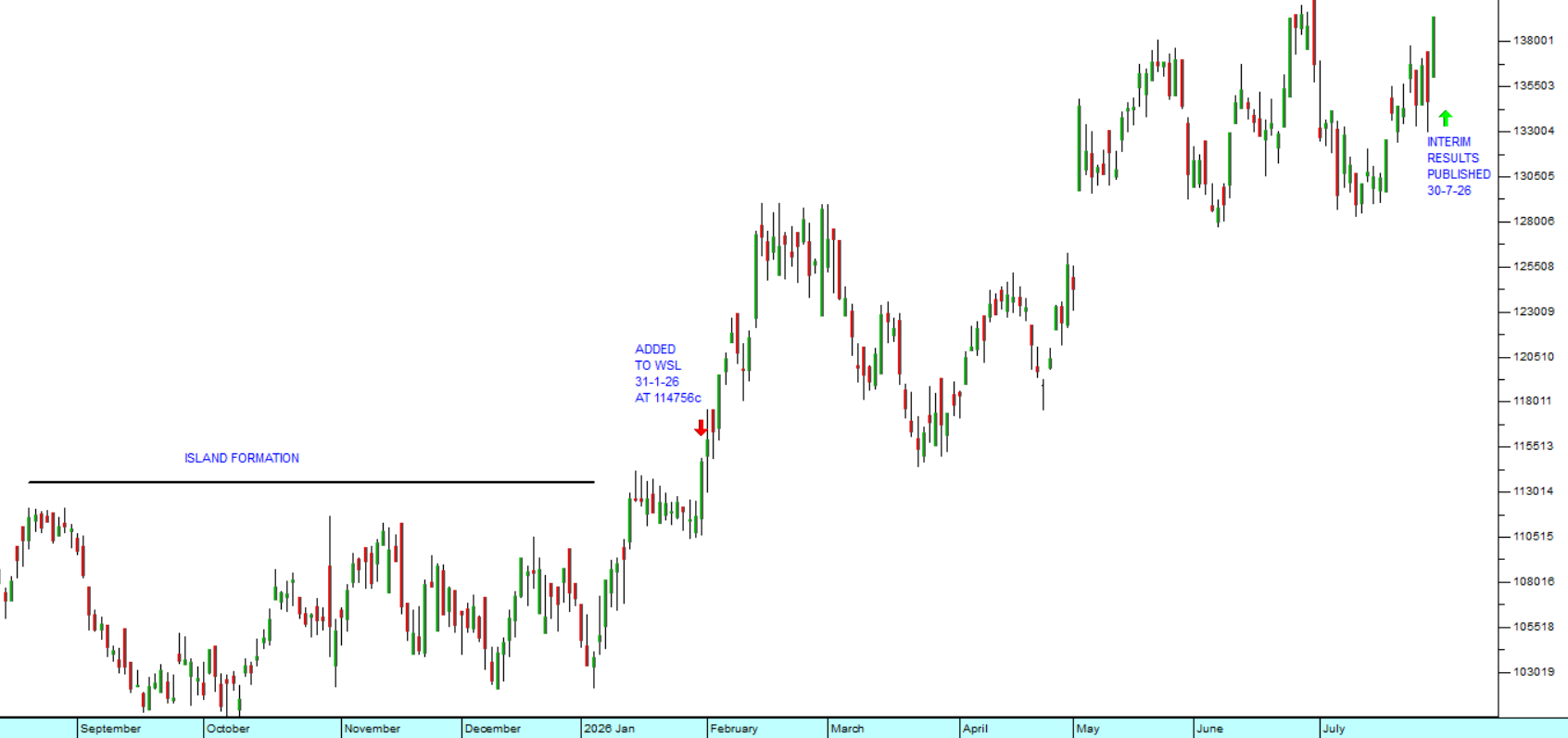
Since that time it has been steadily gaining ground. We added it to the Winning Shares List (WSL) on the 31st of January 2026 at 114756c. Since then it has risen to 139500c – a gain of 24,5% in six months. The sheer size of the company and its absolute domination of the markets that it is in means that growth is slow, but it is very secure, provided you believe that people continue to drink beer.
BATS
British American Tobacco is a famous international manufacturer and seller of cigarettes that describes itself euphemistically as “a leading consumer goods company”. The fact of the matter is that smoking is generally frowned upon and discouraged throughout the Western World these days and BAT does everything it can to distance itself from what is seen as an unhealthy habit. Despite this, it is a very successful company which is consistently profitable. The company has diversified into new category products such as vaping and electronic cigarette markets, which it claims offer it a long-term prospect for growth. In its latest financials for the six months to 30th June 2026 the company reported revenue up 1,4% with smokeless products now accounting for almost 20%. The company has had to settle numerous lawsuits and in this period and its profits were down 15,8%, “partly due to a credit in the prior year related to the Canadian settlement provision”. Once again, we became interested in the share after it broke up out of a protracted sideways market in 2024. We felt that it was under-priced and due for an upward move. Consider the chart:
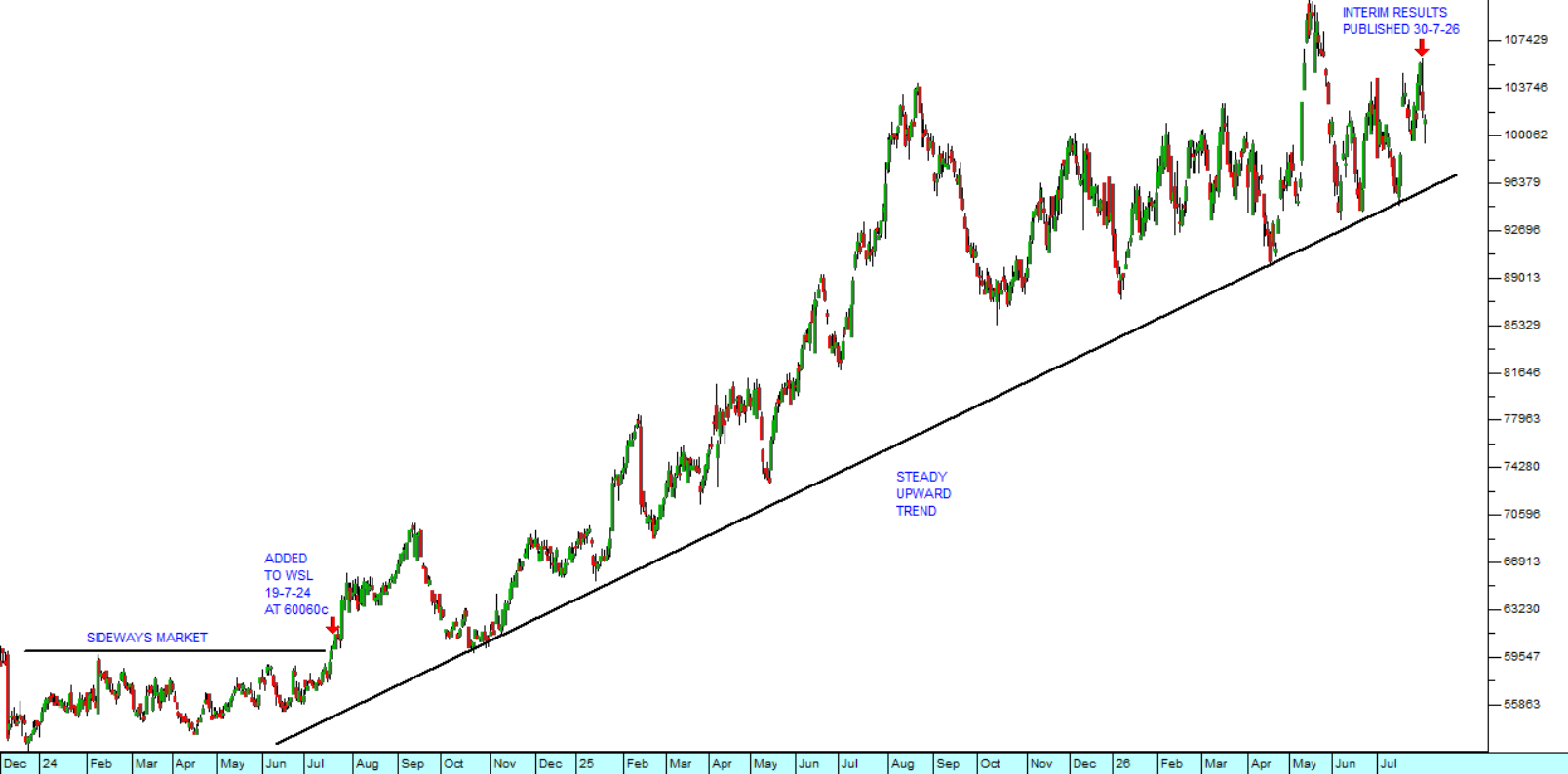
The chart shows the period of sideways movement and the upside break that attracted our attention. We added it to the Winning Shares List (WSL) on the 19th of July 2024 at a price of 60060c. Since then the share has been moving up in a volatile upward trend. We expect it to continue performing well in the future.
HAMMERSON
Hammerson is an international property company which has a secondary listing on the JSE. It focuses on flagship retail destinations and premium outlets. As such it offers South African an almost risk-free rand hedge investment which is blue chip and is growing steadily. In its latest results for the six months to the 30th of June 2026, it reported footfall up 3% ahead of the national benchmark and the acquisition of 50% of Manchester Arndale for a headline price of £218m. The CEO of the company, Rob Wilkinson, says that the acquisition will result in the 2026 full-year earnings being 27% higher than those of 2025. Consider the chart:
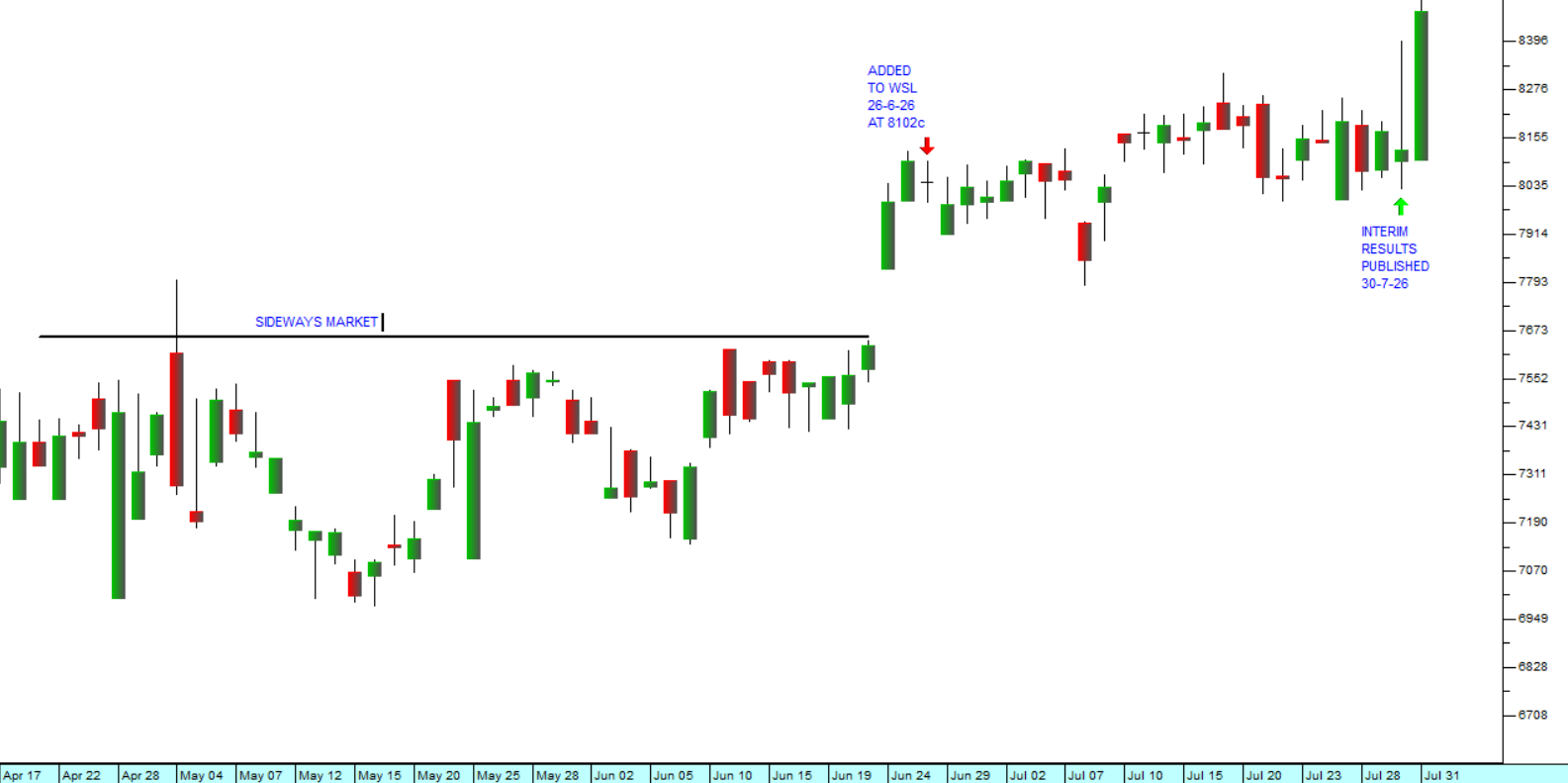
We have recently added Hammerson to the Winning Shares List (WSL) when it broke up out of a sideways pattern. We added it at 8102c just over a month ago and with the publication of its results it has already jumped up to 8479c – a gain of nearly 5%. In our view this share offers steady long-term appreciation with minimal risk.
MONDI
Mondi is a big international paper and packaging company that was started in South Africa and spread across the world. It was doing very well until the start of the war in Ukraine. Because about 12% of its business was located in Russia, it took a bit of a hit. On the 12th of August 2022 it announced that it had sold its entire Russian business – obviously taking a considerable loss. Technically, the share made a double top in May and July of 2024 before beginning a long downward trend. We are always interested in blue chip shares which go into protracted downward trends because they often end up being under-priced and therefore a good buy – so we have been watching Mondi for a few years now waiting for it to begin performing again. Consider the chart:
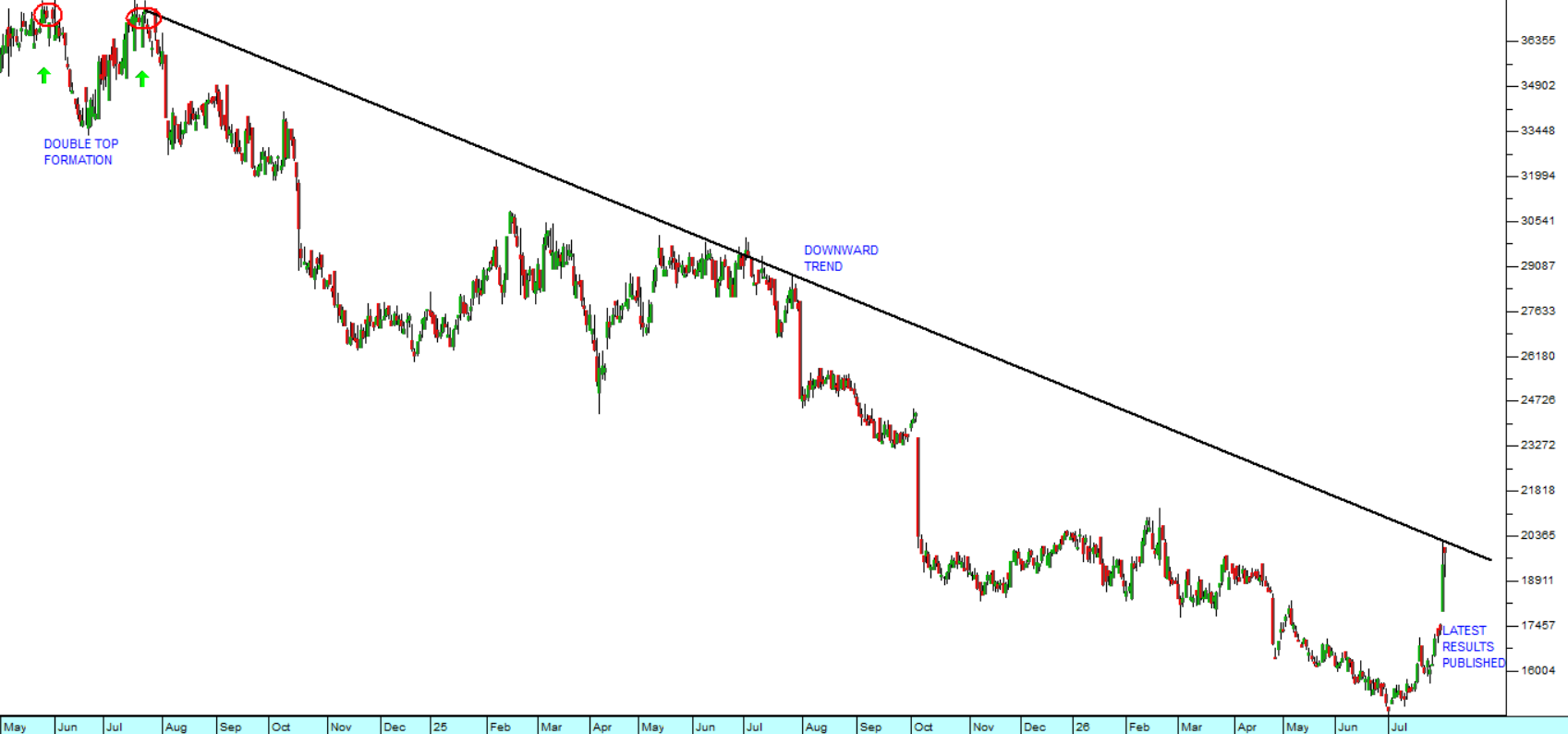
As you can see the double top formation in 2024 indicated the downward trend which followed. However, by the end of June 2026 we felt that the share had off-loaded sufficiently and that it was getting cheap. The latest results for the six months to the end of June – which were published on 30th July confirmed our suspicions. We have not yet added Mondi to the Winning Shares List (WSL) and we are still investigating. However, as you can see from the chart it is on the brink of breaking up through its long-term downward trendline – so I’m sure we will have it on the list soon.
GLENCORE
Glencore describes itself as one of the world’s largest global diversified natural resource companies and a major producer of more than 60 different commodities. In general, we usually advise clients to be careful with commodity shares because their product prices are set on international commodity markets over which they have little or no control. This tends to make them volatile and hence risky. Glencore has managed to reduce this risk by being very widely diversified both across product categories and geographically. Consider the chart: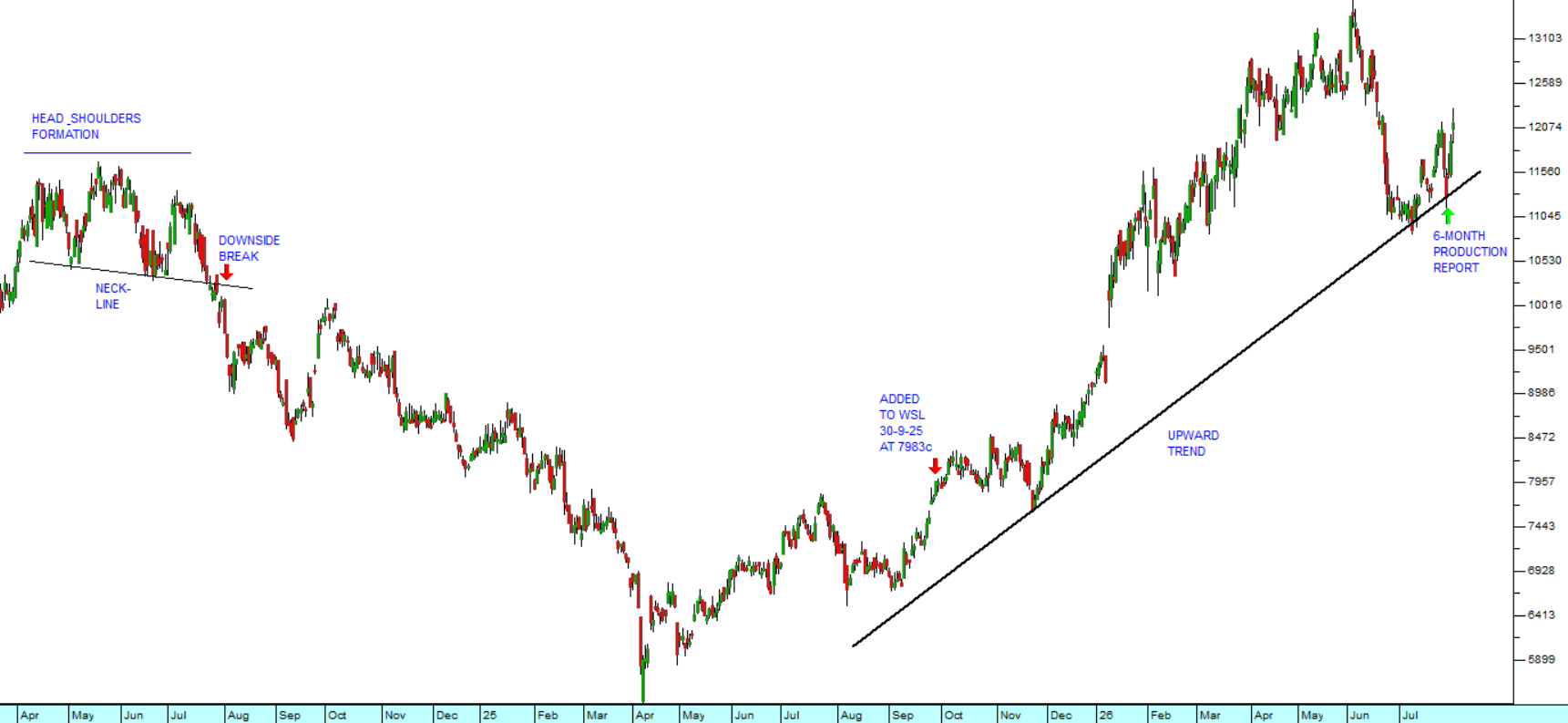
Glencore (GLN) : April 2024 - 31st of July 2026. Chart by ShareFriend Pro.
As you can see, Glencore executed an almost perfect head-and-shoulders formation between April and July of 2024. Once the neckline was broken at the end of July a downward trend became almost inevitable. By September last year, we began to feel that commodities in general had turned the corner and that Glencore was likely to benefit. We added it to the Winning Shares List (WSL) on the 30th of September 2025 at 7983c. It has subsequently moved up to a high of 13398c on the 2nd of June 2026, before correcting back on profit taking. We believe that it is in the process of starting a new leg of its upward trend. Just remember that it is a commodity share and hence riskier.
← Back to Reports