Market View
J200 109,064.00 -1.52% J203 116,763.00 -1.42% J210 135,548.00 -2.44% J211 127,405.00 -1.66% J212 24,904.00 -0.35% J213 138,591.00 -1.01%
Winning Shares (Top 5)
Code Name Added Price Latest % Gain % Gain/Year
WBC WEBUYCARS 2024-05-03 2085 3605 +72.90% +36.01%
ANH AB-INBEV 2026-01-31 114756 131869 +14.91% +53.89%
SBP SABCAP 2024-09-27 8100 15250 +88.27% +54.42%
FGL FINBOND 2025-06-19 88 105 +19.32% +21.56%
APN ASPEN 2026-02-14 12515 14096 +12.63% +53.00%
Opinions (Top 5)
Code Name Date Action
OCT OCTODEC 2026-05-13 View

Octodec (OCT) is a real estate investment trust (REIT) which owns 246 properties mainly in the inner cities of Johannesburg (33,9%) and Pretoria (66,1%). It has a gross lettable area (GLA) of 1 557 460m² and is valued at R11bn. It is owned and controlled by the founding Wapnick family and Jeffrey Wapnick is the CEO.

It owns Killarney Mall and Woodmead Value Mart. In its results for the six months to 28th February 2026 the company reported revenue up 2,4% and headline earnings per share (HEPS) up 15,4%. The company's loan-to-value (LTV) was 37,3%. In our view this is an interesting REIT which has performed relatively well in very difficult conditions.

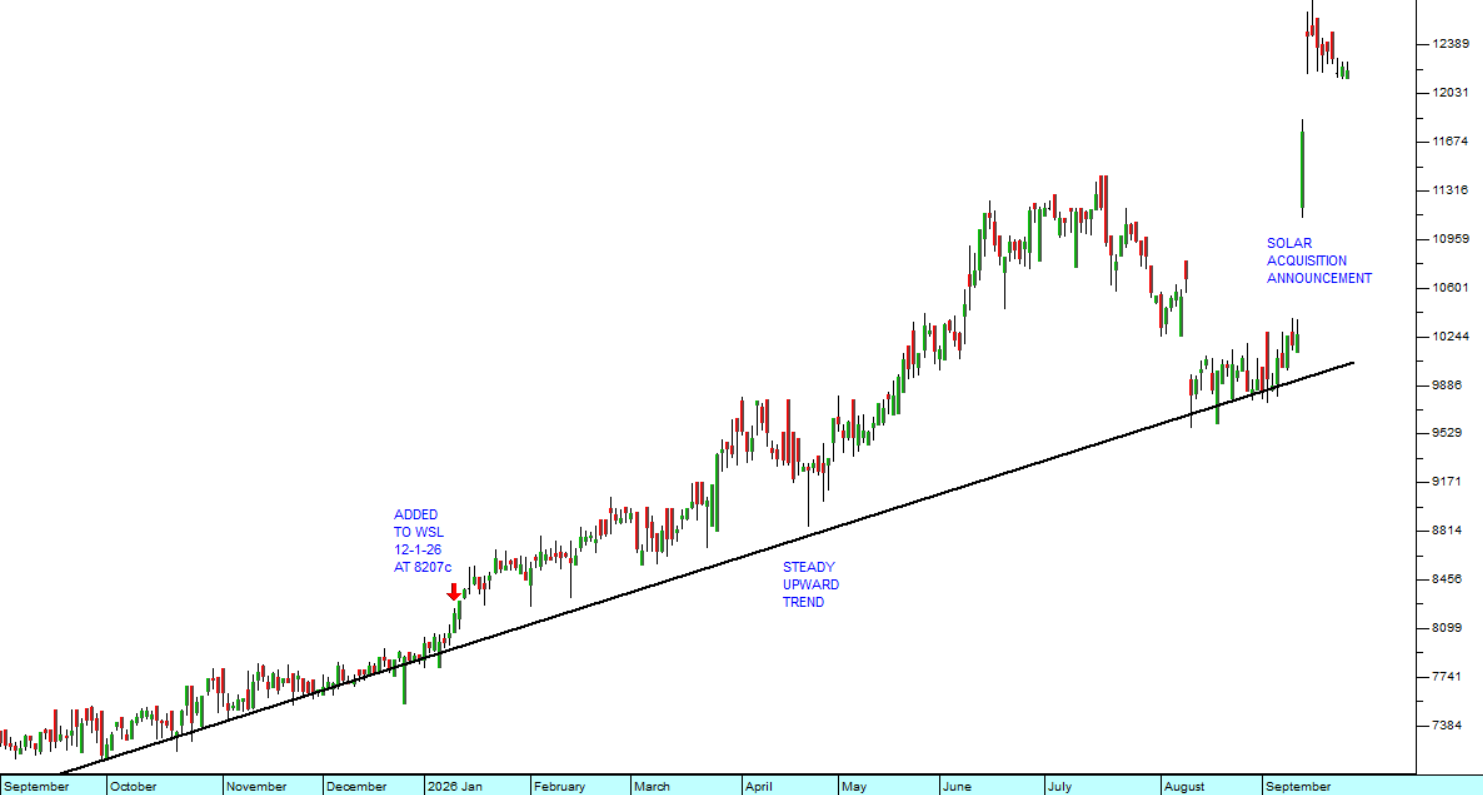
On a P:E ratio of 9,45 and trading at 65% of its NAV, we consider this share to be a possible long-term buy, especially now that it has reduced its loan-to-value (LTV). Technically, the share reached a peak of 1261c on 21-11-24 and then fell to a low of 890c on 9-4-25. Since then it has been in a strong new upward trend and was added to the Winning Shares List (WSL) on 21st August 2025 at 1100c.

It has since moved up to 1656c (12-5-26). 

MTN MTN-GROUP 2026-05-13 View

MTN is a leading emerging market mobile operator, serving 290 million people (including 29m in South Africa) in 19 countries across Africa and the Middle EaSt. MTN's three largest subscriber bases are in Iran, Nigeria and South Africa. Generally, companies supplying a mobile service have been faced with very stiff competition and declining voice revenue.

The sharp increase in data usage has, to some extent, mitigated this change, but these companies remain quite risky. MTN is especially risky because of the political risk in Iran and Nigeria. MTN is working with Sanlam to offer insurance products to its clients in the hopes that "fintech" will become a major part of its business.

The goal is to turn MTN into a "...digital operator with a major focus on the fintech, digital, enterprise and wholesale business areas." MTN has rolled out its mobile money services in both Nigeria and South Africa. It is currently offering these services in 14 out of the 21 countries where it operates, and it has 41,8m mobile money customers.

It is trying to increase that number to 60m. MTN has now listed on the Nigerian stock exchange. On 13th January 2023, MTN received an assessment from the Ghanaian tax authorities that it owed $773m (about R13,3bn). This is seen as a "shakedown" of a wealthy international company by a cash-strapped national government - similar to what happened in Nigeria.

The company announced that Mastercard would take a R100bn stake in its fintech business and partner with it to expand that business. In its results for the year to 31st December 2025 the company reported service revenue up 22,9% and data revenue up 37,7%. Headline earnings per share (HEPS) rose by 67% with total customers rising 5,6% to 307,2m.

The company said, "We deployed capex of R38.5 billion (ex-leases) in FY 2025 to enhance the capacity, coverage and quality, including accelerated investment to support stronger growth in MTN Nigeria and MTN Ghana. Our capex intensity of 17.0% (FY 2024: 15.9%) remained within the 15-18% target range".

In an update for the 3 months to 31st March 2026 the company reported data revenue up 36,1% and subscribers up 5,4% to 312,7m. The company said, "Strong financial delivery with service revenue growth of 20.0% (up 21.1%* in constant currency) and EBITDA margin expansion to 47.6%* (+3.0pp).

Balance sheet strong with Group leverage at 0.2x and HoldCo liquidity headroom at R42.6 billion". The share fell from its cycle high in March 2022 and we recommended applying a downward trendline from that peak and waiting for a clear upside break before investigating further. That break came on 7th December 2024 at a price of 9289c.

It was added to the Winning Shares List (WSL) on 14-1-25 at 9729c and has since moved up to 21312c (12-5-26). 

PRX PROSUS 2026-05-13 View

On 11th September 2019, Naspers (NPN) separately listed Prosus (PRX) on the Euronext in Amsterdam to house all its international assets including its stake in Tencent, Mail.Ru and other internet brands. Naspers holds 73% of Prosus and there is a 25% free float. One of the benefits of the Euronext listing is that it removes the risk inherent in the rand, so Prosus is a rand-hedge which rises when the rand weakens and vice versa.

Prosus is now Europe's largest consumer internet company. The main asset of Prosus is 26% of Tencent - a Hong Kong-listed company that provides social media services and gaming in China. Tencent has 10 of China's 20 top mobile applications reaching over 1,1bn users. Tencent remains vulnerable to the authoritarian regulators in China and their involvement in the gaming industry.

Prosus describes itself as, "...a global consumer internet group operating across a variety of platforms and geographies and is one of the largest technology investors in the world. The Prosus Group's businesses and investments serve more than 1.5 billion people in 89 markets and are the market leaders in 77 of those markets.

The Prosus Group's consumer internet services span the core focus segments of Classifieds, Payments and Fintech as well as Food Delivery, plus other online businesses including Etail and Travel." On 24th June 2022, the company said that it intended to sell some of its Tencent shares to finance an extended open-ended share buy-back program. This caused the share price to jump up.  In its results for the six months to 30th September 2025 the company reported revenue of $3,62bn up from $2,96bn in the previous period.

Core headline earnings per share (HEPS) rose to 179c (US) compared with 144c in the previous period. The company said, "Consolidated revenue grew 22% (14%) to US$3.6bn, driven by strong growth from iFood in Latin America (LatAm), OLX in Europe, and PayU in India. - Our bottom line performance accelerated even further, Ecommerce aEBITDA grew 70% (58%) to US$530m, and aEBIT increased 97% (84%) to US$400m." Technically, the Prosus share had been trending down since November 2025.

We believe that the share is undervalued at current levels. 

BYI BYTES 2026-05-13 View

Bytes Technology was spun out of Altron and separately listed on the London Stock Exchange (LSE) and the JSE. At listing it had a market capitalisation of about R13bn which has subsequently grown to R26,5bn. Altron shareholders received GBP542m in shares and cash at the demerger in a significant release of value.

It describes itself as "...one of the UK's leading software, security and cloud services specialists." The company is the biggest reseller of Microsoft products in the UK and receives about 60% of its revenue in annuity form. In its results for the year to 28th February 2026 the company reported gross income up 11,5% and headline earnings per share (HEPS) down 6,1%.

The company said, "Existing customers contributing 97% of our GP in this year (FY25: 97%), at a renewal rate of 99% (FY25: 109%), with £5m of gross profit contributed by new customers. Year-end headcount growth of 6.9% to 1,331, with ongoing investment in sales and service delivery teams".

Technically, the share has been falling since its high of R161 on 25th January 2024. We recommend waiting until it breaks up through its downward trendline before investigating further - and that has not yet happened. The share began a new upward trend in March 2026 which appears to be gaining  momentum.

This share is a solid rand-hedge and should perform well going forward. 

VOD VODACOM 2026-05-12 View

Vodacom (VOD) is South Africa's largest airtime and data provider for cell phones. It is a subsidiary of the international company Vodaphone. Its competitors are MTN, Cell-C and Telkom. The cell phone industry has been hammered by a steady decline in voice revenue which has to some extent been compensated by a sharp rise in data usage.

The disadvantage which Vodacom has as an investment is that a foreign parent owns it. Vodacom has businesses in Mozambique, Tanzania, the DRC and Lesotho. Now the group is looking to develop a business in Africa's fastest-growing economy, Ethiopia, with a population of 105m. The company is launching a "super-app" in conjunction with JackMa's Alipay to boost its non-voice revenue.

It has also spent R4bn to mitigate the impact of loadshedding. We believe that this share will perform well, but may take some time to reach former heights. In its results for the year to 31st March 2026 revenue was up 10,1% and headline earnings per share (HEPS) up 22,9%. The company said, "With headline earnings and free cash each growing by more than 20%, the benefits of our revenue and geographic diversification are apparent, even amid a complex and dynamic macroeconomic environment".

Technically, the share fell from its high of 16214c on 1st April 2022 and we suggested waiting for a clear break up through its downward trendline which happened on 25th July 2024 at 9836c. Since then it has risen to 15275c (12-5-26). It still looks relatively cheap at current levels with a dividend yield (DY) of around 3,85% - but it is in an environment where the technology and regulation shift continuously making it risky. 

Winning Share: SBP
Opinion: MTN
Stefanutti  (2026-05-11)

Stefanutti is a highly diversified construction company operating in Southern Africa. Its operations include roads and earthworks, marine construction, concrete structures, bulk pipelines, piling, geotechnical services, open pit contract mining, affordable housing, mine residue disposal, renewable…

Stefanutti is a highly diversified construction company operating in Southern Africa. Its operations include roads and earthworks, marine construction, concrete structures, bulk pipelines, piling, geotechnical services, open pit contract mining, affordable housing, mine residue disposal, renewable energy and other services.

It’s status as a level one BBBEE operator enables it to successfully tender for numerous government and state-owned enterprise (SOE) contracts inside South Africa. The company has benefited directly from the advent of the government of national unity (GNU) and the increase in infrastructure spend.

Historically, like the entire construction industry in South Africa, Stefanutti initially suffered from the suppression of the industry by the ANC and the adjustment to BEE requirements. Its share price fell from a peak of 2700c on the 14th of November 2007 to a low of 8c on the 13th of December 2019.

From that low point began a slow, but steady, recovery. We became interested in the share in June 2024 when its potential became more obvious. It had been in an extended sideways and downward market for 18 months before breaking up at the end of June 2024. Seeing its potential, we added it to the Winning Shares List (WSL) on the 22nd of June 2024 at a price of 146c. Consider the chart: 

STEFSTOCK (SSK) : May 2024 - 8th of March 2026. Chart by ShareFriend Pro.

The chart shows the end of the share’s sideways pattern in May and June of 2024 and then the sharp upward trend that followed. This upward trend came to an abrupt halt in September 2024 – but by then the share had already risen to a cycle high of 494c on the 30th of September 2024.

What followed was an 8-month downward channel in which the share price fell back to a cycle low of 300c on the 17th of April 2025. During this period, we maintained our view that the share had considerable upside potential and so kept it on the WSL.

Now a new upward trend has emerged, and the share has appreciated strongly to its close last Friday at a new record high of 654c.

In many senses, Stefanutti is an investment in the new South Africa and the potential of GNU to bring about significant economic reforms. Its wide diversity and BEE status means that it can benefit from projects in almost any industry, while being a preferred bidder for government contracts. This has enabled it to increase its order book and become more profitable.

In its financials for the six months to the 31st of August 2025 the company reported revenue unchanged, but headline earnings per share (HEPS) up 161%.

Since we added it to the WSL the share has appreciated by 338,36% - which amounts to over 180% per annum. Very few companies have achieved this level of growth. We expect the share to continue performing well going forward, especially given that the November 2026 elections are likely to result in further economic reform and a focus on infrastructure development.  

Record Highs  (2026-04-28)

Wall Street’s relationship with Trump is evolving. At the start of his current term, when he was playing with the US tariff system, everything he said moved the markets. Today, tariffs have completely lost their force in the market and Trump has moved on to being a warmonger instead. His attack on…

Wall Street’s relationship with Trump is evolving. At the start of his current term, when he was playing with the US tariff system, everything he said moved the markets. Today, tariffs have completely lost their force in the market and Trump has moved on to being a warmonger instead.

His attack on Venezuela did not move the markets, but it boosted his confidence and made him easy prey for Israel’s Netanyahu, allowing him to embroil the US in a war which does absolutely nothing for America and has certainly damaged Trump’s mid-term election prospects beyond repair.

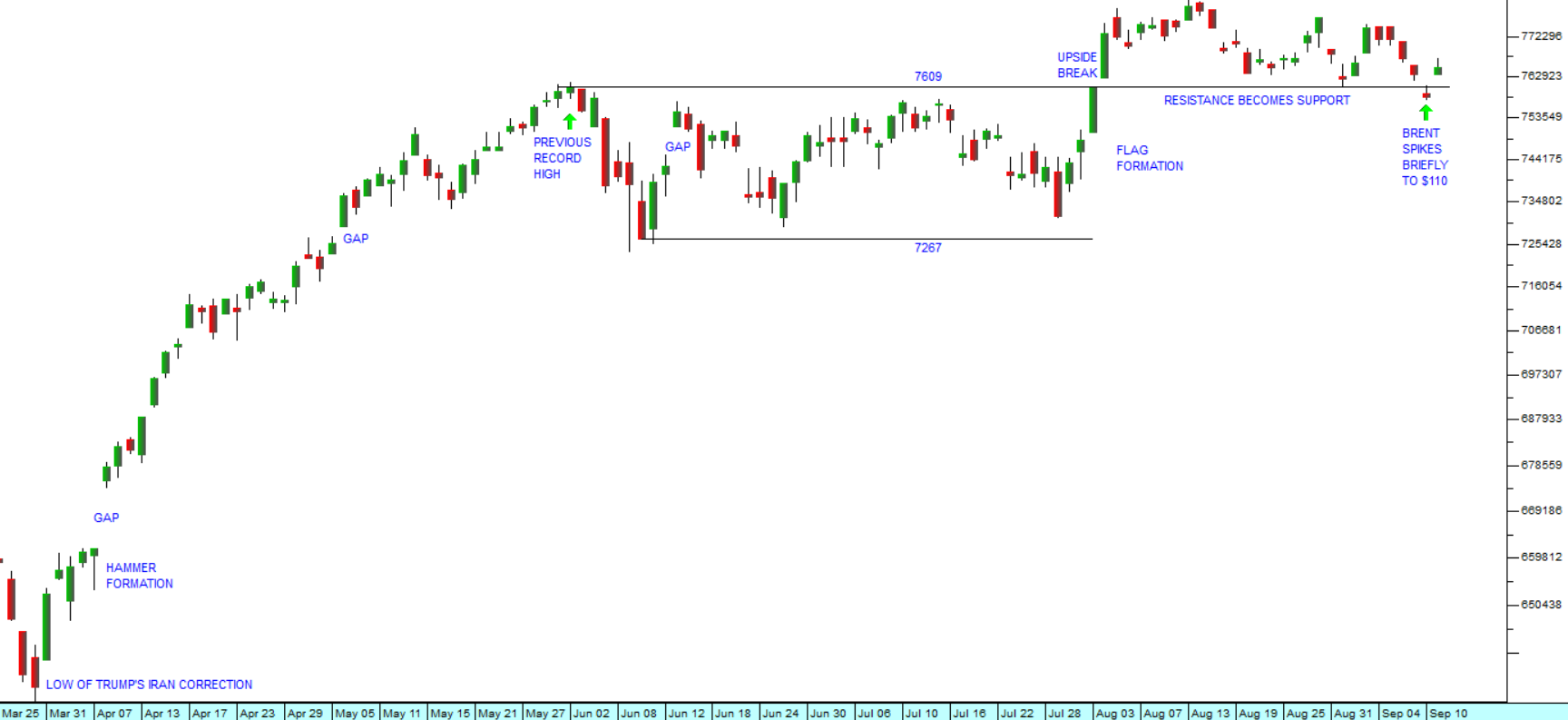
The US/Iran war has reached a stalemate with both sides closing the Strait of Hormuz and both sides seizing commercial ships in the vicinity. What is interesting is that while the price of North Sea Brent oil has now climbed back above $105 per barrel, the S&P500 index has made yet another new all-time record high.

Investors are clearly looking beyond the oil price to the excellent results and predictions coming out of S&P500 companies, and especially the “magnificent seven”. Consider the chart:

S&P500 Index : 28th of October 2025 - 24th of April 2026. Chart by ShareFriend Pro.

The chart shows the previous 5% correction in November last year and then Trump’s Iran war correction which broke to a lower low and created the opportunity for a TACO trade. You will note the important hammer formation on 7th April 2026 which gave a clear early warning that a strong recovery was coming. Note also that the 50-day moving average turned upwards again, away from the 200-day – indicating that a death cross had been averted.

The general investor perception is that the Iran war is a temporary phenomenon which will be resolved one way or another relatively soon. The primary impact of the higher oil price, while negative for the economy, has been to seriously erode Trump’s MAGA support base. It is also having the effect accelerating the movement away from fossil fuels towards renewables.

There is now concrete evidence that somebody in Trump’s camp has been profiting massively from his announcements on the war in Iran. There are three clear instances of insider trading in the oil futures market coming immediately prior to his announcements:

  1. On 23rd March 2026, a $500m short placed 15 minutes before Trump announced a delay in Iranian strikes.
  2. On 7th April 2026, a $950m short placed immediately before Trump announced the US-Iranian ceasefire.
  3. On 17th April 2026, a $760m short, placed minutes before the opening of the Strait of Hormuz was declared by Trump.

The Commodity Futures Trading Commission (CFTC) is investigating these trades.

MAGA has been blithely unconcerned about the fact that Trump is inter alia a convicted criminal, a rapist, an inveterate liar or that he and his minions have been engaged in blatant insider trading. MAGA is, however, very much concerned about the price of petrol (“gas”) which has remained stubbornly above $4 per gallon since the war began.

At the same time, the stock market is bracing for the biggest wave of initial public offers (IPO) in its history with SpaceX, Open AI and Anthropic all planning to come to the market later this year. They are endeavouring to raise a total of $3 trillion led by SpaceX’s $1,75 trillion offer. Open AI is looking for about $1 trillion and Anthropic wants $380bn. What is interesting about this is that all three companies are currently running at a loss. Space X, particularly, reported a loss of $5bn last year on revenues of $18,6bn.

This almost looks like the start of a top-of-market listings boom. Investors are losing sight of the underlying fundamentals and focusing only on blue sky potential. With its latest all-time record high last Friday, the S&P500 is now trading at an historical price:earnings ratio (P:E) above 30 – which must be compared with the median average for that index of between 15 and 18. In other words the index is discounting a substantial increase in earnings for its component companies.

Can that be justified? We believe that it can. There is little doubt that the productivity benefits of AI have only just begun to impact the profits of S&P500 companies – let alone other emerging new technologies like humanoid robotics. We believe that the bull trend will continue – but your best defence against a market collapse remains your stop-loss strategy.

PSG Financial Services  (2026-04-20)

Now that the TACO trade associated with Trump’s war in Iran is over and markets are again posting new all-time record highs, it is worth noting that the JSE has not yet recovered completely and the JSE Overall Index (J203) is still 5,6% below its record high of 128456 made on 27th February 2026. As…

Now that the TACO trade associated with Trump’s war in Iran is over and markets are again posting new all-time record highs, it is worth noting that the JSE has not yet recovered completely and the JSE Overall Index (J203) is still 5,6% below its record high of 128456 made on 27th February 2026.

As an emerging market, the JSE always tends to be more volatile than first world markets – which means it falls further and goes higher. The JSE fell a total of 14,3% during this correction where the S&P500 fell by only 8,8%. It is also important to understand that the markets of the world (including the JSE) always tend to follow Wall Street – so we should expect the JSE Overall index to break to a new record high fairly soon. Consider the chart:

JSE Overall Index : 10th of December 2025 - 17th of April 2026. Chart by ShareFriend Pro.

Our Winning Shares List (WSL) is still dominated by commodity shares like Sasol, Pan African, Southern Palladium and Anglogold, so there are still investment opportunities to be found among the blue-chip industrials and financials.

One such blue chip is PSG Financial Services (KST). KST has been spun out of PSG which has spawned many very successful JSE listings like Capitec, and Curro. KST is a thoroughly South African company that has a long track record of excellent performance.

Its business consists primarily of asset management and insurance. In its results for the year to 28th February 2026 the company reported R540bn of assets under management (AUM), up 20% from the year before. It also reported its gross written premiums up 5% to R8bn. The company’s core income increased by 22% to R8,28bn and its recurring headline earnings per share (HEPS) rose by a whopping 34%. These are excellent results. Consider the chart:

PSG Financial Services (KST) : March 2024 - 17th of April 2026. Chart by ShareFriend Pro.

KST has been in a steady upward trend since March 2024. We added it to the Winning Shares List (WSL) on 23rd May 2024 at 1610c and since then it has nearly doubled to 2865c.

Like most blue-chip shares trading on the JSE, KST shares fell as a result of the war in Iran and the sharp rise in the price of oil. That sell-off gave private investors a rare opportunity to buy further in to this excellent company.

As a private investor it is important to understand that KST is a services company and has an insignificant working capital requirement, while much of its income is annuity income. Its staff are also highly educated and paid – which means that they are not unionised. Given its long track record of generating profits, this makes it an almost risk-free investment.

Of course, we are not the only ones who are aware of KST’s great performance. The institutional fund managers have long favoured its shares and as a result the shares trade for a relatively high P:E ratio of 21,22 – which compares with the JSE Overall indexes average P:E of 15,34. Nonetheless, it is a good share to accumulate during periods of weakness.

JSE Top 40

109,064.00 (-1.52%)

All Share

116,763.00 (-1.42%)

Financial 15

24,904.00 (-0.35%)

J200
J203
J212
Top Gainers
# Code Name Close (c) % move
1 ACT AFRO-C 125 +8.70%
2 MKR MNTKRENEW 2592 +8.63%
3 SKA SHUKA 64 +6.67%
Top Losers
# Code Name Close (c) % move
1 BAC AFBITCOIN 500 -47.31%
2 OAO OANDO 20 -16.67%
3 FTH FRONTIERT 583 -12.86%

Top Movers – Charts

Top Gainer: ACT
Top Loser: BAC