Market View
J200 101,609.00 +0.63% J203 109,820.00 +0.63% J210 113,984.00 +0.59% J211 120,877.00 +0.69% J212 25,768.00 +0.53% J213 137,067.00 +0.62%
Winning Shares (Top 5)
Code Name Added Price Latest % Gain % Gain/Year
IOC IOCO 2024-11-06 220 424 +92.73% +47.01%
LEW LEWIS 2023-12-01 4150 8630 +107.95% +37.14%
CLI CLIENTELE 2026-05-05 1880 1971 +4.84% +32.12%
EQU EQUITES 2025-05-01 1515 1870 +23.43% +15.72%
OMN OMNIA 2026-01-13 8207 12250 +49.26% +62.65%
Opinions (Top 5)
Code Name Date Action
SNV SANTOVA 2026-10-28 View

28-10-2026 Santova (SNV) is an international logistics company with 32 offices in several countries. The company designs, implements, coordinates, controls and monitors international supply chain activities. Through a virtual client-centric information system the company facilitates inventory management to provide far more than simple tracking and tracing services.

The company has offices in the East in Thailand, Vietnam and Malaysia and in Europe in Germany, the Netherlands and the UK and in major cities in South Africa. It also has offices in Mauritius and Sydney, Australia. In its results for the six months to 31st August 2026 the company reported revenue up 40,2% and headline earnings per share (HEPS) up 57,4%.

The company said, "The results for the six months ended 31 August 2026 saw Revenue and net interest income increase by 40,2% to R681,8 million (August 2025: R486,2 million), driven by the inclusion of Seabourne’s revenue for the full six-month reporting period, compared to only three months in the prior period". Technically, the share has essentially been moving sideways since May 2023 but may now be entering a new upward trend.

It has recently fallen back down to 640c per share but then recovered to 786c (27-10-26). The share is fairly well-traded making it practical for private investors and it should benefit from any improvement in the SA and UK economies. 

CML CORONAT 2026-10-28 View

28-10-2026   Coronation (CML) is one of South Africa's largest asset managers and the only one listed on the JSE. Founded in 1993, the company grew very well until 2015. At that point, the founding CEO resigned and a new CEO, Adrian Pillay, took over. Pillay is eminently well-qualified for the job, but things have not done well since he took over.

The company was heavily invested in African Bank and lost a lot of money there. It was also heavily invested in Steinhoff. These missteps have caused the investment community to re-evaluate Coronation's ability to keep choosing winners on the JSE and elsewhere. The result has been an outflow of institutional funds.

The fund management business is all about confidence. As a fund manager you need to get institutional fund managers to trust your judgement. Usually that means employing a team of very highly qualified people with solid track-records in managing funds. Unfortunately, no matter how good your team is, they are going to make mistakes and lose money sooner or later.

On 13th October 2024 the company said it intended to increase black ownership from the current level of 31% to 51% to enable it to obtain more business from government agencies like the Government Employees Pension Fund (GEPF). On 22nd April 2025 the company announced that AUM on 31st March 2025 was R676bn.

In its results for the six months to 31st March 2026 the company reported revenue up 3% and headline earnings per share (HEPS) down 5%. The company said, "Total assets under management (AUM) decreased by 2% to R746 billion (30 September 2025: R761 billion), largely due to market movements during the period, while average AUM increased by 15% to R776 billion (31 March 2025: R677 billion), supporting the stability of our revenue base".

In a trading statement for the year to 30th September 2026 the company estimated that EPS would decrease by between 5% and 15%. AUM was R750bn on 30th September 2026. Technically, the share has recently entered an upward trend and is likely to remain there. We recommended applying a long-term downward trendline and waiting for a clear upside break which happened on 21st June 2024 at 3599c.

The share was added to our Winning Shares List (WSL) on 11th May 2024 at 3281c. It then moved up to 5175c at the end of January 2026 before entering a new downward trend. We believe that it offers good value at current levels (4106c on 27-10-26).

QFH QUANTUM 2026-10-28 View

28-10-2028   Quantum (QFH) is in the chicken business. It has four divisions - Animal feeds, eggs and layers, broilers and an African division where it sells related products. Quantum was obviously badly impacted by the drought in Southern Africa, but since that abated and the price of animal feeds came down, it has benefited from the much higher prices of eggs and the lower cost of feeds.

In general, the chicken business is a tough business. It is labour intensive which creates exposure to union action, it involves large quantities of working capital tied up in stock and to a lesser extent debtors, it is subject to unexpected disease threats like avian flu or Newcastle disease and it has experienced the dumping of cheap chicken onto the South African market from Europe, Brazil and America.

With top class management, a sustainable profit can be achieved, but the industry is regarded as relatively high risk by investors which accounts for its low price:earnings (P:E) multiple and its high dividend yield (DY). The unprotected strike at Kaalfontein Farm has restricted output and cost an estimated R10m.

The company suffered an outbreak of HPAI at its Lemoenkloof Farm as well as loadshedding and labour unreSt. In its results for six months to 31st March 2026 the company reported revenue down 5% and headline earnings per share (HEPS) up 16%. The company said, "Feed input costs declined materially during the current reporting period.

The average SAFEX yellow maize price decreased by 30.6% as South African maize prices moved closer to export parity, compared to the previous reporting period when local maize prices were closer to import parity". In a trading statement for the year to 30th September 2026 the company estimated that HEPS would increase by between 17% and 29%.

Nobody knows what difficulties this business may experience over the next 12-month period. So, if you plan to invest in this share, be prepared for considerable volatility. This company sometimes has difficulty in passing on higher raw materials costs to consumers especially in the current economic environment. 

PIK PICKNPAY 2026-10-27 View

27-10-2026   Pick 'n Pay (PIK) is a retail grocery chain with over 2000 stores, mostly in South Africa, but also in the rest of Africa. The company was started by Raymond Ackerman in 1967 and became the dominant grocery retailer over time, before being displaced by Shoprite/Checkers.

Summers has once again resumed the role of CEO, following his stint at Pick n Pay as CEO between 1999 and 2007. In its results for the 26 weeks to 30th August 2026 the company reported turnover up 2,4% and a headline loss of 40,71c per share compared with a loss of 59,77c in the previous period.

The company said, "The Group reported a 56.2% (R178 million) year-on-year improvement in loss before tax and capital items to R139 million, against a loss of R317 million for H1 FY26. The profit improvement was delivered at the operating level, with trading profit improving by R180 million, while net finance costs were approximately flat".

Technically, Pick 'n Pay has been in a downward trend from 2016 and has lost substantial ground to Shoprite. On the latest results, it appears to be moving into a new volatile upward trend since March 2026. The share remains risky, and, in our opinion, has not yet addressed all the underlying problems of its customer shopping experience and staff motivation, but there are some signs of improvement.

Recently, the share appears to have found support at around R18 per share and looks to be rising off that level. On 5th May 2026 the company announced the commencement of section 189A proceedings aimed at negotiating redundancies among the labour force. On 22nd September 2026 the company announced that Spencer Sonn will take over as CEO with effect from 1st February 2027. 

VAL VALTERRA 2026-10-25 View

25-10-2026   Valterra, (VAL) was previously Anglo American Platinum, or Amplats, and is the second largest platinum producing company in the world (after Sibanye), producing a large portion of the world's platinum. VAL was one of the first platinum mining companies in South Africa to move away from expensive deep-level mining towards shallower, more mechanised mining.

The company has reduced the number of mines it is operating from 18 to 7 over 5 years, decreased overheads by 50% and its number of employees by 50%. This shift is now paying dividends. The Mogalakwena open-cast operation is a palladium-rich operation with costs in the lowest quartile in the platinum group metals (PGM) industry world-wide.

A new project at Mogalakwena will see platinum production up by 250 000 ounces and palladium production up by 270 000 ounces. The company also recently bought out Glencore's 40,2% stake in their joint venture Mototolo mine and the adjacent Der Brochen property for R1,5bn. Mototolo is a highly mechanised shallow mine which can be extended into Der Brochen without putting in new surface infrastructure.

The platinum price is plagued by an effective re-cycling industry which produces about 2 million ounces a year by recovering from old auto catalysts.  In its results for the six months to 30th June 2026 the company reported revenue up 93% and headline earnings per share (HEPS) of 82,02c compared with 4,73c in the previous period. The company said, "Our exceptional results were a direct consequence of a solid metal-in-concentrate (M&C) production increasing by 4% to 1.5 million PGM ounces and sales volumes rising by 18% to 1.7 million PGM ounces".

In an update  on the third quarter to 30th September 2026 the company reported PGM production down 6% and PGM sales volumes down 27%. Guidance for the full year remains unchanged. Technically, the share was moving sideways from September 2023 to June 2025, mainly due to the challenges faced by the industry including loadshedding and falling PGM prices, but is now responding to rising PGM prices and moving into a strong upward trend.

We added it to the Winning Shares List (WSL) on 2nd July 2025 at 83183c and it has since gone up to 186439c (27-2-26). Since then it has fallen back to 113323c (23-10-26). It remains a volatile commodity play.

Winning Share: OMN
Opinion: PIK
Sasol and the Rising Oil Price  (2026-10-26)

Every major event that happens in the world inevitably offers some kind of investment opportunity for the private investor. The challenge is to work out how best to capitalise on it. So, it was with the war in Iran. At the time that the war began with the Israeli and American bombing raids on 28th…

Every major event that happens in the world inevitably offers some kind of investment opportunity for the private investor. The challenge is to work out how best to capitalise on it. So, it was with the war in Iran.

At the time that the war began with the Israeli and American bombing raids on 28th February 2026, we had already been watching the progress of Sasol for some time. The situation in Iran was tense with riots reported and North Sea Brent had climbed back up to $70 per barrel, but we had no idea that the Americans and Israelis were about to launch a bombing attack.

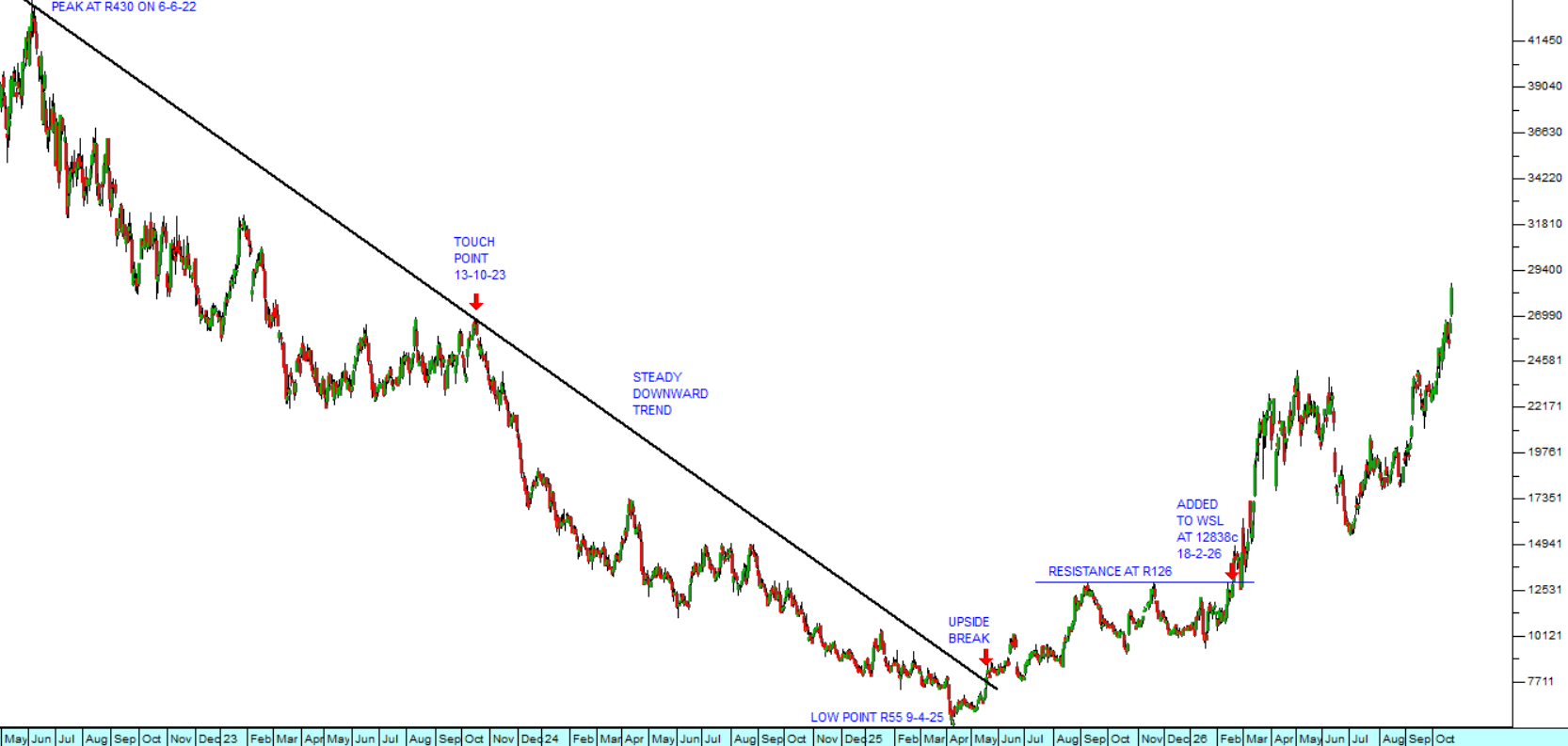
Sasol was always a blue-chip share and has historically occupied a dominant position in South Africa's synthetic fuels industry. It had, however been through some difficult times and the share price had fallen from a high of R430 per share to as low as R55 in April 2025. It then went through an extended period of sideways consolidation. We finally decided to add it to the Winning Shares List (WSL) on 18th February 2026 at a price of R128.36. Technically the share broke above resistance at R126 indicating that something was afoot. Consider the chart:
Sasol (SOL) : May 2022 - 23rd of October 2026. Chart by ShareFriend Pro.

The chart shows Sasol’s long downward trend that began in the middle of 2022, mainly because of the falling price of various grades of oil. North Sea Brent oil fell from a high of $125 per barrel on 8th March 2022 to its cycle low just below $60 per barrel in mid-December 2025. Since Sasol derives more than half of its revenues and profits from the fuel industry, it is directly linked to the price of oil.

Sasol had been recovering but had encountered significant resistance at R126 per share. When it broke decisively above that level, that gave us the signal we needed. Immediately prior to the start of the war the oil price had been climbing, and in January 2026 there were riots in Iran which Trump and Netanyahu used as a pretext to begin the bombing. The price of Brent rose above $70 per barrel on 18th February, before the bombing started, and that triggered a rise in Sasol’s share price. We decided then that Sasol was probably under-valued and due for an upside move.

Sasol’s latest results for the year to 30th June 2026 show the benefits of the rising price of oil. Turnover was up 9% and earnings before interest taxation depreciation and amortisation (EBITDA) was up 17% while the company reduced its debt by 11%.

We do not normally advise investors to buy commodity shares like Sasol because they are riskier, but sometimes they can offer very good capital gains. In the case of Sasol the share appreciated rapidly after we added it to the WSL and then there was a correction as the oil price temporarily fell back in June and July this year. We held on because we thought there might be further upside potential.

The best investment policy is to try to hold onto your shares for at least three years, unless you are moving into a loss position (i.e. you had to execute an early stop-loss sale). This is because if you hold them for less than 3 years the Receiver may seek to declare you to be a share dealer – and then any gain you make will be added to your taxable income and you will be taxed on it at your marginal rate. If you hold for longer than 3 years, then your appreciation is treated as a capital gain for tax purposes and taxed at 18%.

As it turns out holding on to Sasol was the right decision and the share has now appreciated by 134% in about 8 months since we added it to the WSL – which is just shy of 200% per annum.
October Month  (2026-10-19)

There are generally two types of risk in the share market – the risk that a specific share which you have bought falls known as unsystematic risk, and then the risk that the market as a whole falls and drags all your shares down with it - known as systematic risk. The systematic risk that the market…

There are generally two types of risk in the share market – the risk that a specific share which you have bought falls known as unsystematic risk, and then the risk that the market as a whole falls and drags all your shares down with it - known as systematic risk. The systematic risk that the market is in or about to enter a bear trend is obviously a vital consideration for the private investor. During a bear trend about 80% (or more) of shares will fall while only 20% will rise. This means that from a purely statistical point of view it is better for private investors to stay out of the market during bear trends.

It is also very important to be able to distinguish between a correction (which is often a buying opportunity) and a bear trend. The safest approach is always to always buy shares which are rising, in sectors which are rising in a market which is rising. At the same time keeping a strict stop-loss strategy is vital to protect the bulk of your capital. As a private investor you should have an absolute rule that you never lose more than 15% on any share market investment – ever – and that should include your dealing costs. This can only be achieved if you buy free-dealing shares and always adhere to a strict stop-loss strategy.

Today, Monday 19th October 2026 is the exact anniversary of the greatest single day crash in stock market history. Thirty nine years ago, on Monday 19th October 1987, Wall Street collapsed. The S&P500 index fell more than 20% in the day. Other famous bear trends have also begun in October month, including the infamous 1929 crash, the bear trend of the year 2000, the 2008 sub-prime crisis, and the bear trend of 2022 associated with the Ukraine War. So, October month has a bad reputation with investors, and they generally heave a sigh of relief when it is over.

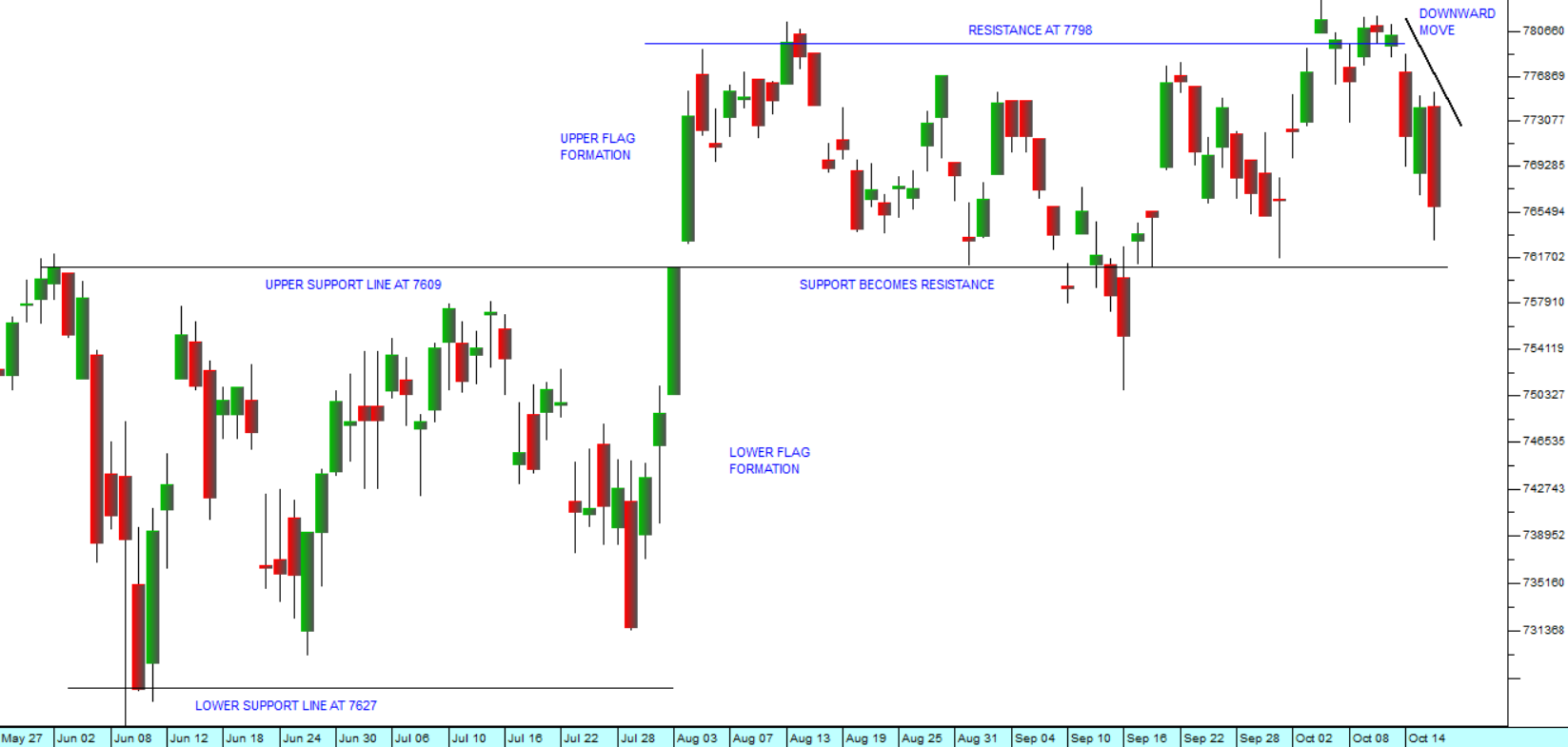
Ominously, Wall Street has been falling over the last week as the Iran war flared up again, pushing the price of North Sea Brent up to nearly $110 per barrel. Consider the chart:

S&P500 Index : 27th of March 2026 - 16th of October 2026. Chart by ShareFriend Pro.

In our analysis, we have drawn your attention to the fact that the S&P500 index has been moving through two sideways markets or flags as the countervailing forces of the rising oil price and the profitability of the artificial intelligence (AI) revolution play out.

The climb in the fuel price is causing a re-evaluation of inflationary risks throughout the world, but especially in America, where the price of petrol has remained stubbornly above $4 per gallon and diesel has hovered above $6 per gallon. With the mid-term elections just weeks away, Republicans and especially Trump are facing a barrage of criticism for their handling of the economy. The Iranians on the other hand are doing everything in their power to keep the oil price at high levels to put the maximum pressure on Trump.

What is notable is that the high oil price appears to be having less and less impact on Wall Street as time goes by. When Trump and Netanyahu began their war with Iran the S&P fell back sharply to 6611 on the 6th of April 2026, and the price of Brent oil went above $110 per barrel. Today Brent is again hovering close to those levels and the S&P has recently managed to reach a new record high at 7818. The world has been facing increased levels of inflation, rising interest rates, and record bond yields - but despite that, AI and corporate profits continue to take the market higher.  

In our opinion, as soon as October month is safely behind us and especially if the mid-term elections have the effect of reducing Trump to a lame dog president, we can look forward to a Christmas rally in the S&P500 during the festive season and into next year. As usual, we strongly advise you to be vigilant and to maintain your stops.

Quantum Computing  (2026-10-12)

We live in an age where advances in technology are driving the gains in productivity and profits, and then being discounted directly into share prices. Artificial intelligence (AI) is already well established and being used by most companies to improve productivity. This can be seen in the results…

We live in an age where advances in technology are driving the gains in productivity and profits, and then being discounted directly into share prices. Artificial intelligence (AI) is already well established and being used by most companies to improve productivity. This can be seen in the results coming out of the companies in the S&P500 index. The impact of AI has only just begun to be discounted and now the next major technological breakthrough, quantum computing, is hovering in the background.

Quantum computing is essentially a jump forward in hardware which allows computers to analyse multiple different solutions simultaneously. Instead of using bits which are either 1 or 0, a quantum computer uses qubits which can exist in multiple states simultaneously - together with quantum entanglement. The technology uses the laws of physics at the atomic and subatomic level to solve complex problems much faster than regular computers, even supercomputers. Microsoft, Google, Amazon, Oracle, and even Meta and Tesla, are rushing to install quantum computing into their infrastructure. In a word, quantum computing will increase the power of AI substantially making it even faster and more powerful than it already is.

With that background, the earnings of S&P companies for the third quarter are beginning to trickle in, with 19 companies having reported so far. Total 3rd quarter earnings for those companies that have reported results already are up +150.9% from the same period last year on the back of revenues which are +27% higher. 79% of those companies are beating EPS estimates and 73.7% are beating revenue estimates.

The average estimate for all S&P500 companies is that earnings will be up by 24,3% in the 3rd quarter when compared with a year ago – and this will be the 8th straight quarter where estimates have been in positive double digits. 15 out of 16 sectors are expected to make significant gains – led by the technology and energy sectors.

As things stand now, the progress of the S&P500 index is being significantly held back by developments in Trump’s Middle East war and the price of oil. Iran would like to hold the price of North Sea Brent above $100 per barrel, at least until after the mid-term elections on 3rd November 2026 – which of course is very bad news for the struggling Republican party and Trump.

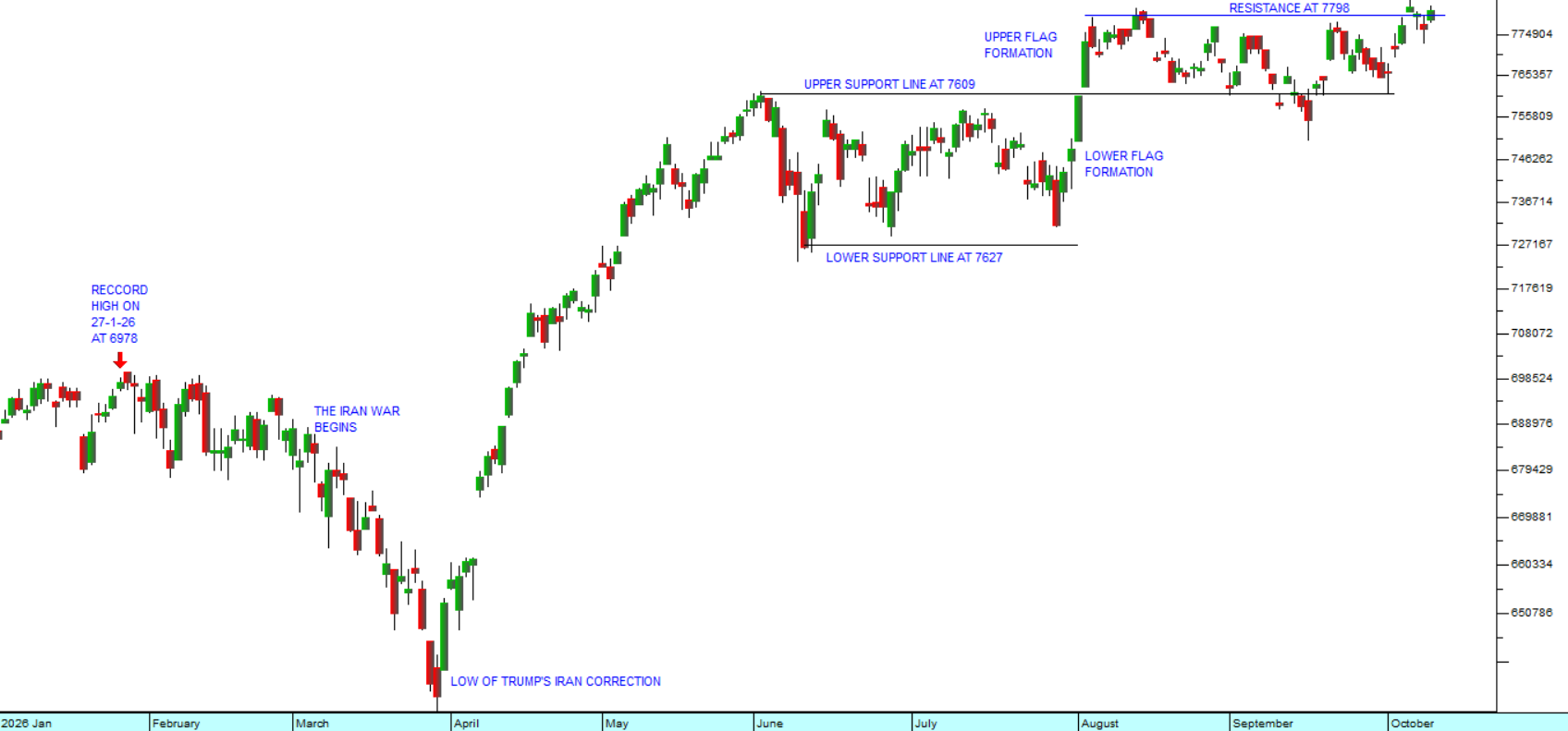
Looking at the chart, the S&P500 index has been moving through a series of protracted sideways markets for the past four months. During that time, technology and the prospects of that technology have not stood still. They have been advancing at a rapid pace.

Our belief is that as soon as the situation in the Middle East is resolved and the oil price comes back to where it was before the war began, the S&P will suddenly begin discounting the impact of the accumulated technical advances and move sharply higher. It will be like removing the lid from a pressure cooker. Consider the chart:

S&P500 Index : January 2026 - 9th of October 2026. Chart by ShareFriend Pro.

So, what we are saying is that considerable bullish potential has been built up by this war and its impact on oil prices. This can be seen from the fact that even with Brent at over $100 a barrel now, the S&P is still making new record highs, based on the exceptional estimates of 3rd quarter earnings and beyond.

There are, of course, those who believe that Brent is about to go much higher – like to $125 per barrel - given the escalation in Yemen with the Houthis and the attacks on the Saudi pipeline. But in our view the underlying direction of the oil price must be downwards as the world moves away from fossil fuels and towards renewables, especially solar.

To be safe, ensure that you have a strict stop-loss level for all the shares in your portfolio. That is the ultimate protection against unexpected downtrends and bear markets. Your absolute rule should be to never lose more than 15% on any share market investment ever – including your dealing costs. Sometimes it is difficult to achieve this, but provided you always choose shares which are free-dealing, it simply becomes a matter of self-discipline. And then if you are able to make several hundred percent on your winners, mathematically, you must be successful over time.


JSE Top 40

101,609.00 (+0.63%)

All Share

109,820.00 (+0.63%)

Financial 15

25,768.00 (+0.53%)

J200
J203
J212
Top Gainers
# Code Name Close (c) % move
1 YRK YORK 234 +20.00%
2 AME AME 6999 +16.65%
3 DLT DELPROP 36 +9.09%
Top Losers
# Code Name Close (c) % move
1 SOH S-OCEAN 76 -30.91%
2 GML GEMFIELDS 69 -16.87%
3 WEZ WESIZWE 37 -7.50%

Top Movers – Charts

Top Gainer: YRK
Top Loser: SOH