Market View
J200 108,146.00 -0.29% J203 115,659.00 -0.34% J210 133,614.00 +1.53% J211 121,811.00 -1.27% J212 25,921.00 -1.43% J213 138,165.00 -1.36%
Winning Shares (Top 5)
Code Name Added Price Latest % Gain % Gain/Year
CAA CA-SALES 2023-08-25 775 1355 +74.84% +25.04%
S32 SOUTH32 2025-12-02 3715 5571 +49.96% +69.87%
CPP COLLINS 2024-05-23 840 1140 +35.71% +15.92%
BLU BLUETEL 2025-01-23 610 802 +31.48% +20.01%
SOL SASOL 2026-02-19 12838 19784 +54.11% +108.51%
Opinions (Top 5)
Code Name Date Action
SOH S-OCEAN 2026-08-21 View

South Ocean (SOH) is a manufacturer of low-voltage electrical cables and an importer of light fittings and electrical accessories. The company has an electrical cable manufacturing plant at Alrode and employs 400 people. The company described itself as, "...an investment holding company, comprising two operating subsidiaries which manufacture low voltage electrical cables, and which holds property for investment purposes." It also owns Anchor Park which is a property company.

In December 2010, this share traded for as much as 245c, but then it fell back on persistent losses to trade at around 22c - on very thin volumes. In its results for the six months to 30th June 2026 the company reported revenue up 30% and headline earnings per share of 8,02c compared with a loss of 9,31c in the previous period.

The company said, "Group revenue for the period ended 30 June 2026 increased by R354.4 million or 30.1% (2025: decreased by R132.1 million or 10.1%) to R1 530.9 million (2025: R1 176.4 million) primarily due to increase commodity prices and an increase in production volumes sold".

The share was in an upward trend until October 2024 and has since been falling and moving sideways on very thin volumes. In our view, it is not practical from private investors.

LBR LIBSTAR 2026-08-21 View

Libstar (LBR) is a recently listed decentralised food and beverage company producing "consumer packaged goods" which raised R3bn in an initial public offer (IPO) in May 2018. It owns the Denny brand which is a leading mushroom supplier, and Lancewood which is known for dairy products and other food brands.

Altogether it makes over 9000 products and has launched 88 new products in the past six months. The company makes private label brands for retailers like Spar, Woolworths, Pick 'n Pay and Shoprite. A centralised head office supports and invests further in autonomous production units.

It supplies capital and expertise and makes acquisitions. The company has spent R60m on coping with COVID-19. Consumer spending is under pressure because of load-shedding, civil unrest, retrenchments, high unemployment the residue of COVID-19, and now developments in central Europe.

This company is entirely dependent on consumer spending. In its results for the year to 31st December 2025 the company reported revenue up 8,2% and headline earnings per share (HEPS) up 21,7%. The company said, "Maintained and expanded market share, particularly in Dairy, Wet Condiments, and Dry Condiments; Improved gross profit margins through disciplined raw material procurement, enhanced capacity utilisation, strategic pricing, and rigorous cost management".

In a pre-close update on 18th June 2026 the company reported revenue up 0,9% and volume growth of 0,3% in the 21 weeks to 31st May 2026. The company said, "The consumer environment remains severely constrained, as evidenced by low-single- digit value growth in the Group's defined retail channel basket".

In a trading statement for the six months to 30th June 2026 the company estimated that HEPS would fall by between 18% and 27,5%. Libstar trades on a multiple of 7,3 and a dividend yield (DY) of 5,97% (20-8-26). Technically, the share has been in a downward trend for some time and has now entered a sideways trend.

EXX EXXARO 2026-08-21 View

Exxaro (EXX) is a BEE coal company with interests in iron and heavy minerals. It has interests in Australia, America and Europe. It is a provider of coal to Eskom's Medupi power station. The company is trying to improve coal production from 48m tons presently to about 60m tons by 2022, but this policy might be changed due to the lower demand for coal on the world market.

This is an immensely cash-generative operation that is usually profitable depending on what happens to the price of coal. The demand for coal both locally and in the export market has been strong, but the shift towards renewable energy is seen as a long-term threat to the business.

It is becoming increasingly difficult to obtain funding for new coal-fired power stations as banks feel the pressure from environmental groups. On 9th April 2021, the company announced that it had sold its interest in Exxaro Coal Central (Pty) Ltd and Leeuwpan Coal Mine operation.

Obviously, the Ukraine conflict initially had a beneficial impact on this share through higher commodity prices, but that effect has now disappeared. The company announced that, with the lower price of coal, it was no longer viable to transport coal to port by truck - something it had been forced to do because of the inefficiency of the South African rail and port systeMs. In its results for the six months to 30th June 2026 the company reported revenue up 7% and headline earnings per share (HEPS) down 20%.

The company said, "Coal production increased 11% to 21.5Mt, strengthened by improved output at Grootegeluk and exceptional ramp-up at Matla. Coal sales increased 4% to 19.9Mt, driven by higher Eskom offtake at Matla and stronger export volumes". Exxaro remains a commodity play. Technically, the share is volatile, but has been in a volatile upward trend since November 2015.

Within that, it has been moving sideways and downwards since September 2022. 

DRD DRDGOLD 2026-08-21 View

DRDGOLD (DRD) was listed in 1895 and is the JSE's oldest listed company. It was followed by SA Breweries which was listed in 1897 and has now been acquired by Anheuser Busch. DRD is now a gold surface treatment operation which is at an all-in sustaining cost of extraction of just over R627247 per kilogram which compares to the average received gold price of R917996.

They are re-treating surface dumps which still have traces of gold that can be profitably extracted with modern extraction methods. The benefit of this type of operation is that it is far less risky than underground gold mining operations because it has far less union exposure and has none of the expenses or difficulties of an underground operation.

Its life and grade, and hence its profitability, are precisely known. The share tends to be volatile because it depends on the current price of gold, but the company has a debt-free balance sheet and strong free cash flows. A deal was concluded for Sibanye to swap out its surface dumps for an additional 265m DRD shares - which took Sibanye to a shareholding of 38%.

Then on 10th January 2020, Sibanye announced that it had exercised its option to increase its stake to 50,1% at a cost of R1086m. The CEO of DRD Gold, Niel Pretorius, wants to join up with other tailing projects on the West Rand to create a massive unified re-processing operation.

The company is building a 20mw solar and battery facility. In its results for the year to 30th June 2026 the company reported revenue up 42% and headline earnings per share (HEPS) up 89%. The company said, "Group gold production exceeded the upper end of guidance by more than 5 500 ounces and, combined with disciplined cost control and continued strength in the gold price, generated robust cash flows and an excellent financial performance".

Technically, the share made a high of 2458c on 9th May 2023 and then began a downward trend. It broke up through its long-term downward trendline on 3rd July 2024 at 1673c indicating a new upward trend. That upward trend accelerated with the rise in the US dollar price of gold to above $5000 per ounce, but had fallen back with the current correction in the gold price.

A new upward trend appears to be beginning from August 2026. It remains a volatile commodity share subject to the international gold price.

CSB CASHBIL 2026-08-21 View

Cashbuild (CSB) is the largest retailer in Southern Africa of building materials and related hardware, concentrating on the home improvements market. In the currently depressed economies of Southern Africa, most of the company's growth comes from opening new stores. Clearly, this is a share which is positioning itself for survival and to benefit from any general recovery in economic conditions in Southern Africa.

In its results for the six months to 28th December 2025 the company reported revenue up 3% and headline earnings per share (HEPS) up 16%. The company said, "Revenue for stores in existence prior to July 2024 (pre-existing stores - 307 stores) increased by 1% and the 15 new, refurbished and acquired stores contributed 2% growth.

Transactions through the tills increased by 4%. Selling price inflation was 0.8 % at the end of December 2025." In an operational update for the third quarter to 31st March 2026 the company reported revenue up 9% with 4% coming from its 301 existing stores and 5% from 16 new stores.

Selling inflation was 0,6%. In an operation update for the 4th quarter to 30th June 2026 the company reported revenue up 6% and selling inflation of 1,5%. In a trading statement for the 52 weeks to 28th June 2026 the company estimated that HEPS would fall by between 5% and 10%. Technically, the share is moving sideways at the bottom of a long downward trend.

It is now at 11899c (19-8-26), with a P:E of 10,41 and a dividend yield of 4,66%. Cashbuild is an extremely well-managed company and well-positioned to take advantage of any improvement in local economic conditions since the advent of the government of national unity (GNU), but it is in a tough and highly competitive industry that has been impacted by the sharp rise in fuel prices. 

Winning Share: BLU
Opinion: DRD
A New Record High  (2026-08-16)

A couple of weeks ago we wrote an article about the sideways market that the S&P500 was in at the time. In that article we pointed out that while the market had been moving sideways for three months, the actual companies which the market represented had been continuing to grow and develop. We…

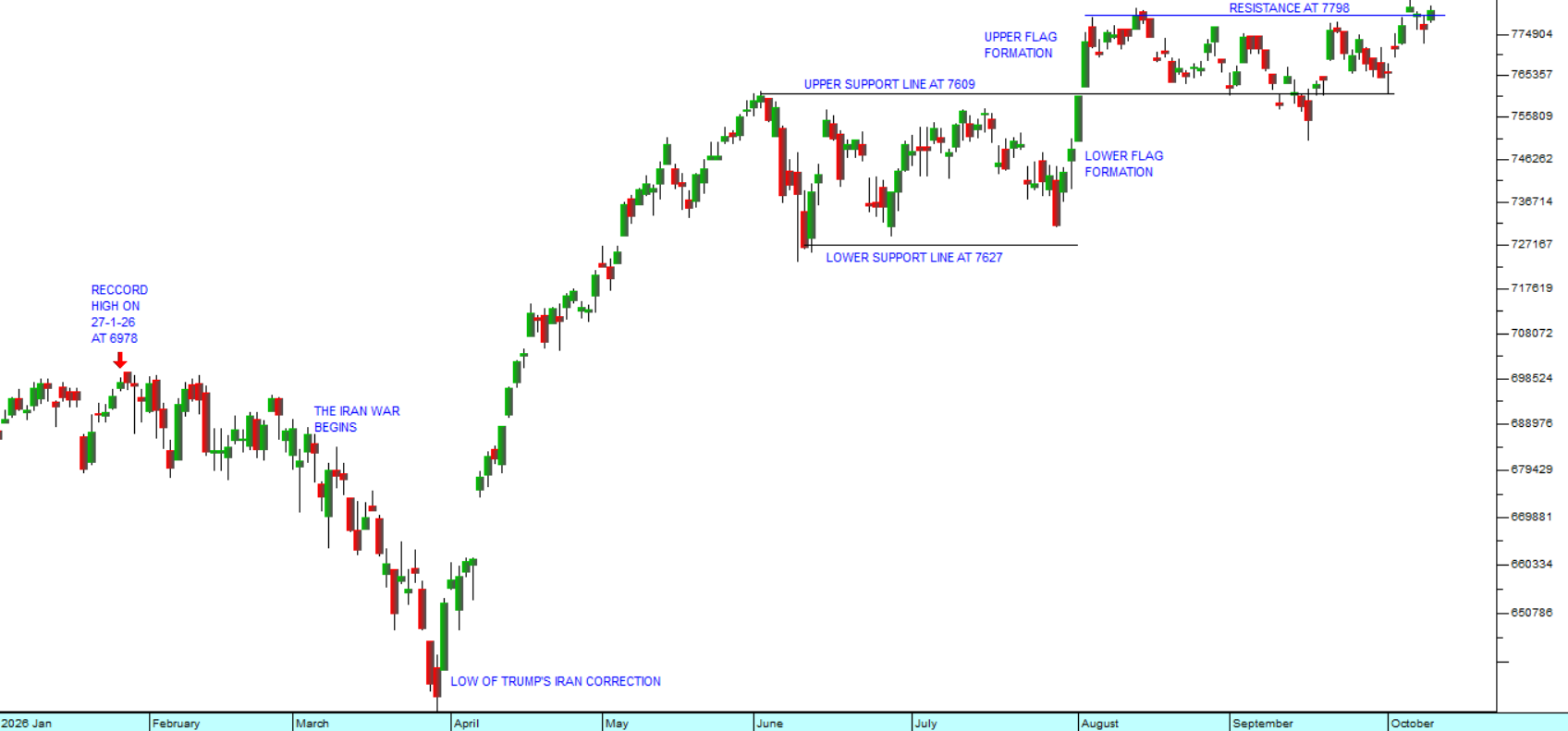
A couple of weeks ago we wrote an article about the sideways market that the S&P500 was in at the time. In that article we pointed out that while the market had been moving sideways for three months, the actual companies which the market represented had been continuing to grow and develop. We anticipated that the market would break to the upside out of that flag formation and that when it did it would have to catch up the growth of the previous three months. Consider the chart:

S&P500 Index :14th of May 2026 - 14th of August 2026. Chart by ShareFriend Pro.

The chart shows how the S&P was moving sideways between the previous record high of 7609 made on the 6th of June 2026 and the low of 7267 made on the 10th of June 2026. Then on the 4th of August 2026 the S&P broke strongly to the upside and made a series of new record highs – just as we expected.

From a fundamental perspective, lower-than-expected inflation and a slower level of job creation gave the market hope that the Federal Reserve Bank would not raise interest rates again at the next meeting of the monetary policy committee (MPC) on the 15th and the 16th September 2026. The consumer price index (CPI) fell to 3,4% in July 2026 from June’s figure of 3,5%. The drop gave investors hope that the worst of the effects of the Iran fuel price hike were behind and that inflation was again moving down.

The producer price inflation figure for the year to the 31st of July 2026 was also encouraging at 4,7% - significantly lower than June’s figure of 5,5% and reflecting the drop-off in the oil price. We believe that interest rates in America will probably remain unchanged until the end of this year.

The stalemate in Trump’s war and its impact on world oil prices appears to have stabilized with North Sea Brent Oil hovering roughly $15 per barrel above where it was before the war began. While developments in the war are still a factor, investors’ attention is back to focusing on the figures coming out of the companies which make up the S&P, especially the so-called Magnificent Seven.

In Q2 2026, Apple was the hero with earnings per share (EPS) up an impressive 29% year-on-year, followed by Microsoft’s 32% gain. Alphabet, Amazon, Meta, and Tesla delivered solid revenue, above forecast, but this was heavily counterbalanced by massive capital expenditure increases mainly for artificial intelligence infrastructure.

Nvidia is reporting its results for the second quarter in a few days’ time on the 26th of August 2026. Wall Street is anticipating another blowout quarter with analysts looking for exponential growth fuelled by the relentless demand for artificial intelligence infrastructure.

What is also clear to us is that Americans are expecting Trump and the Republicans to perform very badly in the coming November mid-term elections, almost certainly losing the House of Representatives and possibly even the Senate. If this happens, it will make Trump into a “lame dog” president, unable to pass any legislation against Democrat opposition. There is also now the clear possibility that he could be forced to resign as a result of increasingly poor health or because he is impeached.

Whatever happens it is clear that his influence over the stock market is declining rapidly. The market has lost interest in his interminable erratic announcements on Truth Social and is instead caught up in the excitement over the productivity benefits of new technologies.

We expect that the S&P will continue to climb to further new record highs and take all world markets up with it, including the JSE. 

Spur Corporation  (2026-08-11)

Everyone in South Africa knows the Spur chain of restaurants. It has been one of the strongest South African brands for decades. Over the years Spur has branched out into a variety of other well-known brands, built its own manufacturing base to supply raw materials to its restaurant chain and…

Everyone in South Africa knows the Spur chain of restaurants. It has been one of the strongest South African brands for decades. Over the years Spur has branched out into a variety of other well-known brands, built its own manufacturing base to supply raw materials to its restaurant chain and expanded internationally. More recently, it has been capitalising on the move towards online ordering of food with many of its restaurants now participating in what it describes as a “virtual kitchen”.

From an investment perspective, the business has the disadvantage of having a working capital element (stock and debtors) and a large staff throughout the country. These risks are substantially mitigated by the fact that most of its restaurants are owned and run by franchisees who are required to buy all their materials from Spur. An important factor is that at 31st December 2025, Spur had over R400m in the bank and almost no appreciable debt. This means that it is well-positioned to take advantage of any opportunities, while being insulated against external shocks.

Of course, the restaurant business is dependent on consumer spending. So, the company’s 753 restaurants need to be constantly patronised by people looking to eat a meal which they have bought rather than cooked themselves. A large proportion of this is sit-down meals in restaurants, but a growing percentage is take-away food ordered online and then delivered.

The restaurant business is based on the reality that everyone has to eat every day and that a good proportion of people will choose at least several times a month to get a ready-made meal even though it is more expensive. Their ability to do this is dependent on their available discretionary cash – and that depends on such things as the increase in real salary levels and the demands on their take-home pay like the cost of fuel and interest rates.

So, Spur’s business is generally aimed at higher income groups, and its success is a function of their perception of how well-off they are. When times are tight, they cut back on dining out – something which happened earlier this year when Trump decided to start a war with Iran resulting in a sharp increase in the cost of fuel and then later a 25 basis point hike in the level of interest rates.

In our view, the impact of the war in Iran is gradually subsiding. This can be seen in lower price of oil, the rands strength and the fact that the monetary policy committee (MPC) decided to keep interest rates on hold at its most recent meeting on 23rd July 2026. We believe that the oil price will continue to decline steadily over the coming months and years as the world economy adjusts to the new situation and moves more and more towards renewables. In other words, this external shock is really just a “bump in the road” for investors and hence probably represents a buying opportunity.

It their results for the six months to 31st December 2025 the company reported revenue up 8,5% and headline earnings per share (HEPS) up 13,6%. In a trading statement for the year to 30th June 2026 the company estimated that adjusted HEPS would increase by between 5% and 13%. The share trades on a dividend yield (DY) of 6,11% and a price:earnings ratio of 11,26. The DY, particularly is of interest to private investors. Any quality company on the JSE trading on a DY of 5% or more is worthy of your attention.

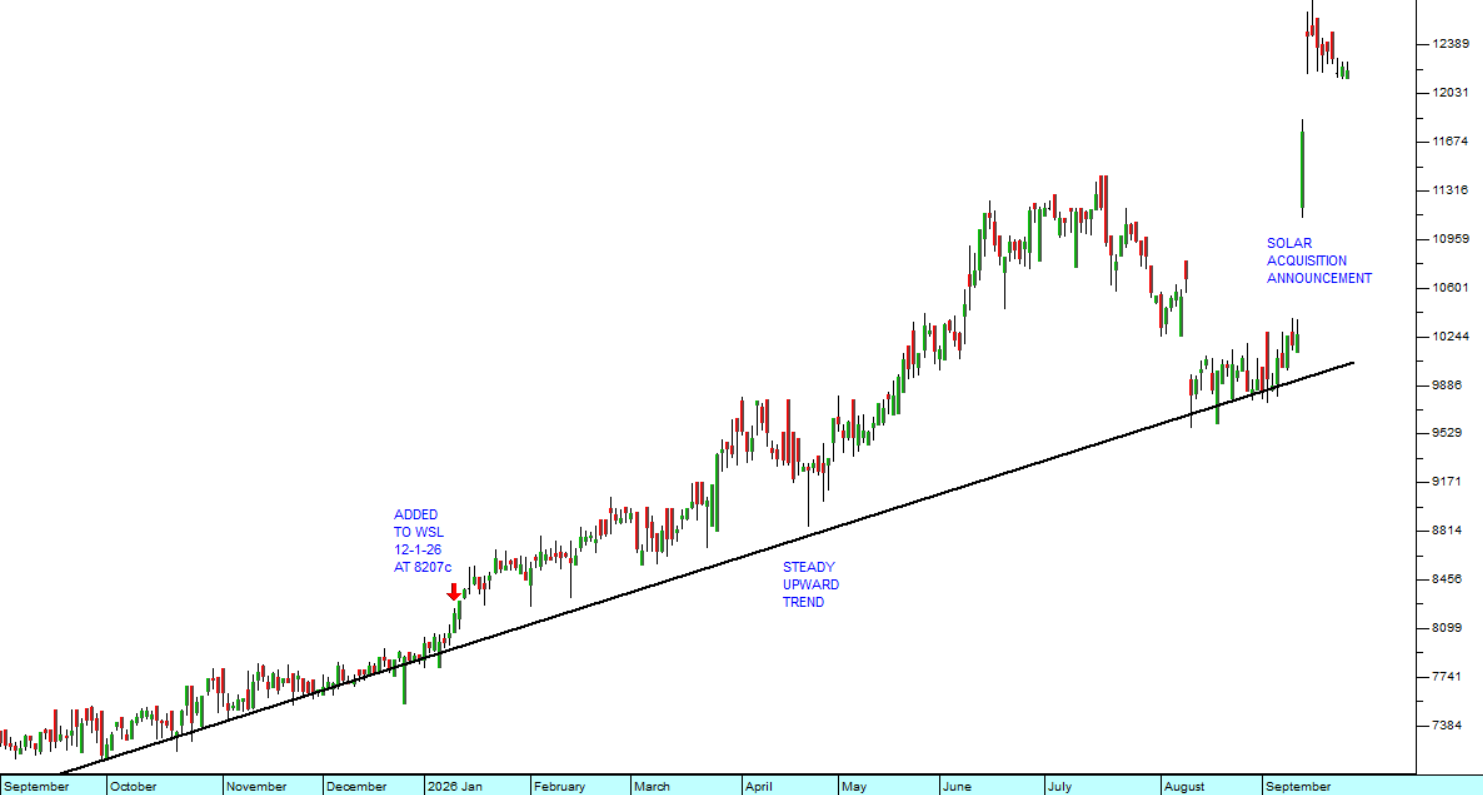
We first added Spur to the Winning Shares List (WSL) on 8th August 2023 at a price of 2488c. Since then, it has been in a steady upward trend paying good dividends which keep growing and maintaining its strong balance sheet. Consider the chart:

Spur (SUR) : June 2023 - 7th of August 2026. Chart by ShareFriend Pro.

We wrote an article about Spur shortly after we added it to the WSL on 16th October 2023 in which we said that we believed that it was “an excellent addition to any private investor’s portfolio”. 

We continue to believe in its long-term investment potential, and we also believe that consumer spending in South Africa will recover as the year progresses and the benefits of our relatively low inflation rate become more apparent.

The Sideways Market  (2026-07-27)

Since its inception in 1960 the JSE Overall index, including dividends, has generated an average compound growth rate of approximately 14,5% per annum in nominal terms. Of course, during that time there have been moments when the index was heavily over-priced – like in October 1987, immediately…

Since its inception in 1960 the JSE Overall index, including dividends, has generated an average compound growth rate of approximately 14,5% per annum in nominal terms. Of course, during that time there have been moments when the index was heavily over-priced – like in October 1987, immediately before the 1987 crash – and moments when it was heavily under-priced like March 1988 immediately after that crash.

Stock market averages or indexes, like the JSE Overall index, over time, always tend to equate to the real growth in the economy - plus the inflation rate. Sometimes investors get overly excited and bid shares up well above their real values and sometimes they become depressed and maudlin, causing shares to fall to record lows. But overall, in the long term, the JSE (and all stock markets around the world) will always go up because of the real growth in their economies and the steady erosion of the purchasing power of paper currencies that we call inflation.

The progress of share market indexes over time could be represented diagrammatically as follows:

Diagram : Market Cycle

The rising straight line represents the real growth of the economy plus the inflation rate, and the curved line shows the theoretical progress of the index through a full cycle. As you can see it fluctuates from being under-priced to being over-priced and back again.

At its lowest point (“A”), after a long downward trend, investor sentiment is balanced between the bulls and the bears (50/50). The negativity of the bears is now being balanced by the realisation that shares are very cheap, and bargain hunters are busy snapping up any loosely held scrip.

As the index begins to move up, sentiment shifts. More and more investors become bullish and there are fewer and fewer bears. Eventually, the index crosses that magical “real value” line (“B”) and the shares become over-priced – but it continues to go up. At this time, about 80% of investors are bullish and only 20% are bearish.  

Eventually, some investors, (the smart money) begin to realise that shares are now over-priced, and they start off-loading their holdings. The point is reached where the bulls and bears are again in balance (“C”) with roughly half of them bullish and the other half bearish (50/50).  

So, what is a sideways market? It is a period when investors as a group are more-or-less evenly divided between the bulls and the bears (i.e. 50/50). For a while neither can gain ascendancy and the index moves sideways. This typically happens at the top and the bottom of the cycle, but it can also happen during the upswing or downswing.

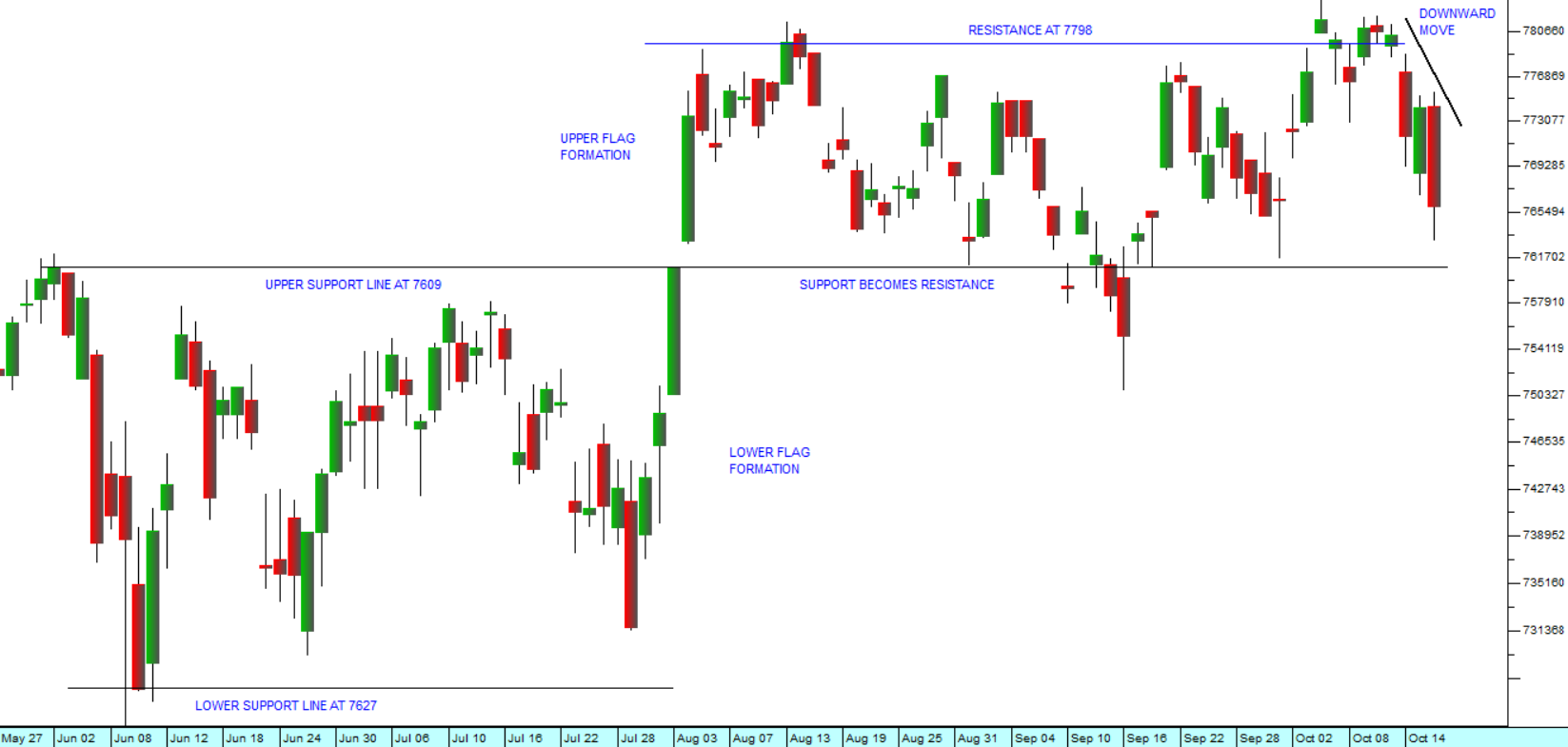
The S&P500 index, for example, right now has been moving sideways since about the end of May 2026 - a period of nearly two months. The shares of the Magnificent Seven have been moving sideways or downwards, but during that time the companies which make up the index have continued to grow and make profits – it is just that investors are worried about where they might go next.

The bears are out in force and there is the added uncertainty of where interest rates might go when the Monetary Policy Committee (MPC) meets again at the end of July. Tesla and Alphabet’s quarterly results were less than wonderful. Investors are suddenly worried about Alphabet’s expected $200bn full-year capex and Tesla’s disappointing profit. And now they are worried about Microsoft, Amazon and Meta which report next.  

Actually, if you consider that Trump has resumed the Iran war and that the Houthis have closed the critical Strait of Bab-el-Mandeb pushing the price of North Sea Brent up to as high as $100, the S&P is doing relatively well. American analysts are calling the market “frothy” or talking about investors “walking on eggshells”.

This does not mean that the upward trend is over or that we are now looking at an impending bear market. It just means that the S&P is pausing to catch its breath after the rapid rise during April and May 2026. Markets never move in a straight line – there are always rallies and corrections and periods of indecision.

In our view, Trump is now facing a terrible dilemma. The November mid-term elections are just 3 months away and his approval rating is disastrous. His traditional MAGA supporters are abandoning him in droves because they really don’t like the high price of fuel. And his bombastic attitude towards the war, which everyone knows he started, is just making the situation far worse. We believe his time is rapidly running out. But we also believe that the AI productivity boom is just beginning and that markets will continue to rise to new record highs. Our view is that the longer this sideways market persists, the stronger will be the upward move when it is finally resolved.    


JSE Top 40

108,146.00 (-0.29%)

All Share

115,659.00 (-0.34%)

Financial 15

25,921.00 (-1.43%)

J200
J203
J212
Top Gainers
# Code Name Close (c) % move
1 ISA ISA 230 +15.00%
2 BAC AFBITCOIN 500 +11.11%
3 GPL GRANPRADE 180 +7.78%
Top Losers
# Code Name Close (c) % move
1 ACS ACSION 870 -21.62%
2 QFH QUANTUM 738 -20.56%
3 PHP PHP 2111 -14.88%

Top Movers – Charts

Top Gainer: ISA
Top Loser: ACS