Market View
J200 109,535.00 +0.13% J203 116,828.00 +0.10% J210 138,541.00 -0.54% J211 120,867.00 -0.13% J212 26,014.00 +1.22% J213 137,916.00 +0.57%
Winning Shares (Top 5)
Code Name Added Price Latest % Gain % Gain/Year
SDO STADIO 2024-06-29 525 1239 +136.00% +63.07%
TBS TIGBRANDS 2023-12-01 18295 27130 +48.29% +17.66%
DIB DIPULA-B 2024-09-04 455 679 +49.23% +24.96%
SUR SPURCORP 2023-08-08 2488 4445 +78.66% +25.80%
AME AME 2026-08-04 7070 7070 +0.00% +0.00%
Opinions (Top 5)
Code Name Date Action
AFT AFRIMAT 2026-08-26 View

Afrimat (AFT) is an open-pit mining company that supplies composites, construction materials and other commodities to a range of industries in Southern Africa. Until the end of 2015, Afrimat was one of the best performing shares on the JSE. The share broke up out of a 3-year sideways pattern which included the COVID-19 crisis.

The company benefited from rising iron ore prices due to supply constraints in Brazil and rising demand from China. On 17th August 2020, the company announced that it had bought a mining exploration company (Coza Mining) involved in looking for iron and manganese in the Northern Cape for R300m.

On 20th March 2022 the company announced that its listing had been moved from Basic Materials Construction and Materials to the General Mining sector which better reflected its business.  In its results for the year to 28th February 2026 the company reported revenue up 20,3% and headline earnings per share (HEPS) up 32,5%. The company said, "Afrimat remains profitable, with operating profit which increased by 9.6% to R523,7 million (FY2025: R477,7 million).

The increase in the cost of sales is primarily due to higher-than-normal repairs and maintenance in the Cement business to improve the performance of the plant". In a pre-close update on the first quarter the company reported, "...reduced Rand-denominated iron ore export revenues at mine gate, driven by a stronger Rand, lower international iron ore prices and significantly higher shipping rates".

Like all commodity companies, Afrimat's shares have declined with the drop in commodity prices, but this company is well diversified making it less risky. The share has broken down through support at around 3400c and looks to fall further. We suggest waiting for a clear break up through the long-term downward trendline before investigating further. 

GFI GFIELDS 2026-08-26 View

Gold Fields (GFI) is a relatively high-cost international gold mining house with a single mine in South Africa - South Deep. South Deep was bought by Gold Fields in 2006 and it has struggled to make the mine profitable, pouring in a total of R32bn (R22bn purchase price plus R10bn in development costs) into it over the past 14 years.

Brett Kebble once described South Deep as, "The world's most expensive long drop...". South Deep is 3 kilometres deep and a very difficult mine with many technical complications, but it is the second largest unmined gold resource in the world - hence Gold Field's persistence. Gold Fields is working with an independent power producer (IPP) to build a 50MW project in SA.

The company has spent a total of $502m over the past two years to ensure that Damang and Gruyere (international operations) would produce 2 million ounces a year for the next ten years. South Deep now has R800m less in costs and R400m less in capital expenditure. The company is focusing on bringing the new Salares Norte gold mine in Chile into production.

On 11th July 2022 the company said that it would list on the Toronto Stock Exchange and that it would adopt a dividend policy of paying between 30% and 45% of profits out.  Its protracted investment in South Deep is definitely beginning to pay off with output expected to rise by about 25% over the next 4 years. On 12th August 2024 the company announced that it had acquired the remaining 50% of Osisko Mining for $1,57bn (R29bn).

In its results for the six months to 30th June 2026 the company reported attributable profit up 81% and headline earnings per share (HEPS) of 208c (US) compared with 115c in the previous period. The company said, "During the six months ended 30 June 2026, 61% of adjusted free cash flow(1) was paid to shareholders and the Company stepped up its share buy-back programme and completed share repurchases of US$300 million between March and July 2026". Technically, the share is volatile and subject to shifts in the international price of gold, but it has been in a strong upward trend over the past five years.

It remains a volatile commodity play. It was added to the Winning Shares List (WSL) on 4th February 2025 at a price of 32915c. It has subsequently risen to 76609 (25-8-26) after some profit taking.

NPH NORTHAM 2026-08-26 View

Northam (NPH) is a fully empowered platinum mining company which operates in the Bushveld complex. In the current difficult legislative environment where the 3rd mining charter is regarded as unfriendly from an investment point of view, Northam is probably the only mining house which is buying up new properties.

It has come to an arrangement with Anglo American to exploit a property adjacent to its Zondereinde mine (the deepest platinum mine in South Africa). It has also bought Eland Platinum from Glencore for R175m which it intends to re-start at a cost of R2bn. On 29th October 2019, the company announced the acquisition of Maroelabult for R20m which is west of the Eland mine with an analogous ore body.

This accelerated the bringing to production of Eland and required very little capital. With the Eland mine, Northam got a concentrator plant which can process up to 250 000 tons a month. In return, Glencore got the right to market all of Northam's chrome. Zondereinde is a deep-level mine which has all the problems associated with mining at depth, while Booysendal is a shallow mechanised mine which is much easier to manage.

Both mines are profitable, but the empowerment structure results in Northam always reporting a loss because of the preference dividend that must be paid. Once Booysendal is complete the company should generate strong cash flows. The appointment of Mcebisi Jonas (former South African Minister of Finance) and Jean Nel (previously CEO of Aquarius Platinum) as non-executive directors has significantly added to the strength of the board.

The company has the stated intention of doubling its workforce as it strives to become a major PGM supplier in the world. With plans to increase production of PGM's over the next few years to 1 million ounces, this is probably one of the better options in the industry. In its results for the six months to 31st December 2025 the company reported sales revenue up 60% and headline earnings per share (HEPS) up over 1000% at 1524c.

The company paid a dividend of R2,8bn or 700c per share. At the end of the period the company had R2,8bn in debt with R9,3bn in cash and cash-equivalents. In a production update for the year to 30th June 2026 the company reported record chrome concentrate production of 1,69m ounces and 4E metals sold of 1,087m ounces.

The company said, "Strong production growth was recorded at Eland, with marginal improvements at Zondereinde ahead of the commissioning of 3 shaft, and at Booysendal on the back of further productivity gains". In a trading statement for the year to 30th June 2026 the company estimated that HEPS would increase to between 3 006.1c and 3 082.3c compared with 380.8c in the previous period.

The share has been in a downward trend since January 2026 but is now turning up. It remains a volatile commodity share. On 25th August 2026 the company announced that it had received an unsolicited approach from a major producer in the South African PGM industry. Valterra and Sibanye are possible suitors. 

MDI MASTDRILL 2026-08-26 View

Master Drilling (MDI) is a South African company that specialises in drilling exploration and other holes for the mining industry, and which has diversified into drilling for hydro-electrical projects and construction. The company has moved away from the South African mining industry and now provides services in North and South America, Europe and elsewhere.

It has developed a new horizontal drilling technology, or tunnel boring machine, which could revolutionise the mining industry world-wide. This technology enables the drilling of horizontal tunnels or tunnels which are inclined up or down by 12 degrees. It is much quicker and cheaper than the traditional blast and clear methods currently in use.

At the moment it requires three operators, but the company is working on a completely automated remote-controlled version. In its results for the six months to 30th June 2026 the company reported revenue up 17% and headline earnings per share (HEPS) up 4,1% (rands). The company said, "Net asset value per share in USD up 11.5% from 148 cents to 165 cents - Revenue pipeline of USD 1 062.3 million - Committed order book of USD 400.9 million".

The share trades on a price:earnings (P:E) multiple of 4,7 (25-08-2026) - which looks like good value. We regard the company's horizontal drilling technology as a potentially disruptive technology in the mining industry which extends the life of some mines and makes others viable again.

So, while this is a risky share, because it is linked to the commodities markets, it has the potential to offer strong growth because of the new technologies which it has that have the potential to revolutionise the mining industry. In our view, this is an interesting company with the potential to perform well as its new horizontal boring machine gains traction.

GND GRINDROD 2026-08-26 View

Grindrod (GND) is an international freight and financial services company which operates in twenty-eight countries. In mid-June 2018, Grindrod unbundled and separately listed its loss-making shipping division (Grinship - GSH). This accounts for the "cliff" in the share price at that time.

The company is now focused on its two remaining divisions - freight and financial services. Grindrod owns the North-South railway line from Beitbridge to Victoria Falls as well as port terminals at Richards Bay, Natal, Walvis Bay, Namibia, and Maputo. The company is positive on the growth of its financial services division which is about 30% of the business.

The company is focused on getting its retail banking division involved with small and medium sized businesses. The conflict in northern Mozambique is a problem for this share. The flooding in Natal caused five of their sites to be suspended for several weeks. On 6th November 2024 the company reported that it had closed down all its rail, port and terminal operations in Mozambique because of the closure of the Lebombo border post due to violence on the Mozambique side.

A few days later on 8th November 2024, the company reported that the restrictions at Lebombo had been lifted - but the event showed Grindrod's vulnerability and exposure to unrest in Mozambique. In its results for the six months to 30th June 2026 the company reported port volumes up 29% and earnings before interest taxation depreciation and amortisation (EBITDA) up 52%.

Revenue was up 19% and headline earnings per share (HEPS) was unchanged. The company said, "The prior period earnings included one-off net profits of R902.8 million relating to foreign currency translation reserves released on both the buy-up of the remaining 35% interest in the Matola terminal joint venture and the exit of the marine fuel trading joint venture".

Technically, the share has been rising since February 2022. It completed a reverse "head-and-shoulders" formation in August 2025 - which is very bullish. It has taken a knock from the war in Iran, but should recover as that situation becomes clearer. We expect the share to continue to perform well despite being volatile. 

Winning Share: SUR
Opinion: NPH
Harmony Takes Off  (2026-08-24)

The gold price has been in a persistent correction since its record high on 28th January 2026. It has been in what technical analysts call a descending flag formation which we have drawn you attention to on several occasions. As with any formation we are looking for the direction of the breakout…

The gold price has been in a persistent correction since its record high on 28th January 2026. It has been in what technical analysts call a descending flag formation which we have drawn you attention to on several occasions. As with any formation we are looking for the direction of the breakout from that formation to give a clear idea of the future trend. In the case of gold, we have always been confident that it would break to the upside – and that is what it did last week on 19th August 2026. Consider the chart:

Gold price in US dollars : August 2022 - 21st Of August 2026. Chart by ShareFriend Pro.

The chart shows the US dollar price of gold since August 2022. It broke up out of a long-term sideways pattern in March 2024, and we drew your attention to that in the Confidential Report at the time. The chart shows how the upward trend was paused in 2025 until the precious metal broke above resistance at $3424 and it shows the all-time record high of $5305 on 28th January 2026.

The flag formation has taken place between two parallel downward sloping trendlines, showing how gold lost about $1000 over 5 months then found support before breaking to the upside.

As a private investor you should be thinking about which shares would have enabled you to capitalise on gold’s amazing run – and one of the best was Harmony. Of course, gold shares are always going to be speculative and risky, but under the right circumstances they can provide an excellent long-term investment.

In the case of Harmony, the key, for us, was its purchase of the Mponeng gold mine for $200m in September 2020. This was a very brave, potentially dangerous acquisition and we waited for some time before recognising that they were making a success of it. Mponeng is the deepest mine in the world. It is currently mining at depths of around 3800 meters with plans to go deeper to 4200 meters. This means that it is operating 2 kilometres below sea level from the Highveld near Carletonville. At those depths the grade is excellent - around 11,27 grams per ton – more than double the average grade for South African gold mines. The problem is that mining at those extreme depths is expensive and potentially very dangerous. It is the very definition of a high-risk, high-return investment.

We added Harmony to the Winning Shares List (WSL) on 16th November 2023 at a price of 9920c per share. It reached an all-time high of 40841c on 28th January this year before falling back as gold corrected. Since 3rd August 2026 it has been moving up strongly again as gold recovered. Consider the chart:

Harmony (HAR) : August 2023 - 21st of August 2026. Chart by ShareFriend Pro.

Harmony published an excellent trading statement on Friday last week, predicting that its headline earnings per share (HEPS) would increase by between 90% and 105% in US dollars. 

Altogether, Harmony has risen by more than 250% since we added it to the WSL nearly 3 years ago and we believe it will continue to perform well – but it remains a commodity share and hence both volatile and risky.

A New Record High  (2026-08-16)

A couple of weeks ago we wrote an article about the sideways market that the S&P500 was in at the time. In that article we pointed out that while the market had been moving sideways for three months, the actual companies which the market represented had been continuing to grow and develop. We…

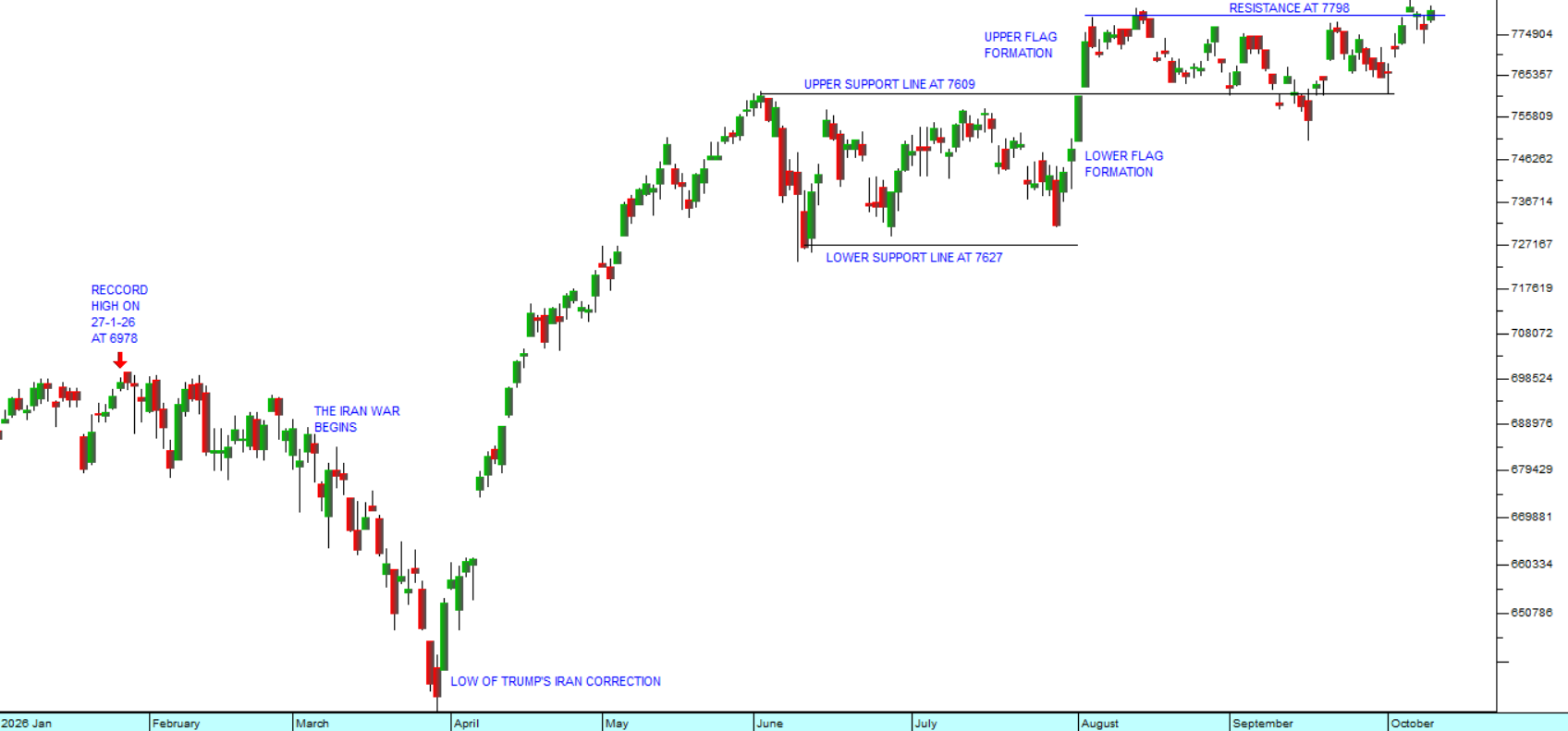
A couple of weeks ago we wrote an article about the sideways market that the S&P500 was in at the time. In that article we pointed out that while the market had been moving sideways for three months, the actual companies which the market represented had been continuing to grow and develop. We anticipated that the market would break to the upside out of that flag formation and that when it did it would have to catch up the growth of the previous three months. Consider the chart:

S&P500 Index :14th of May 2026 - 14th of August 2026. Chart by ShareFriend Pro.

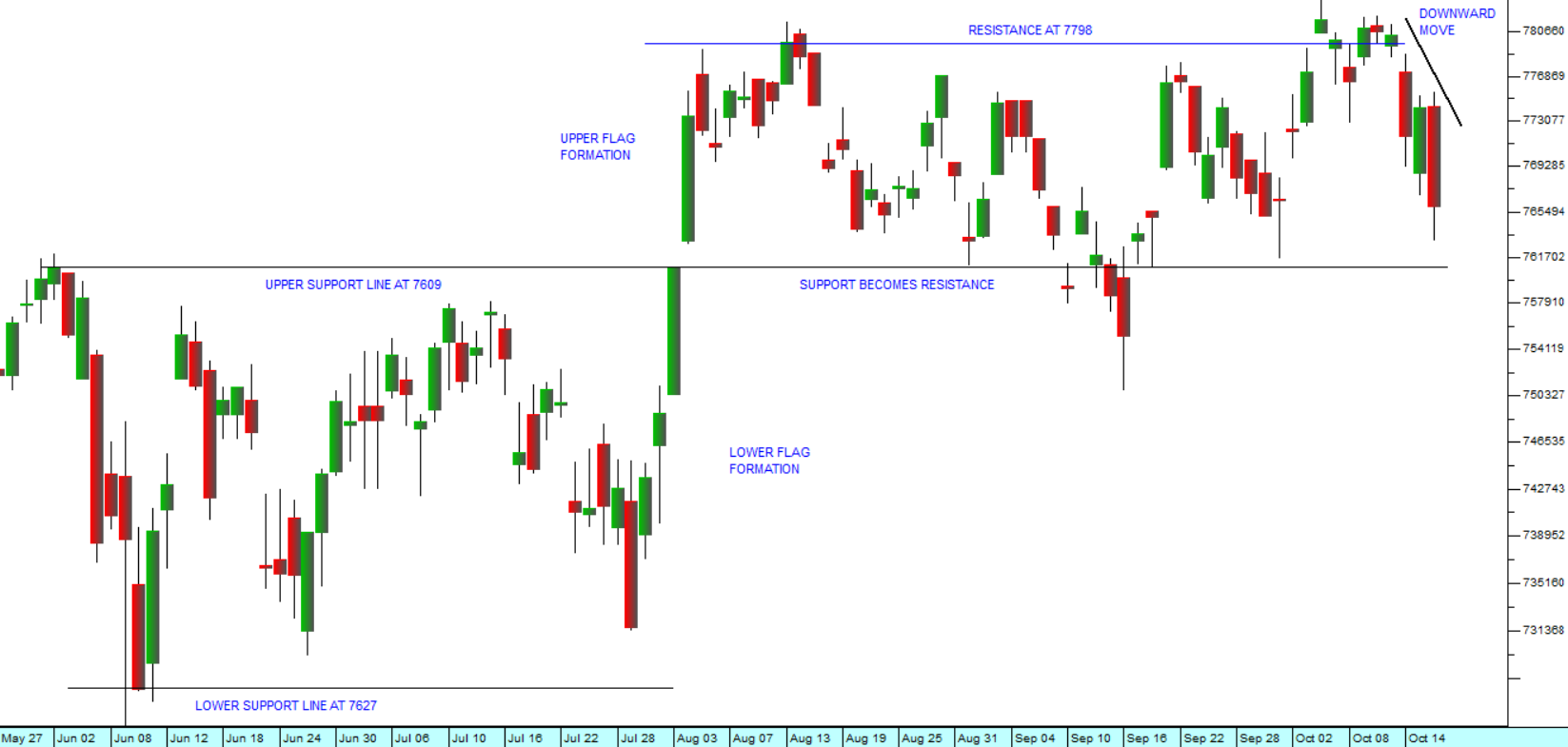
The chart shows how the S&P was moving sideways between the previous record high of 7609 made on the 6th of June 2026 and the low of 7267 made on the 10th of June 2026. Then on the 4th of August 2026 the S&P broke strongly to the upside and made a series of new record highs – just as we expected.

From a fundamental perspective, lower-than-expected inflation and a slower level of job creation gave the market hope that the Federal Reserve Bank would not raise interest rates again at the next meeting of the monetary policy committee (MPC) on the 15th and the 16th September 2026. The consumer price index (CPI) fell to 3,4% in July 2026 from June’s figure of 3,5%. The drop gave investors hope that the worst of the effects of the Iran fuel price hike were behind and that inflation was again moving down.

The producer price inflation figure for the year to the 31st of July 2026 was also encouraging at 4,7% - significantly lower than June’s figure of 5,5% and reflecting the drop-off in the oil price. We believe that interest rates in America will probably remain unchanged until the end of this year.

The stalemate in Trump’s war and its impact on world oil prices appears to have stabilized with North Sea Brent Oil hovering roughly $15 per barrel above where it was before the war began. While developments in the war are still a factor, investors’ attention is back to focusing on the figures coming out of the companies which make up the S&P, especially the so-called Magnificent Seven.

In Q2 2026, Apple was the hero with earnings per share (EPS) up an impressive 29% year-on-year, followed by Microsoft’s 32% gain. Alphabet, Amazon, Meta, and Tesla delivered solid revenue, above forecast, but this was heavily counterbalanced by massive capital expenditure increases mainly for artificial intelligence infrastructure.

Nvidia is reporting its results for the second quarter in a few days’ time on the 26th of August 2026. Wall Street is anticipating another blowout quarter with analysts looking for exponential growth fuelled by the relentless demand for artificial intelligence infrastructure.

What is also clear to us is that Americans are expecting Trump and the Republicans to perform very badly in the coming November mid-term elections, almost certainly losing the House of Representatives and possibly even the Senate. If this happens, it will make Trump into a “lame dog” president, unable to pass any legislation against Democrat opposition. There is also now the clear possibility that he could be forced to resign as a result of increasingly poor health or because he is impeached.

Whatever happens it is clear that his influence over the stock market is declining rapidly. The market has lost interest in his interminable erratic announcements on Truth Social and is instead caught up in the excitement over the productivity benefits of new technologies.

We expect that the S&P will continue to climb to further new record highs and take all world markets up with it, including the JSE. 

Spur Corporation  (2026-08-11)

Everyone in South Africa knows the Spur chain of restaurants. It has been one of the strongest South African brands for decades. Over the years Spur has branched out into a variety of other well-known brands, built its own manufacturing base to supply raw materials to its restaurant chain and…

Everyone in South Africa knows the Spur chain of restaurants. It has been one of the strongest South African brands for decades. Over the years Spur has branched out into a variety of other well-known brands, built its own manufacturing base to supply raw materials to its restaurant chain and expanded internationally. More recently, it has been capitalising on the move towards online ordering of food with many of its restaurants now participating in what it describes as a “virtual kitchen”.

From an investment perspective, the business has the disadvantage of having a working capital element (stock and debtors) and a large staff throughout the country. These risks are substantially mitigated by the fact that most of its restaurants are owned and run by franchisees who are required to buy all their materials from Spur. An important factor is that at 31st December 2025, Spur had over R400m in the bank and almost no appreciable debt. This means that it is well-positioned to take advantage of any opportunities, while being insulated against external shocks.

Of course, the restaurant business is dependent on consumer spending. So, the company’s 753 restaurants need to be constantly patronised by people looking to eat a meal which they have bought rather than cooked themselves. A large proportion of this is sit-down meals in restaurants, but a growing percentage is take-away food ordered online and then delivered.

The restaurant business is based on the reality that everyone has to eat every day and that a good proportion of people will choose at least several times a month to get a ready-made meal even though it is more expensive. Their ability to do this is dependent on their available discretionary cash – and that depends on such things as the increase in real salary levels and the demands on their take-home pay like the cost of fuel and interest rates.

So, Spur’s business is generally aimed at higher income groups, and its success is a function of their perception of how well-off they are. When times are tight, they cut back on dining out – something which happened earlier this year when Trump decided to start a war with Iran resulting in a sharp increase in the cost of fuel and then later a 25 basis point hike in the level of interest rates.

In our view, the impact of the war in Iran is gradually subsiding. This can be seen in lower price of oil, the rands strength and the fact that the monetary policy committee (MPC) decided to keep interest rates on hold at its most recent meeting on 23rd July 2026. We believe that the oil price will continue to decline steadily over the coming months and years as the world economy adjusts to the new situation and moves more and more towards renewables. In other words, this external shock is really just a “bump in the road” for investors and hence probably represents a buying opportunity.

It their results for the six months to 31st December 2025 the company reported revenue up 8,5% and headline earnings per share (HEPS) up 13,6%. In a trading statement for the year to 30th June 2026 the company estimated that adjusted HEPS would increase by between 5% and 13%. The share trades on a dividend yield (DY) of 6,11% and a price:earnings ratio of 11,26. The DY, particularly is of interest to private investors. Any quality company on the JSE trading on a DY of 5% or more is worthy of your attention.

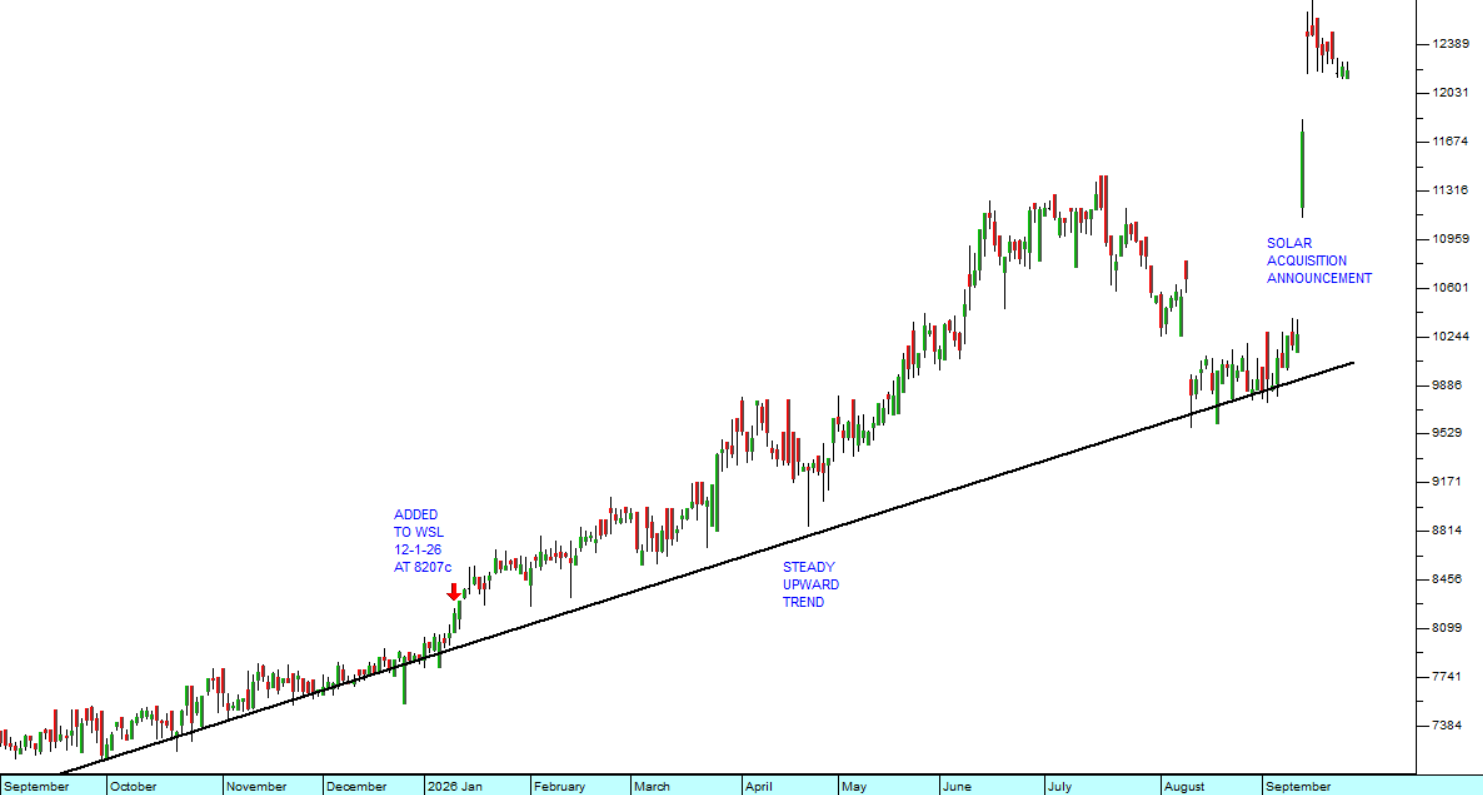
We first added Spur to the Winning Shares List (WSL) on 8th August 2023 at a price of 2488c. Since then, it has been in a steady upward trend paying good dividends which keep growing and maintaining its strong balance sheet. Consider the chart:

Spur (SUR) : June 2023 - 7th of August 2026. Chart by ShareFriend Pro.

We wrote an article about Spur shortly after we added it to the WSL on 16th October 2023 in which we said that we believed that it was “an excellent addition to any private investor’s portfolio”. 

We continue to believe in its long-term investment potential, and we also believe that consumer spending in South Africa will recover as the year progresses and the benefits of our relatively low inflation rate become more apparent.

JSE Top 40

109,535.00 (+0.13%)

All Share

116,828.00 (+0.10%)

Financial 15

26,014.00 (+1.22%)

J200
J203
J212
Top Gainers
# Code Name Close (c) % move
1 OAO OANDO 20 +66.67%
2 LAB LABAT 3 +50.00%
3 EUZ EUROMET 34 +25.93%
Top Losers
# Code Name Close (c) % move
1 WEZ WESIZWE 37 -17.78%
2 MTU MANTENGU 22 -12.00%
3 RNG RANGOLD 378 -11.06%

Top Movers – Charts

Top Gainer: OAO
Top Loser: WEZ