Market View
J200 101,334.00 -1.76% J203 109,105.00 -1.55% J210 116,833.00 -5.67% J211 118,987.00 +0.74% J212 25,219.00 +0.00% J213 134,748.00 +0.37%
Winning Shares (Top 5)
Code Name Added Price Latest % Gain % Gain/Year
OCT OCTODEC 2025-08-21 1100 1787 +62.45% +56.57%
IOC IOCO 2024-11-06 220 405 +84.09% +44.42%
MTH MOTUS 2025-08-27 10360 11185 +7.96% +7.32%
DTC DATATEC 2024-10-26 3950 8052 +103.85% +54.00%
KRO KAROO 2024-11-27 76000 101306 +33.30% +18.14%
Opinions (Top 5)
Code Name Date Action
SPP SPAR 2026-09-29 View

29-09-2026   Spar (SPP) runs a chain of supermarkets across Southern Africa with 2402 stores. It also operates the Build-It chain in hardware and building materials and the Tops Liquor chain. It has operations in Southern Ireland under the name "BWG" which operates through 1392 stores and the Spar chain of 388 stores in Switzerland.

As a group, Spar is a very serious competitor in the South African retail industry, making extensive use of franchising to expand its network. The development of the new Polish enterprise has been frustrated by COVID-19. Its diversification into Ireland and Switzerland gives it a solid rand-hedge component which does not appear to be reflected in its multiple.

In its results for the 26 weeks to 27th March 2026 the company reported turnover up 3,6% and headline earnings per share (HEPS) down 53,9%. The company said, "Group gross profit margin at 10.5%, broadly in line with the Prior Period (10.7%), reflecting resilience in the underlying business and a positive contribution from Ireland.

Operating profit of R740.5 million (Prior Period: R1 353.7 million); operating profit before extraordinary items of R882.0 million (Prior Period: R1 464.1 million)". In an operational update on 28th September 2026 the company said, "FY2026 is expected to underperform FY2025, with the pressure concentrated in Southern Africa, specifically in Groceries & Liquor". In our view, the share is now becoming under-priced at current levels and could represent something of a bargain.

It would be best to wait until it breaks above its long-term downward trendline or at least its 65-day exponential moving average (which may be imminent) before investigating further. On 11th June 2025 Business Day reported that Spar's CEO, Max Oliva, had resigned with effect from 1st July 2025.

On 20th February 2026 the company announced that Angelo Swartz had resigned as CEO with effect from 28th February 2026 and will be replaced by Reeza Isaacs. The news caused the share price to fall.

WEZ WESIZWE 2026-09-29 View

Wesizwe (WEZ) is a miner of platinum group metals through its development of the Bakubung Platinum Mine (BPM). The company is developing a mine to access the Merensky and Upper Group 2 (UG2) resources. The mine is near Rustenburg on the Western limb of the Bushveld complex. The company also owns 17,1% of projects 1 and 3 of Maseve Investments.

In its results for the year to 31st December 2025 the company reported headline earnings per share (HEPS) of 9,86c compared with a loss of 12,23c in the previous period. The company said, "...the Group experienced a material cybersecurity incident during the 2024 financial year which resulted in management being unable to provide sufficient and appropriate audit evidence in respect of certain transaction balances and underlying general ledger data".

The share has fallen from a high of 197c in October 2021 to levels around 53c on the recent results - it may well be heading for liquidation. The share was suspended on 4th June 2025 and was re-listed on 11th June 2026. In an operational update on 28th June 2026 the company said, "The Company is pleased to advise shareholders that, following constructive progress in these engagements, it intends to commence a phased restart of operations ("Restart of Operations") during the week commencing 29 June 2026".

In an update on 31st July 2026 the company reported the temporary closure of operations at the Bakubang Platinum mine. In a trading statement for the six months to 30th June 2026 the company estimated that HEPS would decrease by more than 100%. The company is a marginal precious metals company which is subject to the vagaries of PGM prices - which makes it risky. 

CLS CLICKS 2026-09-29 View

29-09-2026   Clicks (CLS) describes itself as a retail-led healthcare group. It incorporates Clicks, GNC and The Body Shop. Clicks has 782 stores of which 585 include pharmacies - which makes Clicks the largest pharmacy chain in Southern Africa. Although more retail outlets are installing pharmacies in their shops, the listed Dischem is Clicks main competitor.

Probably the only negative about this company was its involvement with the fifty-nine stores of Musica, which it has now closed. On 10th May 2021 the company announced that it had acquired the pharmacy business of Pick n Pay - which consists of twenty-five pharmacies located inside Pick 'n Pay stores.

These will now be re-branded to Clicks stores. Technically, the share has been a steady performer over the past 20 years. Its share price has risen by more than 2500% since it listed - which compares very well with the JSE's average over the same period. We regard this as one of the best blue-chip shares trading on the JSE.

It has proven that it is more-or-less recession-proof and continues to perform remarkably well. In its results for the six months to 28th February 2026 the company reported turnover up 7,4% and headline earnings per share (HEPS) up 8,1%. The company said, "Against a background of constrained consumer spending and internal systems challenges, Clicks delivered a resilient performance, with pharmacy sales increasing by 8.6% and retail pharmacy market share strengthening to 24.9% from 24.2% in the prior period.

Retail turnover was impacted by delays in the implementation of the warehouse management system (WMS) at the Clicks distribution centre in Cape Town which reduced product availability in Western Cape and Eastern Cape stores, particularly over the festive season. Management estimates that the systems delay reduced retail turnover by approximately R175Â million (0.9% of retail sales).

Product availability improved steadily and returned to targeted levels by the end of February 2026". As a result of its high rating, the share trades on a P:E of 20,26 - but we believe that it remains an excellent medium-term investment which should find a place in every private investor's portfolio.

It is what we refer to as a "diagonal" share because over the past 15 years its chart goes from the bottom left-hand corner of your screen to the top right-hand corner. It is a "must have" for private investors and should be bought on any weakness. On 28th September 2026 the company announce that it had increased its stake in ARC Store to 61%.

PPC PPC 2026-09-29 View

29-09-2026   PPC is a leading manufacturer and supplier of cement, aggregates, ready-mix, lime, limestone, and fly-ash in Africa. It has eleven cement factories in South Africa, Botswana, the DRC, Zimbabwe, Rwanda, and Ethiopia with a total production capacity of 11,5 million tons.

It produces aggregates at its Mooiplaas quarry in Gauteng which is the largest aggregates producer in South Africa. It has twenty-six batching plants for ready-mix in South Africa and Mozambique. Importantly, the company has managed to re-negotiate its lending so that it no longer requires a highly dilutive rights issue.

No dividends have been paid for the last five years. PPC is basing its hopes on growth from the rest of Africa. In our view, PPC has been suffering together with the entire construction industry from the lack of new government and quasi-government projects in South Africa. It has been compensating by cutting costs and investing in the rest of Africa, but we regard the cement industry as over-supplied currently, and therefore difficult to manage.

The company has also been benefiting from the government's new "localisation" policy in terms of which government operations have to buy locally produced cement. In its results for the year to 31st March 2026 the company reported revenue up 3,9% and headline earnings per share (HEPS) up 45%.

The company said, "EBITDA increased by 67%, from R1,2 billion in FY24 to R2,1 billion in FY26. Even more remarkable was the eight percentage- point expansion in EBITDA margin, from 12,3% to 20,3% establishing PPC as a structurally stronger and more competitive group". In an operational update for the five months to 31st August 2026 the company reported revenue up 1% with a 5% gain in Zimbabwe offset by a 2% decline in South Africa.

The company said, "Group EBITDA increased by 40% and group EBITDA margin strengthened by 6,2 percentage points to 22,1% from 15,9% in the comparable period". Technically, the share has been in an upward trend since October 2022 which we expect to continue. PPC should benefit from the new government of national unity (GNU) and the reduction of interest rates - which is now in doubt due to the Iran war.

MKR MONTAUK RENEWABLES 2026-09-29 View

Montauk (MKR) is an American company that specialises in extracting methane from landfills, mostly in America. The company benefits from the fact that America requires refiners of fuel to include a percentage of renewable fuels in their product. This gives Montauk a lucrative guaranteed market for its product.

In fact, they do not have sufficient landfills in America and they are now experimenting with cow manure as a new source. In its results for the year to 31st December 2025 the company reported headline earnings per share (HEPS) down 62,5% and net asset value (NAV) up 2,8% at 184c (US) per share.

In our opinion this share remains fully priced at current levels on a P:E of 36,73 (12-3-26). Another problem is that the company is very dependent on the regulatory environment in America. If the government decides to change the rules, its profitability could evaporate. Aside from those risks, it is a rand-hedge share which is involved in exploiting renewable energy in the United States - which possibly makes it interesting.

Winning Share: KRO
Opinion: WEZ
The Omnia Takeover  (2026-09-28)

Omnia is a manufacturer of chemicals used in agriculture (fertilisers), mining (explosives) and various industries. It operates primarily in South Africa, but its products are sold throughout Southern Africa and abroad. In its latest financial statements for the year to 31st March 2026 the company…

Omnia is a manufacturer of chemicals used in agriculture (fertilisers), mining (explosives) and various industries. It operates primarily in South Africa, but its products are sold throughout Southern Africa and abroad.

In its latest financial statements for the year to 31st March 2026 the company reported revenue up 6% and headline earnings per share (HEPS) up 21%. The company benefited in some ways from the war in Iran and the closure of the Strait of Hormuz because that restricted the flow of agricultural chemicals onto world markets resulting in higher prices. Omnia was able to pay a dividend of 470c for the year, plus a special dividend of 280c. During the year it also bought back and cancelled 187436 of its own shares at an average price of 6465c per share returning a further R12,1m to shareholders.

This is one of the companies that was very hard hit by the COVID-19 pandemic, and its share price fell to a low of 1536c in May 2020. We published an article about it on 2nd September 2019, drawing attention to the fact that it had been consistently trading well below its net asset value (NAV) for some time. Obviously, when a profitable listed company trades below its NAV, it generally becomes a potential take-over target for both local and international investors.

For the next five years Omnia continued to strengthen and diversify its position. By March this year it was growing profits in all divisions and had a strong balance sheet. This attracted the attention of a large international chemicals company operating out of India, The Solar Group, who have now made an offer to buy 100% of Omnia’s ordinary shares for 13450c each. Omnia will delist from the JSE once the acquisition scheme by Solar SA Investments is implemented.

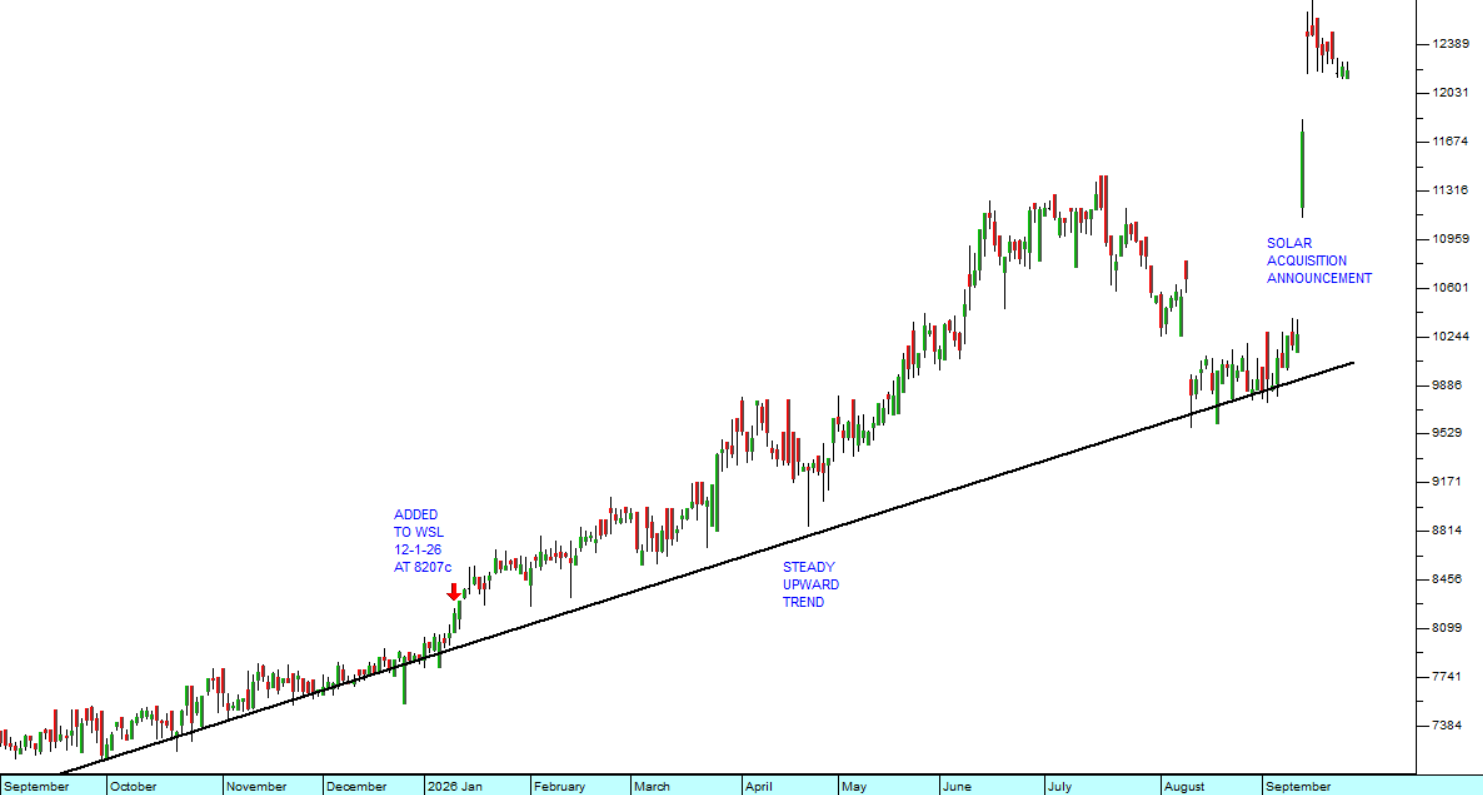
The cautionary announcement was published on the Stock Exchange News Service (SENS) on 11th September this year and the share price immediately rose sharply in response. The fact that it did not rise earlier indicates that there was little or no insider trading associated with this announcement. Consider the chart:
Omnia (OMN) : September 2025 - 25th of September 2026. Chart by ShareFriend Pro.

In anticipation of good results at the year-end in March 2026, we added Omnia to the Winning Shares List (WSL) on 12th January 2026 at a price of 8207c per share. At the time we felt that the company was trading well below its value given its track record and performance.

The Solar Group sells its products in 90 countries around the world and has manufacturing facilities in 11 countries. There are considerable synergies flowing from the acquisition, especially considering that Solar does not appear to be in agricultural sector. Omnia’s expertise and product knowledge will add considerably to the group over time.

Taking into account that an investor would have received 750c in dividends, the decision to buy into Omnia when we added it to the WSL would have yielded a return of 13450c + 750c – 8207c = 5993c or 73% in a period of much less than a year. Altogether a very satisfactory investment!
Using AI  (2026-09-21)

Artificial Intelligence (AI) has been sweeping the world over the past year affecting almost every field of human endeavour. The investment world is no exception. Today the private investor, through AI, has access to a range of analysis which is totally unprecedented and lightning fast. For example…

Artificial Intelligence (AI) has been sweeping the world over the past year affecting almost every field of human endeavour. The investment world is no exception. Today the private investor, through AI, has access to a range of analysis which is totally unprecedented and lightning fast. For example, if you pose the following to Google's Gemini:

“Using a price:earnings growth ratio (PEG), with historical earnings figures over the past 10 years, compare Clicks and Dischem on the JSE for relative value at their current prices”.

A few seconds later, you will receive the following answer:

Based on a 10-year historical valuation framework using the Price/Earnings-to-Growth (PEG) metric, Clicks Group Limited (CLS) offers significantly better relative value than Dis-Chem Pharmacies Limited (DCP), with Clicks holding a PEG ratio of 1,07 compared to Dis-Chem's elevated PEG ratio of 4,92. While both healthcare retailers have faced growth pressures over the past year, Clicks’ consistent long-term earnings growth profile maps to a far more sustainable valuation at current market prices.

It then goes on to say:

To understand the core drivers behind these valuation gaps, we normalize the current trailing Price-to-Earnings (P/E) ratios against their respective multi-year historical Compound Annual Growth Rates (CAGR) in Headline Earnings Per Share (HEPS).

Clicks Group (CLS) — Steady Compounder

  • Robust Growth Track Record: Over the past decade, Clicks Group has compounded its diluted HEPS at an impressive 13,5% per annum, alongside a dividend growth rate of 14,2%.
  • Defensive Cost Efficiencies: Its massive retail presence (~1,000 stores) gives it exceptional operating leverage. At a current P/E of 14,45x, the market has compressed Clicks' historical premium rating (which typically sat closer to 30x), creating a much safer entry point where the earnings growth rate almost directly mirrors its multiple.

Dis-Chem Pharmacies (DCP) — Growth Disruption

  • Earnings Volatility: While Dis-Chem Pharmacies initially listed with immense growth premium expectations in 2016, its long-term financial delivery has slowed down. For instance, its FY2026 annual performance saw a sharp 17,3% drop in HEPS to 113,7 cents due to significant operational and macroeconomic pressures.
  • Depressed Growth Base: Compounding its HEPS from its first full year post-listing (74,7 cents in FY2017) to FY2026 yields a long-term compound growth rate of only 4,78%. A P/E multiple of 23,53x is highly mismatched against this lower single-digit structural growth pace, heavily inflating its PEG ratio.

Risk Guardrails & Framework

Peter Lynch’s traditional benchmark dictates that a PEG ratio near 1,0 indicates a stock is fairly priced relative to its growth, while any metric significantly exceeding 2,0 alerts investors to potential overvaluation relative to realized history. For long-term portfolios, Clicks presents a structurally sound baseline where you are paying a reasonable price for a stable, high-return business framework, whereas Dis-Chem requires aggressive operational margin expansions (such as its automated staffing framework 2.0 initiatives) to justify its present multiple.

This analysis shows that Clicks is cheap at current prices, while Dischem is probably over-priced. Of course, you could have come to the same conclusion if you had done the work yourself, but that would be extremely laborious and time-consuming. For many months now we have been watching Clicks closely. Its price has virtually halved since the middle of last year. And when the price of a blue chip share like Clicks halves, it is always worth investigating.

Of course, before you know to ask such a question you would need to have a basic understanding of how the PEG ratio works or even that there is such a thing as the PEG ratio. Even with the advantage of AI, you need to know enough to be able to ask the right questions – but AI can help you with that too.

We are not suggesting that you let AI make your investment decisions, but we are suggesting that when you find an investment idea it can be a very powerful tool for analysis.

And we do believe that Clicks offers significant value at current levels. Certainly, we believe that it is far better value than Dischem. That is why we asked AI the question in the first place.

Muddy Waters  (2026-09-14)

It has become difficult to keep up with all the news coming out of America. Trump’s erratic behaviour is combining with other factors to make the systematic risk picture complicated and unpredictable. On the one hand, there have been some excellent results coming out of the S&P500 companies riding…

It has become difficult to keep up with all the news coming out of America. Trump’s erratic behaviour is combining with other factors to make the systematic risk picture complicated and unpredictable. On the one hand, there have been some excellent results coming out of the S&P500 companies riding the wave of AI.

AI Boom Lifts S&P 500 Earnings 32% as 86% of Companies Beat Estimates | Business | CryptoRank.io

Wall Street investors now expect that the earnings of the S&P500 companies will be roughly 32% higher than they were a year ago as second quarter earnings dramatically exceed analysts’ expectations. 86% of S&P500 companies have now reported earnings above forecast. Alphabet reported second-quarter earnings that included a $98 billion gain, while Amazon recorded $53.4 billion in non-operating pre-tax income, primarily related to its Anthropic investments. Nvidia’s revenue in the second quarter was $96,2bn – more than double the same quarter last year.  

On the negative side, the price of North Sea Brent oil spiked up to nearly $110 per barrel last week, but has now fallen back to just below $100. This decline to $100 comes because of new hopes for peace negotiations such as planned meetings between Gulf and Iranian foreign ministers. These hopes helped ease immediate fears of a total, prolonged blockage of the Strait of Hormuz. At the same time, oil producers in the Persian Gulf shifted shipments to alternative pipeline capacities and non-Middle Eastern regions (like the US, Canada, and Ghana) which increased output to bridge supply gaps. Finally, major international bodies, including the International Energy Agency indicated that there was slowing consumption and a broader economic slowdown, and notably reduced oil demand from major importers like China driven partly by the transition to electric vehicles.

In the middle of all this, on Tuesday and Wednesday this week the US Federal Reserve Bank’s monetary policy committee will be meeting to decide on the future course of interest rates, and they will be focusing on these figures.

https://coinpaper.com/35641/stock-market-today-sp-500-nasdaq-jump-1-as-oil-falls-despite-hot-cpi

The US inflation rate for August 2026 came in at 3,4% for the year to the 31st August 2026. This was the same rate as July and shows broad increases across both goods and services with the price of gasoline being the major contributor. In the month itself, inflation was 0,4% because of a 3,9% increase in the price of gasoline.

Following hotter-than-expected August inflation data, market metrics and prediction venues show a massive shift toward monetary tightening. The CME Fedwatch Tool suggests that the probability of a 25 basis point hike in  interest rates is now between 84% and 87% while Polymarket says there is an 81% probability. A hike in interest rates will add to the misery of consumers in America already facing an average price across the country of $4.30 per gallon of petrol.

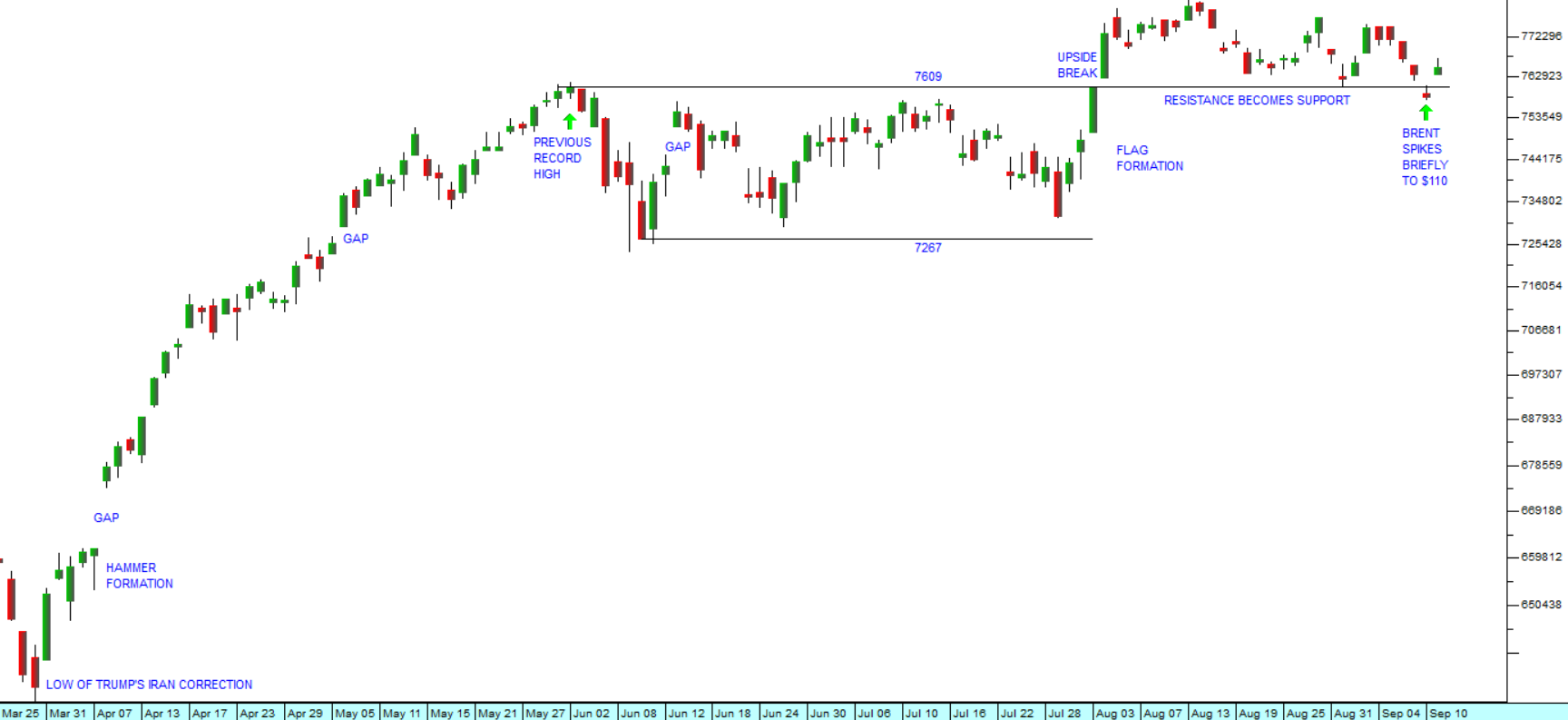
The S&P500 index has been trying to discount all these disparate forces and is basically moving sideways since it broke above the key support/resistance level at 7609. Consider the chart:

S&P500 Index : 25th March 2026 - 11th of September 2026. Chart by ShareFriend Pro.

There can be little doubt about the bullish sentiment which underlies the extended sideways market in the S&P. The news coming from big tech companies appears to be slowly overcoming the bad news coming out of the Middle East. The unexpected spike in the oil price to $110 was short-lived, but it did unnerve the market for a day. That was quickly rectified the next day.

And in the background is the looming mid-term election in America, which is increasingly focusing the Trump camp’s attention, resulting in some radical moves on his part like promising to pay every adult American $5000 if the Republicans win both the House and the Senate. The cost of this is a further $1,23 trillion to be added to the budget deficit already above $40 trillion. He also said that after the elections the petrol price will drop back to $2 per gallon – and anyone who believes that is not following what is happening on the ground.

Trump approval rating hits new low over Labor Day weekend

The Focaldata/Financial Times poll released on September 6, 2026, found that only 32% of Americans now approve of Trump's job performance. Trump's approval rating dropped three points from the previous month, the lowest since the poll series began in May. Critically, his approval among Republicans fell to 72%, a two‑point decline and a new low for that group. The poll was conducted from August 28 to September 2 with 2,178 U.S. adults surveyed. Only 17% of respondents approved of Trump's handling of inflation and the cost of living, while 69% disapproved.

In our view, the Republicans will almost certainly lose the House and the Senate race is now a “toss-up”. If he loses both, we can expect impeachment proceedings to commence promptly.

The S&P500 and markets around the world will ultimately be drawn higher by the AI driven boom in American and elsewhere. We expect new record highs on all indexes in due course.

JSE Top 40

101,334.00 (-1.76%)

All Share

109,105.00 (-1.55%)

Financial 15

25,219.00 (+0.00%)

J200
J203
J212
Top Gainers
# Code Name Close (c) % move
1 RNG RANGOLD 387 +16.57%
2 HUG HUGE 115 +15.00%
3 ENX ENXGROUP 238 +12.80%
Top Losers
# Code Name Close (c) % move
1 CCC CILOCYBIN 78 -56.67%
2 SOH S-OCEAN 84 -16.00%
3 GPL GRANPRADE 157 -12.78%

Top Movers – Charts

Top Gainer: RNG
Top Loser: CCC