Market View
J200 98,669.00 +1.90% J203 106,428.00 +1.71% J210 106,324.00 +2.30% J211 122,630.00 +1.26% J212 24,879.00 +2.05% J213 135,754.00 +1.58%
Winning Shares (Top 5)
Code Name Added Price Latest % Gain % Gain/Year
SDL SOUTH-PD 2025-09-09 725 1980 +173.10% +143.60%
GFI GFIELDS 2025-02-04 32915 59008 +79.27% +44.04%
SOL SASOL 2026-02-19 12838 20205 +57.38% +75.61%
GLD NEWGOLD 2024-01-18 35895 58714 +63.57% +22.31%
RMH RMBH 2026-04-30 49 56 +14.29% +25.19%
Opinions (Top 5)
Code Name Date Action
ABG ABSAGROUP 2026-11-24 View

24-11-2026   ABSA (ABG) is one of the largest banking groups operating in Africa. It has well-established branches in 12 African countries and representative offices in at least 6 more. It offers a range of products for personal and business banking, credit cards, insurance, and asset management.

Obviously, as one of the "big five" banks, ABSA has been impacted by the recession in South Africa and the generally low consumer spending in the economy. The company announced a joint venture with Patrice Motsepe's African Rainbow Energy to launch a R6,5bn renewable energy fund.

ABSA is certainly a blue-chip share and is worthy of your attention. The separation from Barclays is now complete. On 31st March 2023 the company announced a BBBEE transaction that will take its Black ownership to more than 25%. In its results for the six months to 30th June 2026 the company reported total income up 4,1% and headline earnings per share (HEPS) up 7,9%.

The company's net asset value (NAV) increased 4,6% to 20968c per share and the cost-to-income ratio was 53,4%. The company said, "The Group’s common equity tier 1 (CET1) capital ratio rose to 12.8% from 12.5%, to remain above regulatory requirements and the top end of the Board’s target range of 11.0% to 12.5%".

In a pre-close update for the year to 31st December 2026 the company reported that it was in line to meet its earlier guidance with revenue rising to more than R150bn and return on equity (ROE) moving back towards 17%. Technically, the share made a low in March 2020 and then moved sideways for the next six months before beginning a new upward trend which is ongoing.

We are generally very positive about the potential of banking shares on the JSE. ABSA shares have been falling since February 2026 and are now on a P:E of 6,88 and a dividend yield (DY) of 6,37, which looks cheap to us. The war in Iran has negatively impacted all banking shares, but this will probably prove to be temporary.

ARL ASTRAL 2026-11-24 View

24-11-2026   Astral Food (ARL) is a leading poultry producer in South Africa. The company's activities include integrated broiler operations, where they have a processing capacity of 4,4 million broilers per week; Ross Poultry Breeders, which supplies breeding stock to the South African broiler industry; National Chicks, which is a day-old chick and hatching egg supplier; and Meadowfeeds, which has seven mills producing a wide range of specialised products for farm animals.

Buying this share is a gamble on weather conditions and the cost of feed (maize). Since poultry imports into South Africa are about 30% of total consumption, it is also a gamble on the dumping of cheap chicken onto the South African market by Europe, Brazil, and the US - but at current levels the share looks reasonable.

As an essential service, Astral has not been greatly impacted by COVID-19 except that it is expecting an over-supply of chicken as a result of higher unemployment in due course. Overall, we view this as a relatively risky commodity share, but one which is trading well below previous levels.

In its results for the year to 30th September 2026 the company reported revenue up 3% and headline earnings per share (HEPS) up 102%. The company said, "An operating profit of R2 350.4 million was reported for FY2026 compared to R1 247.4 million in FY2025, an increase of 88.4%. This increase was mainly as a result of softer maize and soya meal prices supporting a lower feed input coSt. The operating profit margin for the Group improved to 10.1% (2025: 5.5%)".

Technically, the share was in an upward trend from August 2025, but began correcting from February 2026. The company has had problems with feed costs and has been impacted by the unreliability and costs of electricity and water. Rising maize and fertiliser costs as a result of the war in Ukraine and the rising price of fuel as a result of the Iran war negatively impacted margins as well as the recent avian flu.

We find this company generally well-managed and cheap at current levels - but volatile.

NVS NOVUS 2026-11-24 View

24-11-2026   Novus (NVS) is South Africa's largest printing company with 11 printing plants. Until recently, it had the monopoly contract to do all of Media24's printing. With effect from 1-4-18, that contract was reduced to roughly 58% of Media24's printing and the price paid by Media24 for printing was also reduced.

The company appointed a new CEO, Neil Birch, who has decided in the short term to abandon the company's acquisitions and focus on consolidating the business and improving its operating performance. The board may also look to sell the company's tissue business. The company has a level 4 BEE status but will need to improve that to become more competitive.

On 12th August 2022 the company announced that it would acquire 75% of Pearson South Africa. In its results for the six months to 30th September 2026 the company reported revenue up 80,7% and headline earnings per share (HEPS) down 8,9%. The company said, "Group revenue excluding Mustek, decreased by 6,5% to R1 973 million down from R2 109 million in the prior year.

Revenue excluding Mustek was mostly impacted by the delayed timing of work under the Department of Basic Education". Technically, we suggested waiting for a convincing break up through a 65-day moving average before investigating further. That happened on 8-10-20 at 88c and the share has since moved up to 566c (23-11-26).

The share trades about 100 000 worth of shares a day on average which makes it practical for private investors. 

NTC NETCARE 2026-11-24 View

24-11-2026   The Netcare Group (NTC) operates hospitals and medical response teams throughout South Africa and Lesotho. It has fifty-nine hospitals, four of which are public/private partnerships, employs 22000 people in South Africa and has 10600 beds. Netcare 911 operates from seventy-nine sites and has over 1000 paramedics.

Healthcare is generally not impacted by the business cycle because consumers have to pay for their healthcare, even in a recession, but Netcare says it is being impacted by the competitive nature of medical aids which force them to take lower prices. On 23rd March 2021 Netcare received a letter from the Lesotho government cancelling its contract to run the Queen Mamohato Hospital in Maseru over a wildcat strike by nursing staff.

The vast majority of Netcare’s hospitals have full island capacity, allowing them to operate independently of the grid. In addition, all facilities are supported by Uninterrupted Power Supply (UPS) systems and a fleet of 200 backup diesel generators across the portfolio. In its results for the year to 30th September 2026 the company reported revenue up 4,2% and headline earnings per share (HEPS) up 20,3%.

Earnings before interest taxation depreciation and amortisation (EBITDA) was up 5% and net debt excluding lease liabilities was up 9% to R6bn. Technically, the share was in a downward trend since its peak of 4300c in March 2015 until its bottom in March 2020 at around 1200c. A new upward trend began in May 2024 and while volatile appears to be gaining momentum.

The share has broken above resistance at 1713c and is in a new upward trend. On a P:E of 11,87 (23-11-26) the share looks like a good prospect.

RLO REUNERT 2026-11-24 View

24-11-2026   Reunert (RLO) is a company involved in electrical appliances, electrical engineering, and information communications. The company has been in existence for 130 years and listed for 70 years. It has operations in Australia and Sweden as well as in Zimbabwe, Zambia, and Lesotho.

It exports to many countries around the world. Electrical engineering accounts for roughly half of its annual turnover which is about R10bn. In its results for the year to 30th September 2026 the company reported revenue down 2% and headline earnings per share (HEPS) down 48%. The company commented on weak demand both in South Africa and Zambia as well as increased commodity prices and a stronger rand.

The company said, "Global copper prices increased by 33% and aluminium prices by 24% during the year, which led customers to defer power cable orders and reduced margins, while the Rand strengthened by 8,4% against the USD and by 3,7% against the Euro, reducing the Rand value of the Group's export revenue". The share trades on a P:E of 14,01 which still looks over-priced to us.

However, its future performance will depend on the rand/US dollar exchange rate, a recovery in the South African economy and increased business from government and quasi-government organisations. Technically, the share has been falling since November 2024 and we advise waiting for it to break up through its downward trendline before investigating further.  We anticipate that in time it may recover.  

Winning Share: RMH
Opinion: ARL
Correction or Bear Trend  (2026-11-23)

The S&P500 index closed on Friday 20th November 2026 down 3,7% on the day and 11,6% off its all-time record high of 7818 made on 6th October 2026. This puts it firmly into correction territory which is generally defined as any fall of more than 10%. So now investors have to decide whether this is…

The S&P500 index closed on Friday 20th November 2026 down 3,7% on the day and 11,6% off its all-time record high of 7818 made on 6th October 2026. This puts it firmly into correction territory which is generally defined as any fall of more than 10%. So now investors have to decide whether this is the beginning of a long-term bear trend or just a healthy correction - and therefore a buying opportunity.

To answer this question, we really need to look at the fundamentals. How is the US economy performing? Are interest rates likely to go up or down? Is the tidal wave of support for the Democrats in the mid-term election likely to lead to any curtailment of the AI build-out? And how can you determine technically when the bottom has been reached?

The nature of the fall is that so far, it is not a crash like 1987 when the S&P fell 23% in a single day, but it could still turn into one if there is a big enough overhang of sell orders by Monday morning (23rd November 2026) when the market opens (at 4.30pm our time). If you are interested, you can watch how the S&P opens and its tick-by-tick progress at:

https://www.google.com/finance/quote/.INX:INDEXSP#scso=_OIBvXeSCL7aq1fAPq6m6iAw6:0.

Earlier in the day, the London Stock Exchange (LSE) will also give an indication of which way things are moving. That can be seen by watching the progress of the FTSE250 index through the day.

The rules on Wall Street have changed since the 1987 crash. Today Wall Street is subject to circuit breakers. If the S&P falls 7% during a single day, trading is halted for 15 minutes. If it drops by 13%, there is a second 15-minute break in trading. And, finally, if it falls by 20%, the market closes until the next day. These are designed to allow investors to pause, gather their thoughts and assess the situation before they continue trading.

It is noteworthy that international investors have shifted dramatically from risk-on to risk-off in the last six trading days. This can be seen by the fact that the rand has collapsed back to R17.50 to the US dollar, losing about 5,5% of its value. So some overseas investors have been dumping South African bonds and shares and taking their money out of the country to more secure destinations. Since the rand is generally the benchmark currency for emerging economies, this shows that these investors are willing to forgo the higher returns to be made here and in other emerging economies for the safer returns in first world countries.

The fall in the rand is NOT however due to the current round of coalition negotiations taking place locally as some journalists have tried to suggest. Those are barely relevant to what is happening on the world stage.

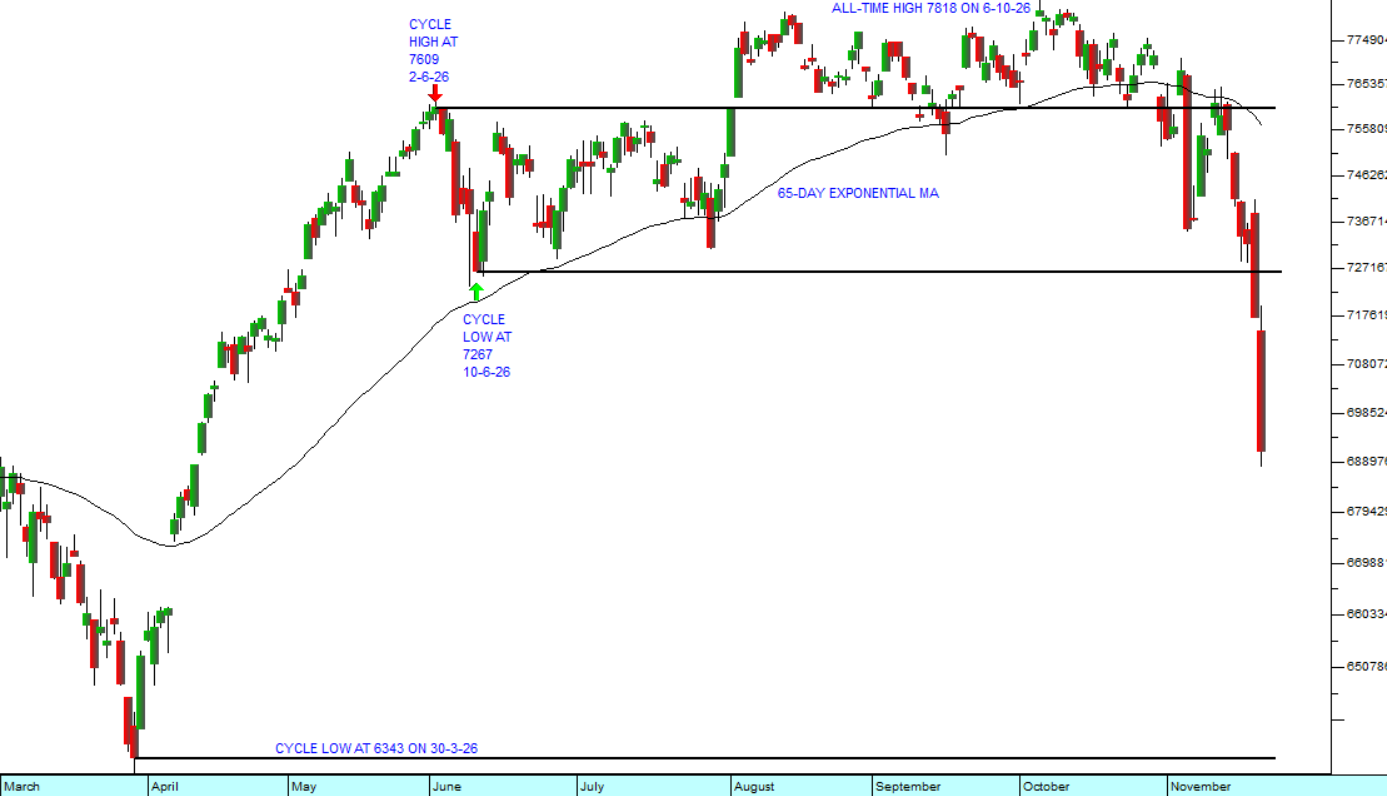
Technically, the S&P has now smashed down through the two previous historical support levels at 7609 (the cycle high of 2nd June 2026) and 7267 (the cycle low of 10th June 2026). Consider the chart:
S&P500 Index : March 2026 - 20th of November 2026. Chart by ShareFriend Pro.

The next important technical support level is at 6343 – which was the cycle low made on 30th March 2026. That level is 18,5% below the all-time high and so any fall significantly below that level would be classified as a new bear trend.

In our view the US economy is doing well enough and inflation, which is high, should come down as the oil price settles lower. The Magnificent Seven continue to generate good profits from AI and their prosperity is widening to other companies in the S&P500 index. We view the significant win of the Democrats as a definite long-term positive for markets, even though there could be some volatility as investors settle into the new reality.  

We do not believe that the low of 10th March 2026 will be seriously tested and we expect markets to recover rather than move into a bear trend. You will note that we have added a 65-day exponentially smoothed moving average to the chart above. An early signal that the correction is over will come when the S&P breaks up through that moving average. A more conservative position would be to wait for the moving average itself to turn up.

Please bear in mind, however, that we can be wrong and that whether you are still holding shares or plan to buy the dip, your ultimate safeguard remains your stop-loss strategy. That is what will protect the bulk of your capital, and you should never ignore it. Having said that, a downward trend like this should be viewed as a good thing - because it will afford you the opportunity to buy shares at more attractive levels.

Postscript: You may be wondering why gold is falling at this time. The reason is that many of the people who have lost money on their stock portfolios in the last weeks bought those shares on a margin account. This means that they borrowed as much as half of the money they needed to buy the shares in the first place, usually from their stockbroker. As the share market falls, they are required to top up those margins (i.e. put in more cash) to prevent their stockbroker from selling their shares. For many of them the easiest way to get cash quickly was to sell their holdings of gold or gold ETFs – and that causes the gold price to fall – in the short term.
Nvidia  (2026-11-16)

Charismatic leadership in business can often be a major problem. When a company is dominated by a single individual who then becomes incapacitated for some reason, the result is normally a sharp downward re-rating of the share. Charismatic leadership can increases the key-person risk for an…

Charismatic leadership in business can often be a major problem. When a company is dominated by a single individual who then becomes incapacitated for some reason, the result is normally a sharp downward re-rating of the share. Charismatic leadership can increases the key-person risk for an investor.

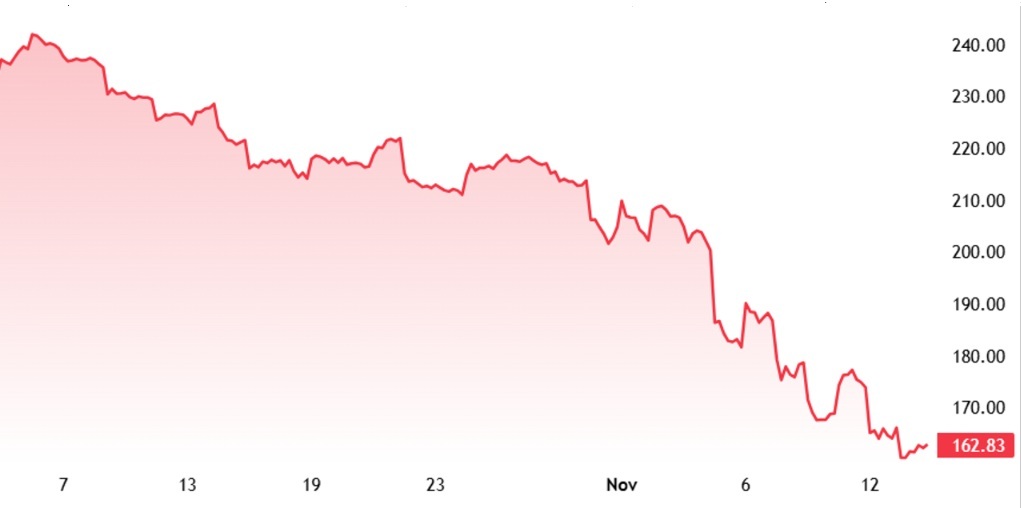
In the current case of Nvidia, the CEO, Jensen Huang, has now resigned following a series of scandals regarding his extra-marital affairs and their possible link to Chinese spying. The impact on the share price over the past month has been substantial. On 6th October 2026 Nvidia shares closed at $241,90 and on Friday last week they closed at $162,83 – that is a drop of almost one third and wiped $1,85 trillion off its market capitalisation. Consider the chart:

Nvidia : 7th of November 2026 - 13th of November 2026. Source: https://www.tradingview.com/symbols/NASDAQ-NVDA/?timeframe=3M


Huang was the co-founder of Nvidia in 1993 and had served as its President for 33 years. After early struggles, the company broke through with chips like the RIVA 128 and went public in 1999, the same year it introduced the GeForce 256—the world's first graphics processing unit (GPU). This led to the bold bet to launch CUDA, a parallel computing platform that allowed GPUs to handle general-purpose computing—laying the foundational software architecture for modern deep learning and artificial intelligence (AI). This scaled Nvidia into the backbone of the global AI and data centre revolution, driving the company to a multi-trillion-dollar valuation and transforming it into one of the most influential technology companies in history.

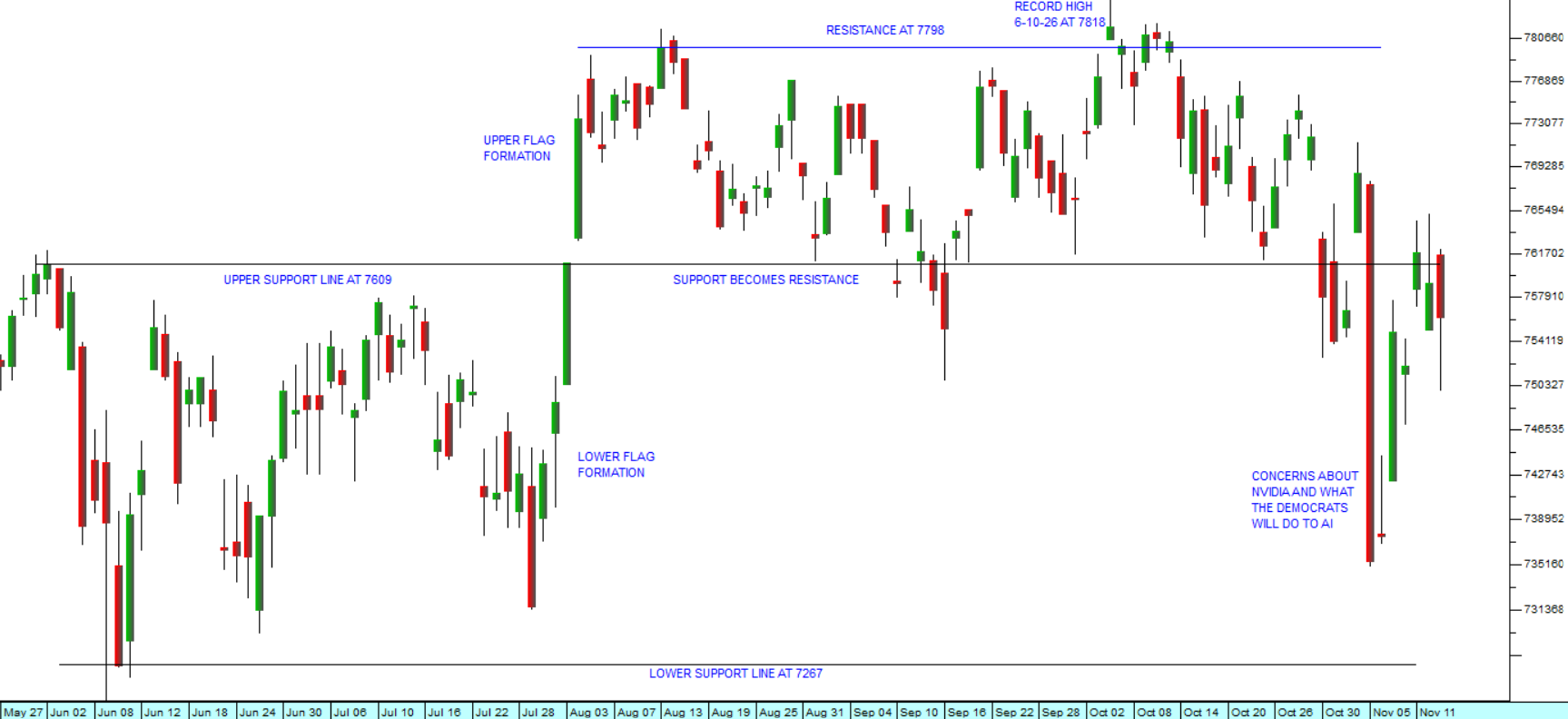
Clearly, Huang was an important person and his leadership on the Nvidia board was crucial – so when rumours began circulating of his relationship problems and the possible connection to China, investors began selling the stock as concerns about leadership uncertainty increased. What is interesting is that the sharp decline in the price of Nvidia has not dragged the other shares in the Magnificent 7 down with it, and while it was the main contributor to a correction in the S&P500, it has not precipitated a major collapse. The S&P500 also reached an all-time record high on 6th October 2026 closing at 7818, but it was only down by 3,3% from that record high at Friday’s close. Consider the chart:

S&P500 Index :  27th of May 2026 - 13th Of November 2026. Chart by ShareFriend Pro.

The chart shows that developments at Nvidia combined with concerns around what the Democrats might do to curtail the growth of AI took the S&P500 down but did not penetrate the lower support line at 7267. In our view, AI has its own momentum and is now stimulating growth in most companies across America and the world. The Democrat victory in the mid-term elections is unlikely to derail that. One major positive impact of the election was that it immediately brought the price of North Sea Brent down to $95.

In our view, the Democrat win also brings another major positive – it signals the end of the MAGA/Trump era with all the uncertainty that that entailed. Notably the JSE Overall index has actually been going up since 6th October 2026 showing that local investors never really believed that Wall Street was in a major correction. We are expecting further declines in the price of oil and fewer disruptive shocks from the Trump administration going forward.  

Democrat Sweep  (2026-11-09)

It seems fair to say that while most analysts and investors expected the Democrats to do well in the US mid-term elections, most were also caught completely off-guard by the extraordinary extent and depth of that win - and this has resulted in a burst of increased volatility in the markets as they…

It seems fair to say that while most analysts and investors expected the Democrats to do well in the US mid-term elections, most were also caught completely off-guard by the extraordinary extent and depth of that win - and this has resulted in a burst of increased volatility in the markets as they adjust to the new reality. Trump’s decision to appoint Stephen Miller as his Chief of Staff shows that he has no intention of moderating his position by working with the Democrats – instead he is doubling down on the extreme right-wing politics which has made him so unpopular.

The initial reaction to the vote was undoubtedly one of relief and euphoria as the Democrats claimed first the House and then the Senate. Then the next day that excitement gave way to fear that they might use their now overwhelming power to somehow curtail or limit AI and the build out of data centres across America.

This led, the next day, to a massive 4,4% drop in the S&P500, completely wiping out the gains of the previous day and taking the NASDAQ particularly, down sharply. Voters and newly elected officials have already passed dozens of local measures restricting data centres (from outright bans to temporary moratoriums), while incoming governors in states like Texas and Georgia have signalled plans to pause or heavily regulate new construction.

Hyperscalers and data centre operators have been funding massive expansions with heavy borrowing and private credit. Rising AI credit costs and heavy debt loads have sparked fears among investors of financial strain, stranded assets, or potential defaults if demand falls short. What if the direction of the technology changes and these huge investments are suddenly irrelevant and there is an unsupportable overhang of debt and abandoned assets?

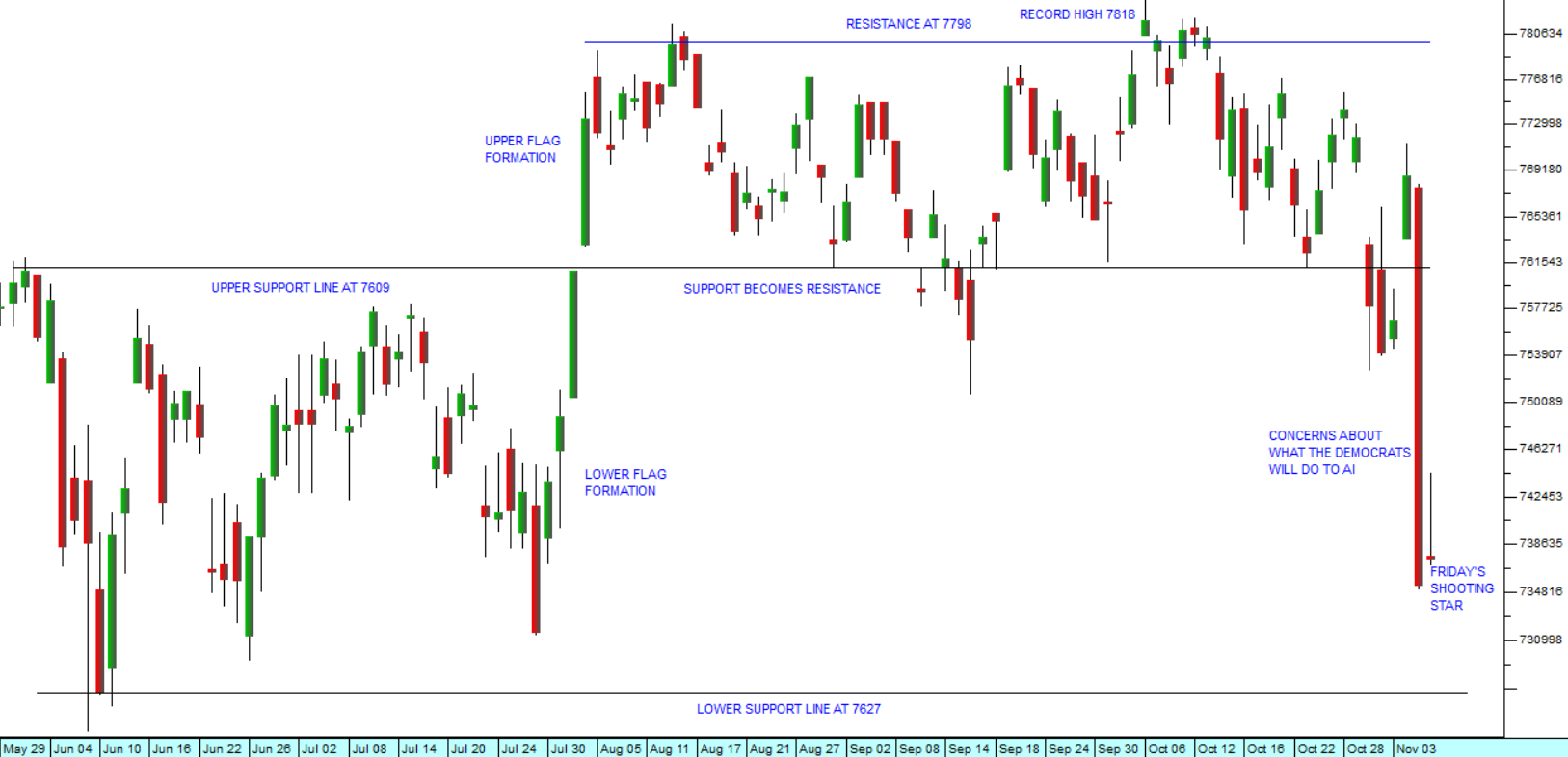
Those fears, added to the fact that tech shares were very already high and due for some kind of correction, has led to a rapid rotation out of AI and into other sectors or into cash. Consider the chart:

S&P500 Index : 29th of May 2026 - 6th of November 2026. Chart by ShareFriend Pro.

Of course, the Anthropic IPO is due to happen on 19th November 2026 and their prospectus has already been issued. They are looking to raise between $80bn and $100bn off a market valuation of between $1,5tr to $2tr. That will now almost certainly have to be curtailed – possibly to as little as $1tr. While Anthropic showed explosive growth - posting $16.3 billion in revenue for the first half of 2026 (up 1,300% year-over-year) - it also recorded an $80.7 billion net loss during that same period.

As a private investor on the JSE watching all this unfold on world markets and with our own election results in the background, you must obviously ask how these things will impact on emerging markets and on South Africa in particular. Our markets, and especially the rand have remained remarkably stable throughout the turbulence. The rand weakened, as far as R16,75 to the US$ and strengthened as far as R16,35, and now has settled in the middle ground of R16,51. This shows that the sharp downward move on Wall Street has not resulted in a huge shift towards risk-off among international investors. The smart money is still buying South African high-yield bonds and our relatively cheap high-quality equities.

On Friday, the US markets stabilised with many investors buying the dip and other even going as far as selling put options for a quick gain if the market recovers some of its former balance. However, the  shooting star formation does not bode well for the coming week. From a purely technical perspective, the lower support line on the S&P at 7626 now becomes important. If that is broken then we are in a full-blown correction.

Against this, we look at the underlying fundamentals of the third quarter S&P500 company earnings and feel that, at the very least, the Thursday sell-off was over-done. At this time 88,2% of S&P500 companies have reported and 82% of those have beaten earnings projections while 74,6% beat revenue expectations. This shows that the bull trend has been very well supported by rising profits across the board. In other words, it does not have the look of a bubble in the throes of bursting. But, in these turbulent times, your ultimate protection remains your stop-loss strategy.

JSE Top 40

98,669.00 (+1.90%)

All Share

106,428.00 (+1.71%)

Financial 15

24,879.00 (+2.05%)

J200
J203
J212
Top Gainers
# Code Name Close (c) % move
1 SEP SEPHAKU 185 +17.83%
2 GML GEMFIELDS 69 +11.29%
3 MTU MANTENGU 10 +11.11%
Top Losers
# Code Name Close (c) % move
1 VUN VUNANI 220 -12.00%
2 ACT AFRO-C 55 -8.33%
3 MTM MOMENTUM 3501 -8.01%

Top Movers – Charts

Top Gainer: SEP
Top Loser: VUN