Market View
J200 103,230.00 +0.82% J203 110,934.00 +0.69% J210 121,126.00 +1.88% J211 120,992.00 +0.31% J212 25,298.00 +0.14% J213 135,934.00 +0.22%
Winning Shares (Top 5)
Code Name Added Price Latest % Gain % Gain/Year
N91 NINETY-1P 2025-05-13 3796 4433 +16.78% +11.76%
GRT GROWPNT 2025-05-31 1349 1540 +14.16% +10.27%
ATT ATTACQ 2024-01-25 965 1810 +87.56% +32.12%
SUR SPURCORP 2023-08-08 2488 4150 +66.80% +20.93%
OCE OCEANA 2026-06-06 6200 6300 +1.61% +4.46%
Opinions (Top 5)
Code Name Date Action
TLM TELEMASTR 2026-10-18 View

16-10-2026 Telemaster(TLM) is a company which supplies voice, data and cloud communications using fixed line, fixed cellular, fixed data, and PBX services. It has three divisions - voice, cloud PBX and internet. The business consists of (1) Catalytic Connections (Pty) Limited is a diversified ICT managed solutions provider to medium and small enterprises.

(2) Contineo Virtual Communications (Pty) Limited operates a Next Generation Unified Communications (“UC”) platform based on Cisco Broadsoft technology. (3) PerfectWorx Consulting (Pty) Limited is a niche network systems integrator. (4) Ultra Data Centre (Pty) Limited built and operates a data centre located outside of Pretoria.

In its results for the year to 30th June 2026 the company reported revenue up 8,15% and headline earnings per share (HEPS) up 334,26%. The company said, "Operational expenses, including the movement in credit loss allowance, were well contained, only increasing by 0.7%. Earnings before interest, taxation, depreciation, and amortisation (EBITDA) of R8.7 million were achieved compared to R6.9 million in the comparative year".

The share is very thinly traded with less than R1000 worth of shares changing hands each day because most of the shares are held by a single shareholder - the Maison D-Obsession truSt. This makes it impractical for private investors. 

MNP MONDIPLC 2026-10-18 View

18-10-2026   Mondi (MNP) is a massive international paper and packaging company that started in South Africa, but now has interests in 30 countries and employs 26000 people at about 100 sites. It has businesses in the full spectrum of packaging, and it is extremely professionally managed.

It owns and runs forests, produces wood pulp, paper, and plastic films for the production of a wide variety of packaging solutions. The company has been impacted by developments in the Ukraine crisis. In its results for the six months to 30th June 2026 the company reported revenue up 2% and headline earnings per share (HEPS) down 85%.

The company said, "Heightened geopolitical tensions in the Middle East caused supply chain disruptions and contributed to higher input costs". n a trading update for the three months to 30th September 2026, the company reported EBITDA, including forestry fair-value movements, of €196 million, up from €167 million in the second quarter.

However, the second-quarter figure included a €43 million forestry fair-value loss, whereas there was no forestry fair-value gain or loss in the third quarter. Excluding these movements, EBITDA fell from €210 million to €196 million, partly reflecting planned maintenance shutdowns and higher input costs.

The company expects input costs to remain under pressure, particularly due to higher fuel costs, and said that, if current prices prevail, including South African diesel prices, it expects no forestry fair-value gain in the fourth quarter.. In our view this is in a difficult business which tends to make the shares volatile.

Technically, the share was in a strong upward trend after March 2020 but was then derailed by the Ukraine situation in March 2022 and subsequently the Iran war in February 2026. The share has been moving sideways and downwards and we recommend waiting for it to break up through its long-term downward trendline before investigating further. 

FBR FAMBRANDS 2026-10-18 View

16-10-2026   Famous Brands (FBR) is Africa's largest branded fast-food retail franchisor with 15 iconic brands and 3008 restaurants in 20 countries. It has 2574 restaurants in South Africa, 62 in the UK and 76 in the rest of Africa and the Middle EaSt. The company owns well-known South African brands like Wimpy, Debonairs Pizza and Steers.

For the last two years, even before COVID-19, the company has been battling to grow in an environment where the consumer has been hammered by rising fuel costs, rising interest rates, high unemployment, and high indebtedness. The retail fast food industry has become increasingly cut-throat.

Famous Brands had been aggressively growing its signature brands, but as yet they were not performing as well as its leading brands (Wimpy, Steers etc.). The acquisition of GBK in the UK appears to be a major blunder just before the Brexit vote. This was purchased in late 2016 for R2,3bn and Famous Brands is being forced to write off what was paid for it and has finally ceased financing it in April 2020.

On 14th October 2020, Famous Brands announced that GBK was put into administration in the UK. During lockdown, most of its restaurants were not allowed to trade. The company has simplified its menus to focus on the most profitable offerings and improved its take-away and delivery options.

In its results for the year to 28th February 2026 the company reported revenue up 5,6% and headline earnings per share (HEPS) up 12,1%. The company said, "The Group remains highly cash-generative and free cash flow decreased by 9% to R662 million (2025: R728 million).

HEPS increased 12% to 583 cents (2025: 520 cents), with BEPS up 10% to 600 cents (2025: 547 cents)". In a trading statement for the six months to 31st August 2026 the company estimated that HEPS would be between 205c and 252c compared with 236c in the previous period.  The share has been in a sideways market for the past five years and will be heavily impacted by the sharp rise in the price of fuel since the start of the Iran war.

It is a barometer of consumer confidence and spending in South Africa.

PSG PSG 2026-10-18 View

16-10-2026 PSG Konsult (KST) is a well-established financial services group which grew out of PSG's stockbroking business and which now offers a wide range of financial services including financial planning, unit trusts, healthcare, short-term insurance and estate planning. PSG still holds 60% of the company.

In its results for the six months to 31st August 2026 the company reported recurring headline earnings per share (HEPS) up 5% and asset under management (AUM) up 15% to R594,1bn. The company said, "PSG Insure’s gross written premium amounted to R4.2 billion (5% increase). Performance fees constituted 1.9% (2025: 7.3%) of headline earnings".

The share trades on an earnings multiple (P:E) of 21,51 - so it is not cheap, but it is a high-quality company that has demonstrated its ability to produce good returns even in an adverse economic climate. Technically, the share has been in an upward trend since March 2020 and is looking like good value after the recent correction. 

VUN VUNANI 2026-10-15 View

Vunani (VUN) is a black-owned financial services group with interests in asset management, investment, banking, property and stockbroking. It also has an interest in coal mining which has been performing well with the rise in coal prices. In its results for the year to 28th February 2026 the company reported revenue up 17% and headline earnings per share (HEPS) of 10,2c compared with a loss of 2,8c in the previous period.

The company said, "The group generated total comprehensive income for the period of R35.3 million (2025: total comprehensive loss of R3.4 million), while total profit attributable to equity holders of the company amounted to R9.6 million". In a trading statement for the six months to 31st August 2026 the company estimated that HEPS will increase by between 52% and 72%.

From a private investor's perspective, the biggest problem with this share is that it is too thinly traded to be a practical investment. 

Winning Share: SUR
Opinion: TLM
Quantum Computing  (2026-10-12)

We live in an age where advances in technology are driving the gains in productivity and profits, and then being discounted directly into share prices. Artificial intelligence (AI) is already well established and being used by most companies to improve productivity. This can be seen in the results…

We live in an age where advances in technology are driving the gains in productivity and profits, and then being discounted directly into share prices. Artificial intelligence (AI) is already well established and being used by most companies to improve productivity. This can be seen in the results coming out of the companies in the S&P500 index. The impact of AI has only just begun to be discounted and now the next major technological breakthrough, quantum computing, is hovering in the background.

Quantum computing is essentially a jump forward in hardware which allows computers to analyse multiple different solutions simultaneously. Instead of using bits which are either 1 or 0, a quantum computer uses qubits which can exist in multiple states simultaneously - together with quantum entanglement. The technology uses the laws of physics at the atomic and subatomic level to solve complex problems much faster than regular computers, even supercomputers. Microsoft, Google, Amazon, Oracle, and even Meta and Tesla, are rushing to install quantum computing into their infrastructure. In a word, quantum computing will increase the power of AI substantially making it even faster and more powerful than it already is.

With that background, the earnings of S&P companies for the third quarter are beginning to trickle in, with 19 companies having reported so far. Total 3rd quarter earnings for those companies that have reported results already are up +150.9% from the same period last year on the back of revenues which are +27% higher. 79% of those companies are beating EPS estimates and 73.7% are beating revenue estimates.

The average estimate for all S&P500 companies is that earnings will be up by 24,3% in the 3rd quarter when compared with a year ago – and this will be the 8th straight quarter where estimates have been in positive double digits. 15 out of 16 sectors are expected to make significant gains – led by the technology and energy sectors.

As things stand now, the progress of the S&P500 index is being significantly held back by developments in Trump’s Middle East war and the price of oil. Iran would like to hold the price of North Sea Brent above $100 per barrel, at least until after the mid-term elections on 3rd November 2026 – which of course is very bad news for the struggling Republican party and Trump.

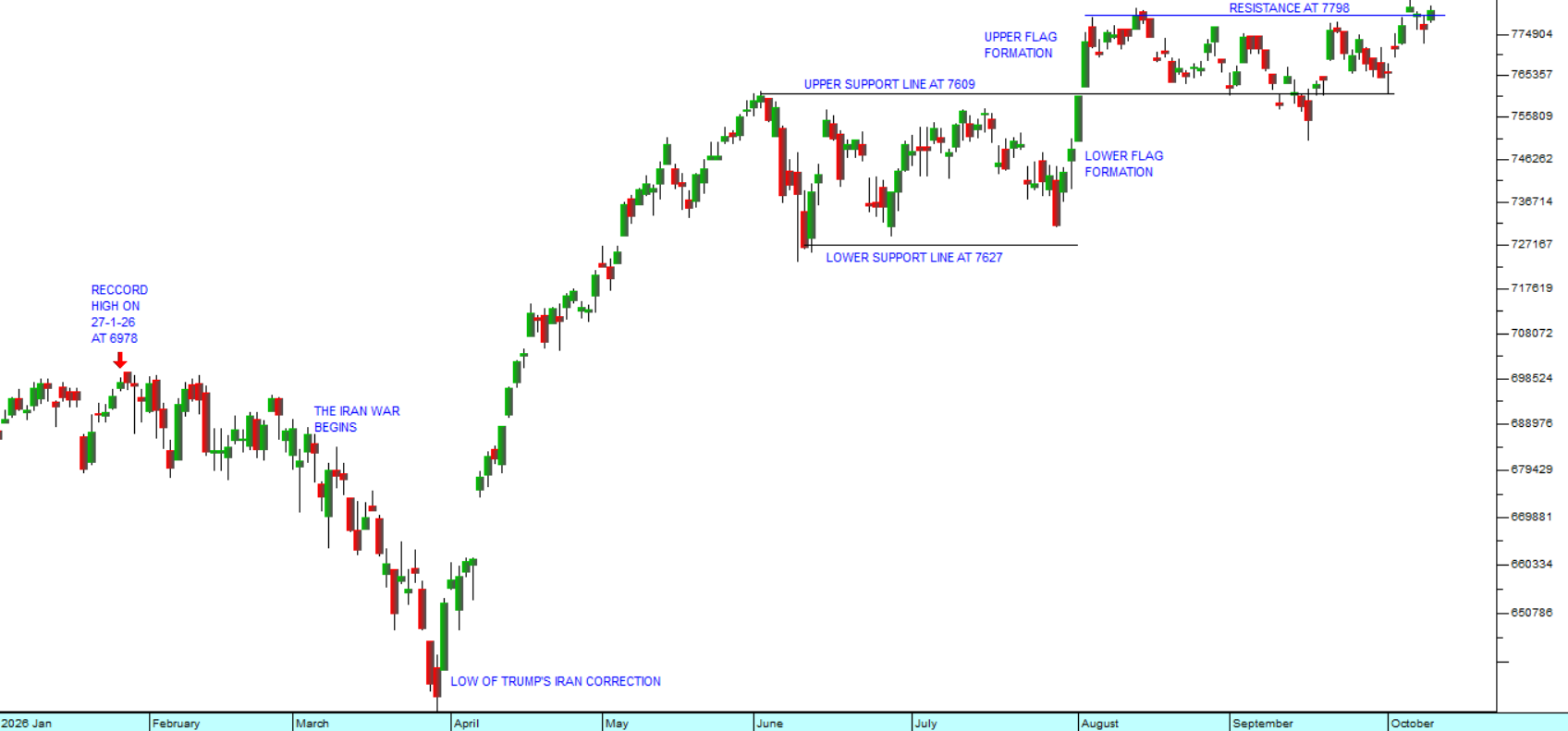
Looking at the chart, the S&P500 index has been moving through a series of protracted sideways markets for the past four months. During that time, technology and the prospects of that technology have not stood still. They have been advancing at a rapid pace.

Our belief is that as soon as the situation in the Middle East is resolved and the oil price comes back to where it was before the war began, the S&P will suddenly begin discounting the impact of the accumulated technical advances and move sharply higher. It will be like removing the lid from a pressure cooker. Consider the chart:
S&P500 Index : January 2026 - 9th of October 2026. Chart by ShareFriend Pro.

So, what we are saying is that considerable bullish potential has been built up by this war and its impact on oil prices. This can be seen from the fact that even with Brent at over $100 a barrel now, the S&P is still making new record highs, based on the exceptional estimates of 3rd quarter earnings and beyond.

There are, of course, those who believe that Brent is about to go much higher – like to $125 per barrel - given the escalation in Yemen with the Houthis and the attacks on the Saudi pipeline. But in our view the underlying direction of the oil price must be downwards as the world moves away from fossil fuels and towards renewables, especially solar.

To be safe, ensure that you have a strict stop-loss level for all the shares in your portfolio. That is the ultimate protection against unexpected downtrends and bear markets. Your absolute rule should be to never lose more than 15% on any share market investment ever – including your dealing costs. Sometimes it is difficult to achieve this, but provided you always choose shares which are free-dealing, it simply becomes a matter of self-discipline. And then if you are able to make several hundred percent on your winners, mathematically, you must be successful over time.
 

The Omnia Takeover  (2026-09-28)

Omnia is a manufacturer of chemicals used in agriculture (fertilisers), mining (explosives) and various industries. It operates primarily in South Africa, but its products are sold throughout Southern Africa and abroad. In its latest financial statements for the year to 31st March 2026 the company…

Omnia is a manufacturer of chemicals used in agriculture (fertilisers), mining (explosives) and various industries. It operates primarily in South Africa, but its products are sold throughout Southern Africa and abroad.

In its latest financial statements for the year to 31st March 2026 the company reported revenue up 6% and headline earnings per share (HEPS) up 21%. The company benefited in some ways from the war in Iran and the closure of the Strait of Hormuz because that restricted the flow of agricultural chemicals onto world markets resulting in higher prices. Omnia was able to pay a dividend of 470c for the year, plus a special dividend of 280c. During the year it also bought back and cancelled 187436 of its own shares at an average price of 6465c per share returning a further R12,1m to shareholders.

This is one of the companies that was very hard hit by the COVID-19 pandemic, and its share price fell to a low of 1536c in May 2020. We published an article about it on 2nd September 2019, drawing attention to the fact that it had been consistently trading well below its net asset value (NAV) for some time. Obviously, when a profitable listed company trades below its NAV, it generally becomes a potential take-over target for both local and international investors.

For the next five years Omnia continued to strengthen and diversify its position. By March this year it was growing profits in all divisions and had a strong balance sheet. This attracted the attention of a large international chemicals company operating out of India, The Solar Group, who have now made an offer to buy 100% of Omnia’s ordinary shares for 13450c each. Omnia will delist from the JSE once the acquisition scheme by Solar SA Investments is implemented.

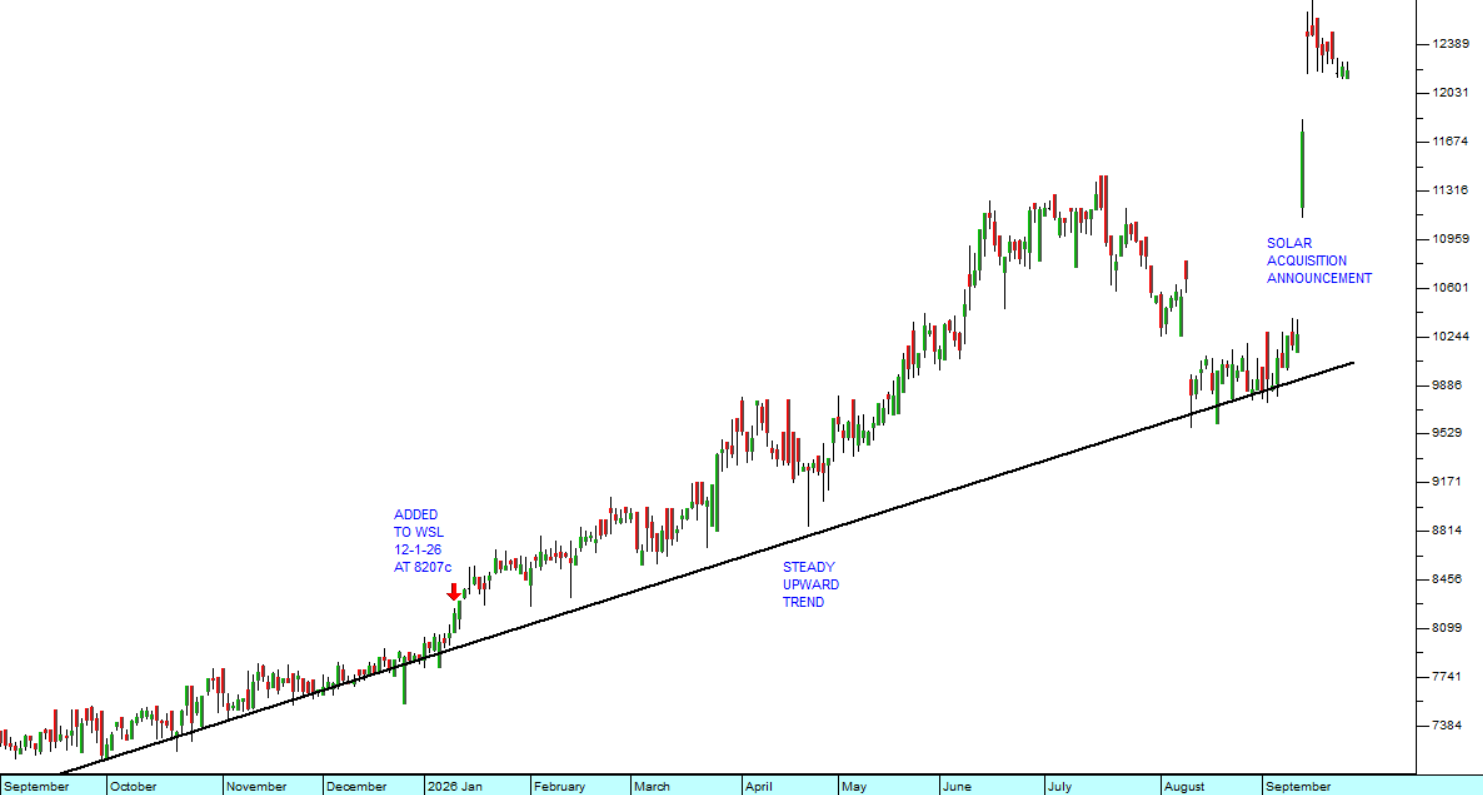
The cautionary announcement was published on the Stock Exchange News Service (SENS) on 11th September this year and the share price immediately rose sharply in response. The fact that it did not rise earlier indicates that there was little or no insider trading associated with this announcement. Consider the chart:

Omnia (OMN) : September 2025 - 25th of September 2026. Chart by ShareFriend Pro.

In anticipation of good results at the year-end in March 2026, we added Omnia to the Winning Shares List (WSL) on 12th January 2026 at a price of 8207c per share. At the time we felt that the company was trading well below its value given its track record and performance.

The Solar Group sells its products in 90 countries around the world and has manufacturing facilities in 11 countries. There are considerable synergies flowing from the acquisition, especially considering that Solar does not appear to be in agricultural sector. Omnia’s expertise and product knowledge will add considerably to the group over time.

Taking into account that an investor would have received 750c in dividends, the decision to buy into Omnia when we added it to the WSL would have yielded a return of 13450c + 750c – 8207c = 5993c or 73% in a period of much less than a year. Altogether a very satisfactory investment!

Using AI  (2026-09-21)

Artificial Intelligence (AI) has been sweeping the world over the past year affecting almost every field of human endeavour. The investment world is no exception. Today the private investor, through AI, has access to a range of analysis which is totally unprecedented and lightning fast. For example…

Artificial Intelligence (AI) has been sweeping the world over the past year affecting almost every field of human endeavour. The investment world is no exception. Today the private investor, through AI, has access to a range of analysis which is totally unprecedented and lightning fast. For example, if you pose the following to Google's Gemini:

“Using a price:earnings growth ratio (PEG), with historical earnings figures over the past 10 years, compare Clicks and Dischem on the JSE for relative value at their current prices”.

A few seconds later, you will receive the following answer:

Based on a 10-year historical valuation framework using the Price/Earnings-to-Growth (PEG) metric, Clicks Group Limited (CLS) offers significantly better relative value than Dis-Chem Pharmacies Limited (DCP), with Clicks holding a PEG ratio of 1,07 compared to Dis-Chem's elevated PEG ratio of 4,92. While both healthcare retailers have faced growth pressures over the past year, Clicks’ consistent long-term earnings growth profile maps to a far more sustainable valuation at current market prices.

It then goes on to say:

To understand the core drivers behind these valuation gaps, we normalize the current trailing Price-to-Earnings (P/E) ratios against their respective multi-year historical Compound Annual Growth Rates (CAGR) in Headline Earnings Per Share (HEPS).

Clicks Group (CLS) — Steady Compounder

  • Robust Growth Track Record: Over the past decade, Clicks Group has compounded its diluted HEPS at an impressive 13,5% per annum, alongside a dividend growth rate of 14,2%.
  • Defensive Cost Efficiencies: Its massive retail presence (~1,000 stores) gives it exceptional operating leverage. At a current P/E of 14,45x, the market has compressed Clicks' historical premium rating (which typically sat closer to 30x), creating a much safer entry point where the earnings growth rate almost directly mirrors its multiple.

Dis-Chem Pharmacies (DCP) — Growth Disruption

  • Earnings Volatility: While Dis-Chem Pharmacies initially listed with immense growth premium expectations in 2016, its long-term financial delivery has slowed down. For instance, its FY2026 annual performance saw a sharp 17,3% drop in HEPS to 113,7 cents due to significant operational and macroeconomic pressures.
  • Depressed Growth Base: Compounding its HEPS from its first full year post-listing (74,7 cents in FY2017) to FY2026 yields a long-term compound growth rate of only 4,78%. A P/E multiple of 23,53x is highly mismatched against this lower single-digit structural growth pace, heavily inflating its PEG ratio.

Risk Guardrails & Framework

Peter Lynch’s traditional benchmark dictates that a PEG ratio near 1,0 indicates a stock is fairly priced relative to its growth, while any metric significantly exceeding 2,0 alerts investors to potential overvaluation relative to realized history. For long-term portfolios, Clicks presents a structurally sound baseline where you are paying a reasonable price for a stable, high-return business framework, whereas Dis-Chem requires aggressive operational margin expansions (such as its automated staffing framework 2.0 initiatives) to justify its present multiple.

This analysis shows that Clicks is cheap at current prices, while Dischem is probably over-priced. Of course, you could have come to the same conclusion if you had done the work yourself, but that would be extremely laborious and time-consuming. For many months now we have been watching Clicks closely. Its price has virtually halved since the middle of last year. And when the price of a blue chip share like Clicks halves, it is always worth investigating.

Of course, before you know to ask such a question you would need to have a basic understanding of how the PEG ratio works or even that there is such a thing as the PEG ratio. Even with the advantage of AI, you need to know enough to be able to ask the right questions – but AI can help you with that too.

We are not suggesting that you let AI make your investment decisions, but we are suggesting that when you find an investment idea it can be a very powerful tool for analysis.

And we do believe that Clicks offers significant value at current levels. Certainly, we believe that it is far better value than Dischem. That is why we asked AI the question in the first place.

JSE Top 40

103,230.00 (+0.82%)

All Share

110,934.00 (+0.69%)

Financial 15

25,298.00 (+0.14%)

J200
J203
J212
Top Gainers
# Code Name Close (c) % move
1 MTU MANTENGU 19 +18.75%
2 CPR COPPER360 60 +13.21%
3 DLT DELPROP 36 +12.50%
Top Losers
# Code Name Close (c) % move
1 EUZ EUROMET 285 -18.80%
2 PPR PUTPROP 855 -13.90%
3 WEZ WESIZWE 40 -6.98%

Top Movers – Charts

Top Gainer: MTU
Top Loser: EUZ