Market View
J200 104,698.00 +2.33% J203 112,721.00 +2.24% J210 113,860.00 +4.72% J211 130,676.00 +0.53% J212 25,845.00 +2.01% J213 143,207.00 +1.19%
Winning Shares (Top 5)
Code Name Added Price Latest % Gain % Gain/Year
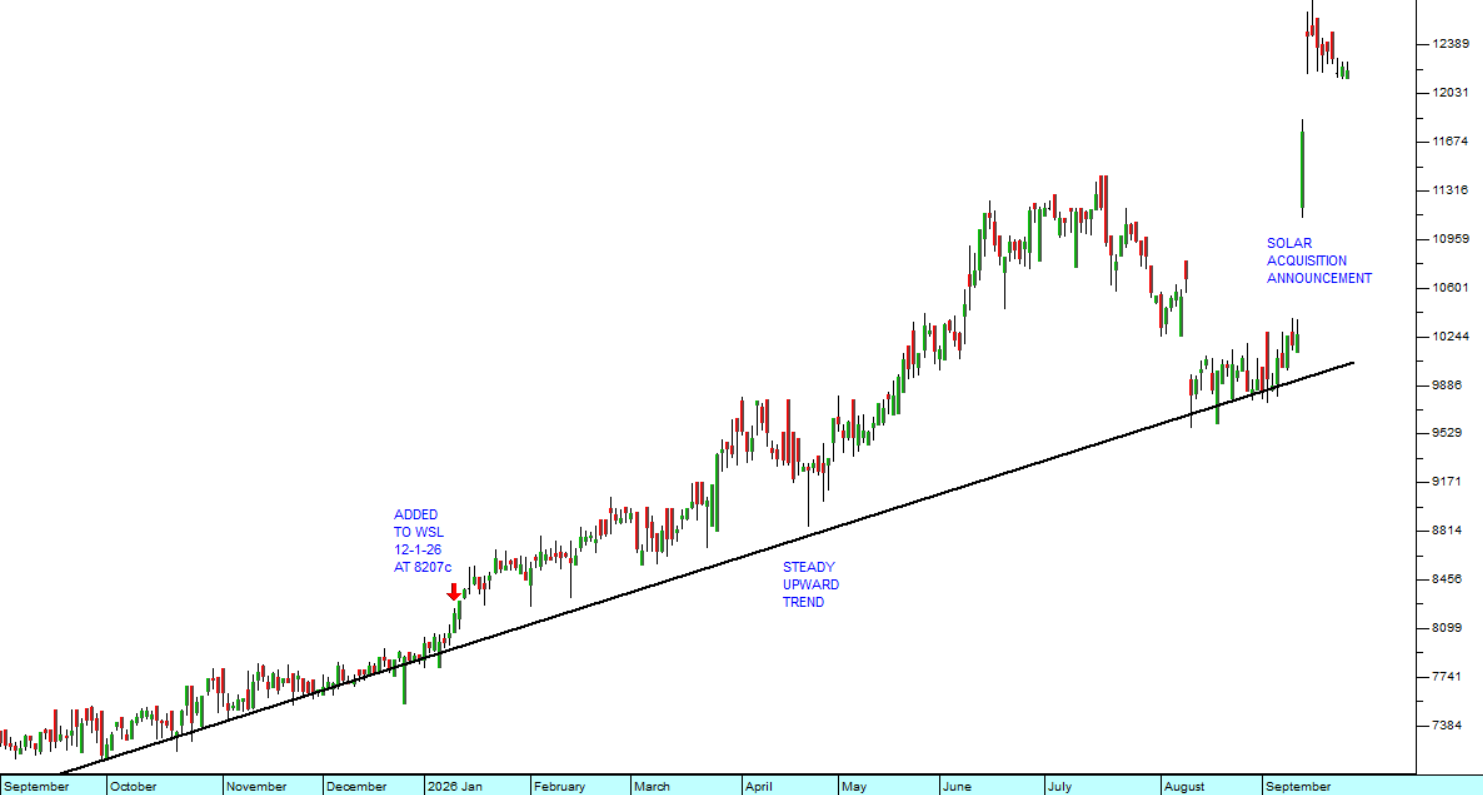
SOL SASOL 2026-02-19 12838 21357 +66.36% +214.34%
APN ASPEN 2026-02-14 12515 14649 +17.05% +52.74%
SNT SANTAM 2024-06-19 31059 39336 +26.65% +13.45%
VOD VODACOM 2025-02-04 11611 15051 +29.63% +21.93%
ADH ADVTECH 2023-08-14 1975 4350 +120.25% +42.49%
Opinions (Top 5)
Code Name Date Action
NVS NOVUS 2026-06-13 View

Novus (NVS) is South Africa's largest printing company with 11 printing plants. Until recently, it had the monopoly contract to do all of Media24's printing. With effect from 1-4-18, that contract was reduced to roughly 58% of Media24's printing and the price paid by Media24 for printing was also reduced.

The company appointed a new CEO, Neil Birch, who has decided in the short term to abandon the company's acquisitions and focus on consolidating the business and improving its operating performance. The board may also look to sell the company's tissue business. The company has a level 4 BEE status but will need to improve that to become more competitive.

On 12th August 2022 the company announced that it would acquire 75% of Pearson South Africa. In its results for the six months to 30th September 2025 the company reported revenue up 1% and headline earnings per share (HEPS) of 26,57c compared with 59,36c in the previous period. The company said, "The financial results for the six months ended 30 September 2025 ("period") is down compared to the prior period, largely due to the lower profitability of the Education segment following delayed procurement from the provincial departments".

In a trading statement for the year to 31st March 2026 the company estimated that HEPS would fall by between 0% and 8%. Technically, we suggested waiting for a convincing break up through a 65-day moving average before investigating further. That happened on 8-10-20 at 88c and the share has since moved up to 570c.

The share trades about R555 000 worth of shares a day on average which makes it practical for private investors. 

WEZ WESIZWE 2026-06-13 View

Wesizwe (WEZ) is a miner of platinum group metals through its development of the Bakubung Platinum Mine (BPM). The company is developing a mine to access the Merensky and Upper Group 2 (UG2) resources. The mine is near Rustenburg on the Western limb of the Bushveld complex. The company also owns 17,1% of projects 1 and 3 of Maseve Investments.

In its results for the year to 31st December 2025 the company reported headline earnings per share (HEPS) of 9,86c compared with a loss of 12,23c in the previous period. The company said, "...the Group experienced a material cybersecurity incident during the 2024 financial year which resulted in management being unable to provide sufficient and appropriate audit evidence in respect of certain transaction balances and underlying general ledger data".

The company is a marginal precious metals company which is subject to the vagaries of PGM prices - which makes it risky. The share has fallen from a high of 197c in October 2021 to levels around 34c on the recent results - it may well be heading for liquidation. The share was suspended on 4th June 2025 and remains suspended.

On 28th May 2026 the company announced that it expected to publish its integrated annual report for the year to 31st December 2025 on 5th June 2026. The JSE's suspension was lifted on 11th June 2026. 

MTH MOTUS 2026-06-13 View

Motus (MTH) was unbundled from Imperial (IPL) and separately listed on the JSE on 22-11-2018. It is a company that owns motor dealerships in South Africa, the UK and Australia. The company has four divisions - import and distribution, retail and rental, motor-related and financial services and aftermarket parts.

It imports and sells more than 80 000 vehicles per annum and runs 356 dealerships and 134 rental outlets for Tempest and Europcar. It offers vehicle finance and fleet management in South Africa with 730 000 clients. It retails parts and accessories for older vehicles through 720 franchised outlets.

Altogether it has a 20% share of the South African retail vehicle market, selling roughly 100 000 vehicles per annum. It is the importer of Hyundai, Kia, Mitsubishi and Renault. The CEO, Osman Arbee, said that the company plans to pay generous dividends because of its strong cash flows.

The company generates 65% of its turnover in South Africa and 93% of its operating profit. On 1st October 2021 the company announced that it had acquired FAI Automotive in the UK for R550m. In its results for the six months to 31st December 2025 the company reported revenue up 3% and headline earnings per share (HEPS) up 19%.

The company said, "For CY2025, the South African automotive market continued its momentum, recovering above 2019 pre-pandemic levels and reaching volumes not seen in a decade, with new vehicle sales of 596 818 vehicles 2. According to naamsa2, SA retailed 317 796 new vehicles for the six months to 31 December 2025 (17,8% above the prior period of 269 680 new vehicles), with passenger vehicle sales growing by 19,5%.

Management's forecast for new vehicle sales for CY2026 is between 600 000 and 630 000 new vehicles". In a pre-close update the company said that sales had moved above 600 000 for the first time in ten years. The company said, "...maintained strong utilisation levels: on the higher end of our target range of 65% to 75%, with record utilisation of 74% recorded for March 2026".

Technically, the share made a double bottom in  May and June 2026 and now looks to be moving up. It is now on a P:E of 6,4 - which makes it reasonably priced in our estimation. We see this as a very well-established company that is to some extent dependent on the state of the economy and the level of consumer spending.

It is benefiting directly from the surge of Chinese and Indian vehicle imports into South Africa. We think it will turn out to be a good investment, especially as the economy improves with the end of loadshedding and the new government of national unity (GNU). 

BEL BELL 2026-06-13 View

Bell (BEL) is a manufacturer and distributor of heavy equipment, earth-moving equipment to the mining construction, agriculture, and waste management industries. As such, it has been directly impacted by the slow-down in construction since 2008 and collapse of the mining industry.

Bell's articulated dump trucks are exported world-wide from South Africa and Germany. Bell also has dealerships for a number of other global manufacturers, giving it a product range of over 120 products. Roughly 60% of its business comes from outside South Africa. The company employs 3200 people of whom 88,6% are in South Africa.

The CEO of Bell, Gary Bell has indicated to Business Day that the company would consider delisting with 1A Bell making an offer to minorities (but he did not disclose at what price). Some of those minority shareholders are now saying that the board has a fiduciary duty to put the company up for sale to the highest bidder.

In its results for the year to 31st December 2025 the company reported revenue down 5% and headline earnings per share (HEPS) down 11%. In July 2024 the share rose sharply on a proposed buyout by the controlling family, but shareholders rejected their offer. Since then the share has been drifting down.

We do not see this as a great investment for private investors. On 4th March 2026 Bell announced that they had concluded a "collaboration" with CNH Industrial to supply construction equipment branded motor graders. On 11th June 2026 the company announced that the CEO, Ashley Bell,has resigned with effect from 31st August 2026.

He will be replaced by Izak van Niekerk.    

AFH AFORBES 2026-06-13 View

Alexander Forbes (AFH) is a financial services company offering asset management, insurance, healthcare, retirement, consulting, and wealth management to both corporate and private clients. It has a presence in 5 countries in Africa outside South Africa - Namibia, Nigeria, Botswana, Uganda, and Zambia.

In the past, the share has fallen from its high of just over R10 in February 2015 to around 430c today. Much of the fall was blamed on its previous CEO, Andrew Darfoor, who was said to have lost the confidence of the board and institutional investors. This was compounded by the resignation of the financial director, Naidene Ford-Hoon, after less than a year with the company.

Patrice Motsepe's African Rainbow Capital (ARC) has been instrumental in pushing for changes to the board. In its results for the year to 31st March 2026 the company reported income up 10% and headline earnings per share (HEPS) down 5%. The company said, "Headline earnings per share from total operations decreased 5% to 67 cents per share.

This movement primarily reflects base effect of the performance of the discontinued operations in the prior year rather than a deterioration in the underlying performance of continuing operations. On a normalised basis, headline earnings per share of 69 cents per share is stable year-on-year". Technically, the share is in a strong upward trend but has been drifting sideways and downwards since June 2025.

At its current price it is on a P:E of 11,19 and looks like good value. The company has sold its group risk and retail life business for R100m which it may use for acquisitions. 

Winning Share: SOL
Opinion: NVS
Market Catching its Breath  (2026-06-08)

Experienced investors know that when a market has run hard for a while, as it has for the last two months, some sort of correction is more-or-less inevitable. We suggested in the recent Confidential Report that right now you should be looking for that correction – and then on Friday the 5th of June…

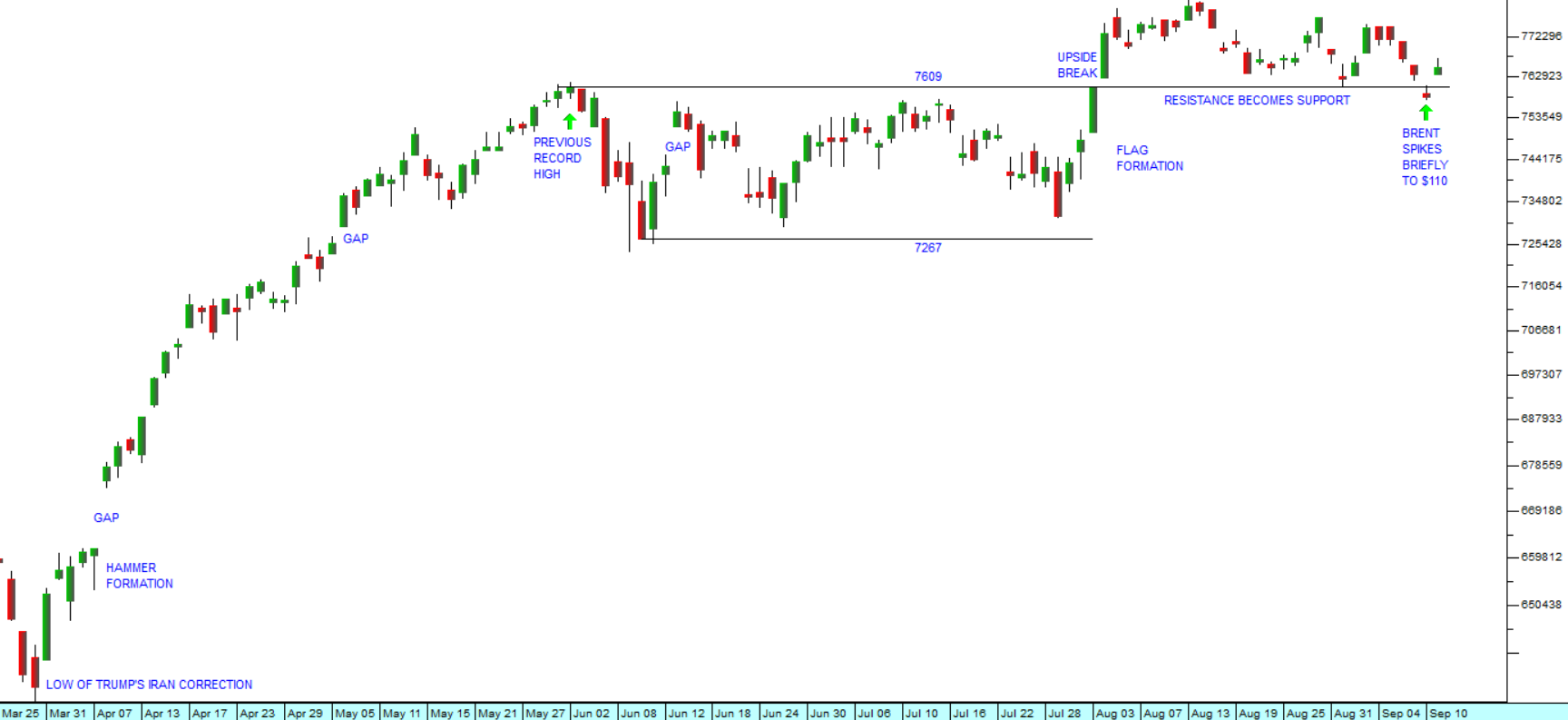
Experienced investors know that when a market has run hard for a while, as it has for the last two months, some sort of correction is more-or-less inevitable. We suggested in the recent Confidential Report that right now you should be looking for that correction – and then on Friday the 5th of June 2026, the S&P500, which was teetering after having made a new record high (7609.78) fell by an impressive 2,64%. Consider the chart:

S&P500 Index : 21st of January 2026 - 5th of June 2026. Chart by ShareFriend Pro.

The anatomy of a correction is that the positive news in the market reaches a point where it has been heavily over-discounted and shares begin to look seriously vulnerable and over-priced. Profit taking then sets in and the market falls back to more reasonable levels. This is a natural and normal pattern - even healthy - which reflects the interaction of the two great human emotions which dominate the market – fear and greed.

The fundamentals of a share can indicate what profits are likely to flow from owning it, while the technicals show the thrust of investor sentiment towards or away from it. When it comes to analysis, there are two kinds of people in the market – those that say they will not buy a share unless they can see the “real” value (the fundamentalists) – and those who say that the real value does not matter. What matters is what people think the real value is (the technicians). In other words, the reality and the perception of that reality.

And markets, like wildfires, can sometimes create their own energy. They can reach a point where they get carried up or down by the mere fact of their own momentum. In the longer term, the positivism or bullishness which is driving this market up today is beginning to become a self-fulfilling prophecy. Some investors are now coming into the market, not because they have done their homework and can see the earning potential of the shares that they want to buy, but rather because they are confident that in a few weeks’ or months’ time, someone with even less knowledge than them will buy the same shares back from them at a higher price.

When this begin to happen, the share’s price tends to lose touch with its underlying fundamentals and become over-priced. The fundamentals may be very good – but the important question is, “Are they good enough to justify the current price?” In 1998, during the dot-com boom, the blue sky potential of the nascent internet boom seemed immense – just as the potential of AI seems immense to us today. But, markets went too far, bid shares up too high, and inevitably fell back to more reasonable levels. However that did not mean that the potential of the internet was suddenly gone – far from it. The internet’s potential was only just beginning to be understood. It was just that markets had become too excited and lost sight of their underlying fundamentals.

We pointed out in our article of 18 May 2026 that the S&P 500 chart is becoming exponential. The blue sky potential of shares is now the dominant factor in investors’ assessments, with the focus shifting to possible future profits rather than established track records. Investors are concentrating on forward, rather than historical, P:E ratios. It is sobering to realise that all three of the enormous new listings coming to Wall Street this year—SpaceX, OpenAI, and Anthropic—are still unprofitable..

In our view, the current correction on Wall Street, and hence on markets around the world including the JSE, is more than likely temporary. After a period of selling, the downward trend will almost certainly give way to bullish investors seeking to buy the dip. Since there is no obvious fundamental factor driving this downward trend we see it as almost completely technical – and therefore temporary and healthy. The market is literally catching its breath.

What is interesting is that the JSE Overall index made its record high on 27th February 2026, at 128456, and has been basically trending down since then. It is apparent that local investors never really believed much in Wall Street’s strong recovery from Trump’s Iran war correction. We have found that often the JSE is a leading indicator of what happens on Wall Street.

Southern Sun Hotels  (2026-05-25)

The Hotel business was probably the worst hit of all sectors during the pandemic in 2020. With the travel restrictions and the various difficulties aimed at preventing the spread of the disease, many business people simply elected to stay at home and conduct meetings on Zoom or Skype. Conventions of…

The Hotel business was probably the worst hit of all sectors during the pandemic in 2020. With the travel restrictions and the various difficulties aimed at preventing the spread of the disease, many business people simply elected to stay at home and conduct meetings on Zoom or Skype. Conventions of various sorts which are major business for hotels also stopped almost completely. Gradually, over the proceeding years the situation has steadily improved, and occupancy rates have climbed back.

From an investor’s viewpoint, the hotel industry offers a very secure and relatively unexciting investment. It has a substantial investment in land and buildings and it has a large staff contingent. In normal times, it can be expected to grow steadily as the economy grows. It remains sensitive to political risk and economic external shocks.

Southern Sun Hotels (SSU) was spun out of Tsogo Sun (TSG) and separately listed on 12th June 2019 – immediately before COVID-19. The share opened at 400c and quickly rose to 460c. It was always expected to be a solid well-traded institutional counter. As the pandemic gained momentum, the share collapsed, eventually reaching an intra-day low of 102c on 23rd March 2020.

At that point it was trading well below its net asset value (NAV), clearly under-priced given its huge property asset base and potential. Slowly, as investors began to realise that the pandemic was past its worst levels and that a vaccine would be produced, they looked around for bargains in the market and SSU was an obvious candidate. Consider the chart:

Southern Sun Hotels (SSU) : January 2020 - 22nd May 2026. Chart by ShareFriend Pro.

You can see here the impact of the pandemic on the newly-listed SSU. At the time we always said that COVID would result in a V-bottom and therefore a buying opportunity precisely because it was a black swan event and its effects would not last. In our article published on 13th March 2020 we said, “...my expectation is that we will see a “V-bottom” in the chart...” SSU (together with many blue chip shares) moved sideways at its worst level for about year and then began to recover.

Then in February 2022, Russia invaded Ukraine and the share price collapsed again – but this time not as badly as during COVID, which was by that time already fully discounted. The subsequent recovery was slow and steady. We finally added the share to the Winning Shares List (WSL) on 17th May 2024 at a price of 555c, but a more adventurous investor might easily have bought it much earlier and at lower levels.

The chart also shows the impact of Trump’s tariffs which initially caused a significant sell-off and, more recently this year, his war with Iran. Both of these events offered private investors further solid buying opportunities, especially for a relatively low-risk share like SSU.

In its results for the year to 31st March 2026 the company reported income up 9% and headline earnings per share (HEPS) up 20%. The company said, "Trading momentum increased in the second half of the year, with broad-based improvements across all regions underpinned by major international conferences and events including the G20 in Gauteng and improved transient demand in South Africa."

Since we added the share to the WSL it has risen 80% in two years. We believe it will continue to perform well as the economic reforms of the government of national unity (GNU) begin to eliminate or at least reduce some of the absurdities in the South African economy. The November municipal elections at the end of this year are likely to increase and consolidate the DA’s grip on the GNU making this effect more pronounced.

Exponential Bull Trend  (2026-05-18)

The current bull trend, in our opinion, began in 2009 from the low point on the S&P500 index of 676 reached on 9th March of that year. It has now been going on for over 17 years – making it the longest bull trend in the history of Wall Street by far. On Thursday, May 14, 2026, the S&P 500 closed at…

The current bull trend, in our opinion, began in 2009 from the low point on the S&P500 index of 676 reached on 9th March of that year. It has now been going on for over 17 years – making it the longest bull trend in the history of Wall Street by far.

On Thursday, May 14, 2026, the S&P 500 closed at a new all-time record high of 7,501 and the Dow Jones Industrial index went back above 50 000. This means the market has gone up 11-fold over the past 17 years. The question which investors have to ask themselves is, “How much further up can it go?” – and nobody really knows the answer to that question.

The historical price:earnings ratio (P:E) of the S&P500 is now just under 32 – which is well above its average level, but this does not necessarily mean that it cannot go higher. The fundamentals driving the 500 shares which make up the index are a direct function of their perceived future earnings and their potential to increase those earnings even further.

This in turn is a function of the on-going impact of new technologies like AI, and humanoid robotics on productivity levels. The problem is that during a protracted bull trend like this one, markets tend to become over-enthusiastic about that future potential, to the point where they begin to create their own momentum. Then share prices can begin to lose touch with the underlying profitability of the companies which they represent – and Wall Street is certainly moving in that direction.

A similar situation arose in the 1920’s when the new technologies of the motor car and the telephone began to become ubiquitous. These technologies impacted the profitability of all companies big and small giving rise to the “Roaring Twenties”. As Wikipedia puts it, “...the decade was characterized by economic prosperity, rapid social and cultural change, and a mood of exuberant optimism.

The problem is that investors tend to push share prices up so high that their potential to produce concomitant profits becomes irrelevant to investors. In other words, the investors get carried away in the excitement and bid shares up to absurd and unsustainable levels. Eventually a “bigger fool” point is reached where investors buy a share, not because of its earnings potential, but because a bigger fool will buy it back from them in a few weeks for even more money. The inevitable result is a 1929-style crash.

So, we need to ask, “Is Wall Street at a similar position now?” We believe it is getting there, but not yet. The new technologies are certainly impacting profitability across the board but the upward trend has not yet become crazy. It is still linked to future profits. So, we believe that Wall Street is still at a relatively early stage in this process and that the bull trend will continue for quite a while, getting steadily more and more excessive.

Our view is that the profitability gains flowing from AI are only just beginning. We are expecting far greater gains in the future. In our view America and the world is at much the same point that it was at, say, in 1923 or thereabouts, just when the Roaring Twenties were just getting going.

Sometimes it is useful to step back from the immediate excitement of the latest all-time record highs to look at the big picture. Consider the following chart which shows the progress of the S&P500 index since the start of this great bull trend 17 years ago:

S&P500 Index : November 2008 - 15th of May 2026. Chart by ShareFriend Pro.

The chart shows the progress of the S&P500 index since March 2009. You can see there the low point of 676 followed by a very gentle upward slope until about 2016. Thereafter, the gradient increased, but not very much and it was interrupted by the COVID-19 pandemic in 2020. Bear in mind that we regard COVID-19 as an aberration, not directly related to the stock market from a technical point of view. After that came the war in Ukraine which held the market back for a time, but since then the market has been accelerating despite Trump’s two interventions. What you can see from this chart is that the market is definitely becoming exponential. It is going up faster and faster. The move from 7000 on the S&P to 8000 is definitely quicker than the move from 6000 to 7000. The chart is rising almost vertically now.

And we can only imagine where the S&P500 would be now if the Brent oil price was still at around $70 per barrel instead of close to $110. Trump’s war in the Middle East has had the effect of temporarily cooling markets, but it has been insufficient to dampen the tidal wave of investor enthusiasm for the “blue sky” potential of AI and related technologies.

It is always fun to participate in the final stages of a great bull market, but you must be aware that nothing goes up forever. Your best protection against the coming bear, whenever it happens, is to maintain a strict stop-loss strategy on all your share investments. Remember, it is acceptable to widen your stop-loss percentages when your investments are strongly in-the-money, but you can never lose sight of the fact that at some unpredictable date in the future the market will come down – so it is important to have a clear strategy that locks in your profits.  

JSE Top 40

104,698.00 (+2.33%)

All Share

112,721.00 (+2.24%)

Financial 15

25,845.00 (+2.01%)

J200
J203
J212
Top Gainers
# Code Name Close (c) % move
1 SKA SHUKA 75 +19.05%
2 ISO ASPI 10791 +12.11%
3 RNG RANGOLD 118 +11.32%
Top Losers
# Code Name Close (c) % move
1 TEX TEXTON 301 -33.11%
2 WEZ WESIZWE 64 -20.99%
3 CHP CHOPPIES 133 -11.33%

Top Movers – Charts

Top Gainer: SKA
Top Loser: TEX