Market View
J200 109,287.00 -0.29% J203 116,948.00 -0.38% J210 137,622.00 +0.88% J211 129,290.00 -0.14% J212 24,620.00 -1.83% J213 138,561.00 -0.94%
Winning Shares (Top 5)
Code Name Added Price Latest % Gain % Gain/Year
SUR SPURCORP 2023-08-08 2488 4000 +60.77% +23.42%
ADH ADVTECH 2023-08-14 1975 3960 +100.51% +38.98%
CGR CALGRO-M3 2023-08-15 356 500 +40.45% +15.71%
CAA CA-SALES 2023-08-25 775 1468 +89.42% +35.09%
CPI CAPITEC 2023-11-04 185496 419915 +126.37% +53.70%
Opinions (Top 5)
Code Name Date Action
MNK MONTAUK 2026-03-13 View

Montauk (MKR) is an American company that specialises in extracting methane from landfills, mostly in America. The company benefits from the fact that America requires refiners of fuel to include a percentage of renewable fuels in their product. This gives Montauk a lucrative guaranteed market for its product.

In fact, they do not have sufficient landfills in America and they are now experimenting with cow manure as a new source. In its results for the year to 31st December 2025 the company reported headline earnings per share (HEPS) down 62,5% and net asset value (NAV) up 2,8% at 184c (US) per share.

In our opinion this share remains fully priced at current levels on a P:E of 36,73 (12-3-26). Another problem is that the company is very dependent on the regulatory environment in America. If the government decides to change the rules, its profitability could evaporate. Aside from those risks, it is a rand-hedge share which is involved in exploiting renewable energy in the United States - which possibly makes it interesting.

SBK STANBANK 2026-03-13 View

Standard Bank (SBK) is 160 years old and is South Africa's second largest bank by market capitalisation - after First National Bank. It has widespread interests in the rest of Africa which are now contributing 34% of its headline earnings. 20% of its shares are owned by the Industrial and Commercial Bank of China (ICBC) and it owns 40% of ICBC Standard Bank - which was previously Standard Bank Plc in the UK (ICBCS).

Following COVID-19 bank had about 70% of its staff working from home. This business is also obviously impacted by load-shedding in South Africa and the latent effects of the coronavirus. In our view this is an excellent investment for private investors at current levels - but it is long-term.

As COVID-19 fades, the economy will pick up and Standard Bank's profits will improve. On 15th July 2021 the company announced that it would make an offer for the ordinary shares and preference shares in Liberty Holdings (LBH). Liberty shareholders got 0,5 Standard Bank shares and R25.50 in cash for each LBH ordinary share which they had.

This gave an implied valuation of just under R90 per LBH share - which was a 33% premium to its price (R67.48) prior to the announcement. The bank is benefiting from increased client numbers and rising interest rates. In its results for the year to 31st December 2025 the company reported headline earnings per share (HEPS) up 12% and return on equity (ROE) of 19,3%.

The company's net asset value (NAV) increased 7% to 16277c per share which can be compared with its current share price (12-3-26) of 29536c. Then company said, "In the 12 months to 31 December 2025 (FY25), Standard Bank Group (the group or Standard Bank) recorded headline earnings of R49.2 billion and delivered a return on equity (ROE) of 19.3%, at the top end of the group's 2025 ROE target range of 17% to 20%.

The banking businesses delivered a strong performance driven by solid balance sheet growth and robust growth in fees and trading revenues". The share price has been rising steadily since May 2020 - and it now looks like very good value on a dividend yield (DY) of 4,28%. In our view this is a very solid long-term investment.

SLM SANLAM 2026-03-13 View

Sanlam (SLM) is one of the largest insurance and financial services groups in South Africa. It was established in 1918 and demutualised in 1998 and then listed on the JSE and the Namibian Stock Exchange. It has operations in South Africa, the UK, America, Europe, India, and Australia as well as a range of other African countries.

Its product range includes general insurance, life insurance, asset management, banking, credit, health and bancassurance. The business has four essential elements: 1. Sanlam Investment Holdings (SIH) - now 25% owned by African Rainbow Capital 2. Sanlam Emerging markets - which includes its 84,5% interest in Saham 3.

Sanlam Personal Finance 4. Santam - in which it owns 61% Outside of South Africa, it has operations in 11 other African countries and Malaysia. Saham has operations in 33 French-speaking countries with 3000 staff members operating out of 700 branches offering a similar product mix to Sanlam.

Sanlam also owns 26% of Shriram which is a leading provider of insurance products and financial services in India. It also made a deal to acquire 69% of Catalyst Fund Managers, a Cape-based manager of listed property assets and 100% of an Irish company, CIG Fund Management. About 50% of Sanlam's profits come from its personal finance operation which is primarily based inside South Africa.

It is therefore impacted by the low levels of consumer spending in this country as well as the economic recession. Sanlam is 18% black-owned and has initiated a partnership with African Rainbow Capital (ARC) in which it intends to focus on lower- and middle-income consumers and small companies.

Sanlam will provide R2bn of seed capital. In its results for the year to 31st December 2025 the company reported new business volumes up 18%, but headline earnings per share (HEPS) down 18%. The company said, "Headline earnings declined by 18%, largely due to corporate activity and structural changes in 2024 and 2025, lower investment returns in shareholder funds due to the strengthening of the rand in 2025, as well as negative investment variances". Sanlam is one of the JSE's foremost blue-chip shares with a history of steady growth over a long period of time.

After recovering somewhat from the fall in markets due to Trump's tariffs it is currently trading on a P:E of 11,6 (12-3-26). We consider it to be good value at these levels. 

SDL SOUTH-PD 2026-03-13 View

An Australian palladium mining company with a secondary listing on the JSE. South PD owns 70% of a South African company called "Miracle upon Miracle" (MUM). In cooperation with the Bengwenyama community the company is engaged in exploration for platinum group metals. The main business activity of the Company is the advancement of its Bengwenyama Platinum Group Metal (“PGM”) project, located in South Africa.

The company raised A$19m to explore in the Limpopo bushveld complex where MUM owns the prospecting right. In its results for the six months to 31st December 2025 the company reported interest income up 24,8% and a headline loss of 0.045c (A$) up 7,1%. The company said, "During the period, the company successfully completed a two-tranche placement at $1.10 per share, issuing 18,181,819 ordinary shares and raising $20,000,000".

Clearly, this is a very thinly-traded mining exploration company with all the associated risk. Technically, the share is in an upward trend but volumes tend to be patchy. It was added to the Winning Shares List (WSL) on 9th September 2025 at 725c and has since risen to 2099c. It remains a volatile commodity play.

GRT GROWPNT 2026-03-12 View

Growthpoint (GRT) is South Africa's largest real estate investment trust (REIT) with a primary listing on the JSE. Prior to COVID-19, it consistently grew its dividends 3% above the inflation rate on average over the last 15 years. The company owns 434 properties in South Africa worth R71bn.

In addition, it has a 62,2% interest in Growthpoint Properties Australia (GOZ) which is listed on the Australian Stock Exchange (ASX) and owns 57 properties worth R49,8bn and an 18,2% investment in ASX-listed Industrial REIT. It also has 4 equity-accounted investments worth R16bn - including a 50% holding of the V&A Waterfront in Cape Town, a 29,4% stake in Global Real Estate Investments which is listed on the London Stock Exchange (LSE) and a 21,6% interest in Global Worth Poland Real Estate (GWRE) which is listed in Warsaw.

Altogether, Growthpoint has 59,2% of its assets in South Africa and 40,8% elsewhere. The company has acquired a 60,8% stake in Capreg which is listed in London and on the JSE and owns 7 properties in the UK worth R14,8bn. We regard Growthpoint as a high-quality blue-chip property group and a solid long-term investment for private investors.

The company is battling with an over-supply of office space following COVID19 and the work-from-home move. In its results for the six months to 31st December 2025 the company reported distributable income per share up 2,3% and revenue up by 2,4%. The company's loan-to-value (LTV) improved slightly to 33,2%.

The company said, "A total of 364 813m² was renewed across 453 leases during the period with 140 632m² (82 leases) in the Logistics & Industrial portfolio, 118 262m² (103 leases) in the Office portfolio and 105 919m² (268 leases) in the Retail portfolio". Technically, the Growthpoint share has been trending up since October 2023 and looks set to continue in that direction, especially as interest rates continue to fall.

In the short-term the share price has been hit by the war in Iran.  The share is still trading well below its NAV. We regard it as a solid, if unexciting, investment. .

Winning Share: CAA
Opinion: SDL
The Iran Correction  (2026-03-09)

Trump’s decision to bomb Iran and kill the Supreme Leader of over 200 million Shia Moslems was taken without the consideration and approval of Congress and without the cooperation of other Western countries. It is the typical act of a dictator and has embroiled America in what looks like an…

Trump’s decision to bomb Iran and kill the Supreme Leader of over 200 million Shia Moslems was taken without the consideration and approval of Congress and without the cooperation of other Western countries. It is the typical act of a dictator and has embroiled America in what looks like an unplanned war situation. This may prove to be very difficult to conclude on any reasonable basis, and especially without a significant cost both in money and American lives.

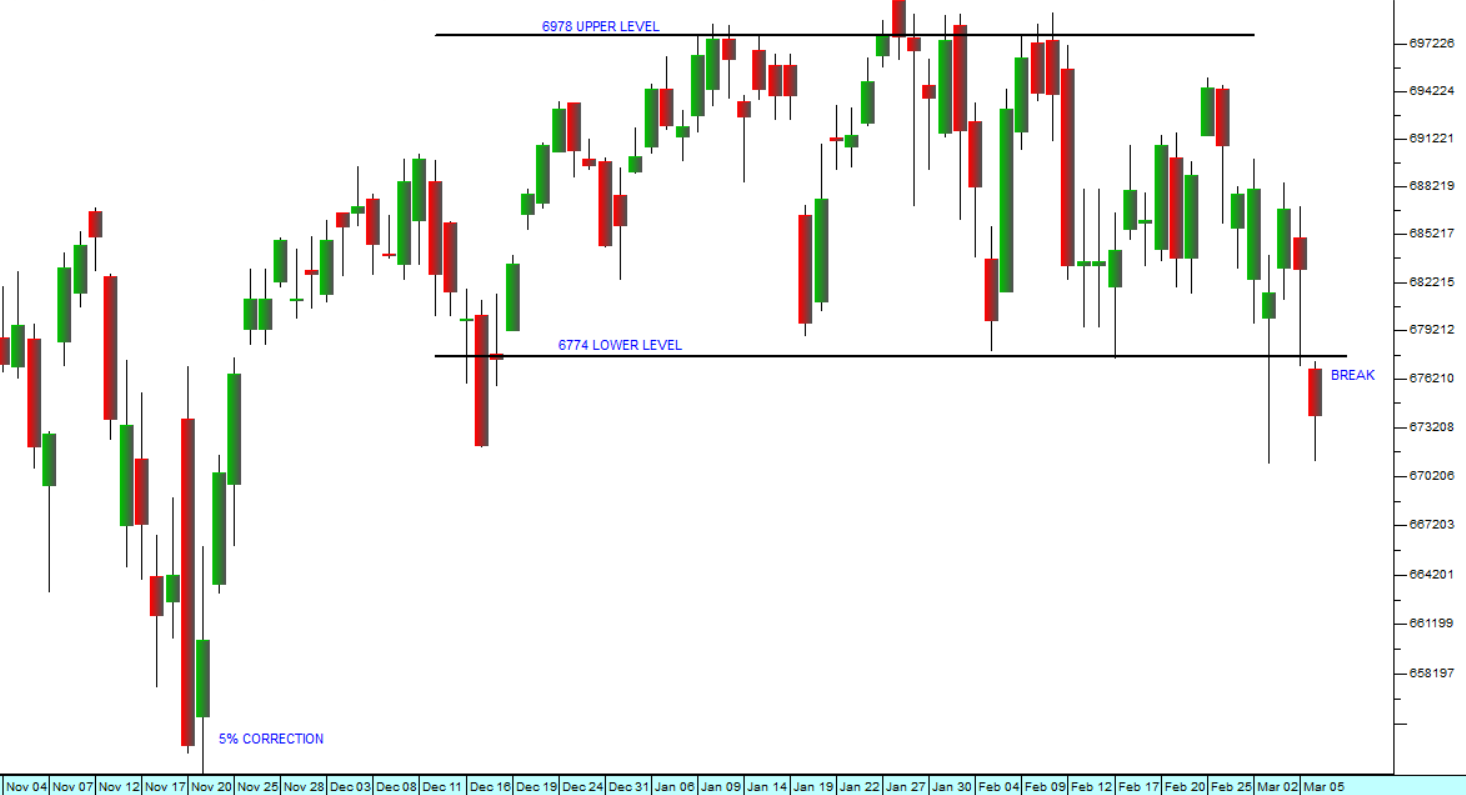
Combined with other disturbing economic data, this has taken Wall Street out of the sideways pattern that it has been in since late last year and put it into a correction. The S&P500 index has so far fallen 3,4% from its all-time record high of 6978.6 on 27th January 2026. Consider the chart:
S&P500 Index: 4th of November 2025 - 6th of March 2026. Chart by ShareFriend Pro.

Part of the problem is the increasingly negative data coming out of the US economy, especially in the labour market. The most recent US jobs report showed that the US economy lost 92 000 jobs in February 2026.

Disturbingly, the steadily deteriorating monthly jobs numbers are an indication either that either the economy may be headed into recession or that the spread of artificial intelligence (AI) technologies is putting a large number of Americans out of work. Consider this chart published on Friday last week by CNBC:
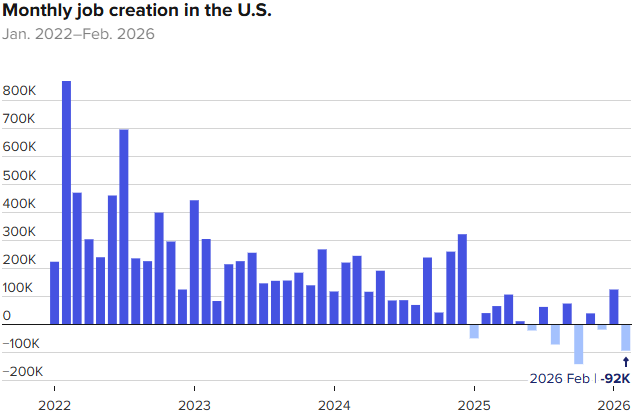
Monthly job creation in the US: 2022 - March 2026. Available at:

https://www.cnbc.com/2026/03/06/february-2026-jobs-report.html

This shows a pattern of falling job creation going back to the beginning of 2022 and becoming steadily more negative in recent months. Combined with this, the unemployment rate has also been edging up and came in at 4,4% in February. This is somewhat higher than the unemployment rates below 4% which characterised the end of Joe Biden’s presidency, painting a concerning picture.

In our view, the productivity benefits of new technologies like AI should, in the medium term, more than compensate for the inevitable loss of jobs. In effect, the US economy is adjusting rapidly to a radically disruptive force which is reshaping the business environment and causing a sharp re-allocation of capital. Some businesses will benefit and others will disappear for ever.

In the longer term, once the dust settles, the economy should emerge stronger and that is why we believe that this is probably a correction rather than a new bear trend – but you will notice that what looks like a correction right now could develop into a head-and-shoulders formation if the record high of 6978.6 on the S&P is not broken when the market recovers.

At the moment, the positive news coming out of the tech sector is being off-set by the bad news on the political front and Trump’s war in Iran. If we are lucky, the war in Iran will be resolved on some basis - probably because he will probably back down in the face of increasing pressure both at home and abroad. If this happens in a relatively short time, the market will turn its attention back to the rapid progress of new technologies and hopefully recover to make a further new all-time record high in due course.
AngloGold Ashanti  (2026-02-23)

It is no secret that precious metals prices have been running. Most of the best-performing shares on the Winning Shares List (WSL) are mining companies with interests either in gold or platinum group metals (PGM). Gold in particular has dominated the investment world. The metal has risen 145% in US…

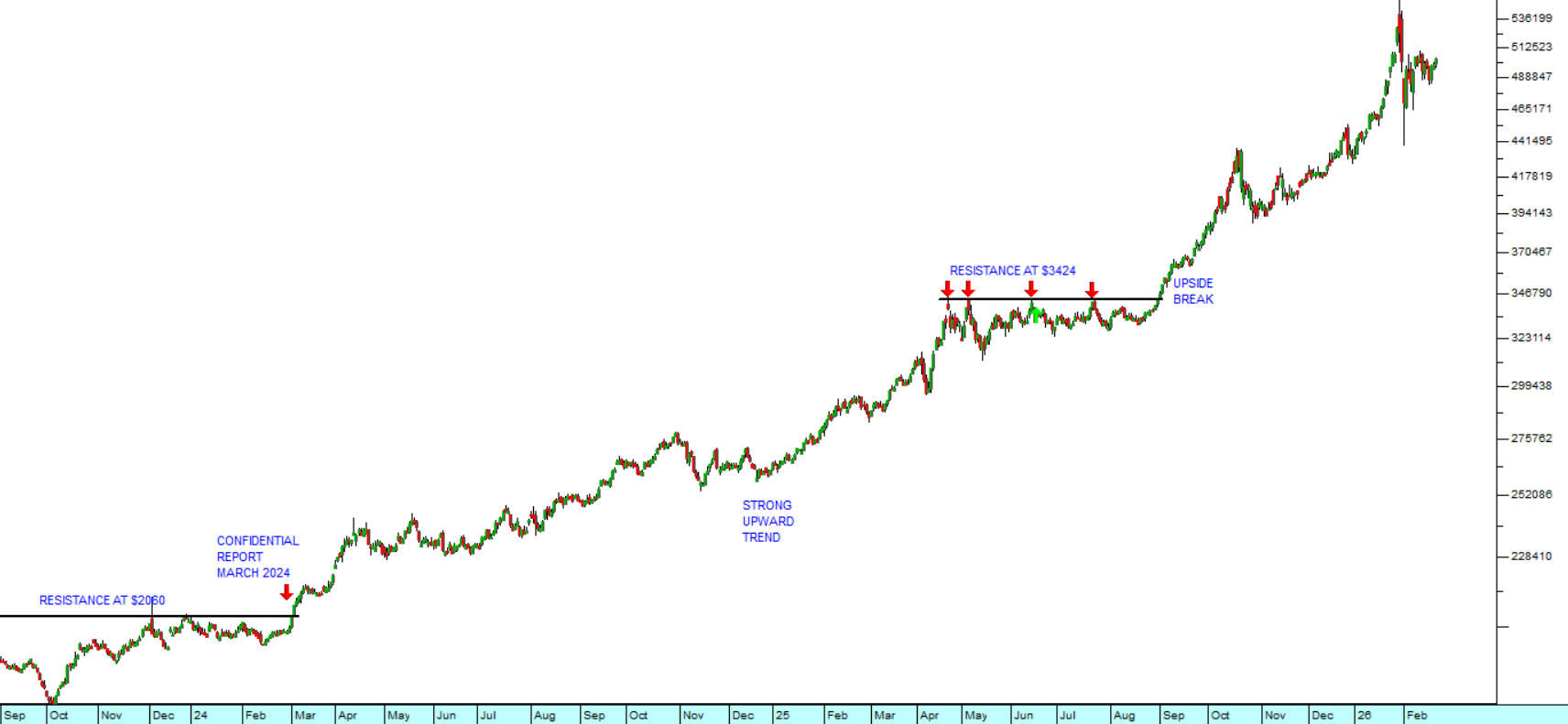
It is no secret that precious metals prices have been running. Most of the best-performing shares on the Winning Shares List (WSL) are mining companies with interests either in gold or platinum group metals (PGM). Gold in particular has dominated the investment world. The metal has risen 145% in US dollars since it broke up through resistance at $2060 at the beginning of March 2024, as reported in the Confidential Report of that month. Consider the chart:

Price of Gold in US dollars : September 2023 - 20th of February 2026. Chart by ShareFriend Pro.

As you can see here the break above resistance at $2060 sparked a strong upward trend. There was another period of resistance at $3424 in the middle of last year which was finally broken to the upside in early September. Gold may now, once again, be in for a period of consolidation, but the trend is clear.

The rising gold price is primarily due to central banks choosing to buy and hold gold as their most secure asset, rather than US Treasury Bills, despite the fact that gold offers no return. This is a testament to the rising levels of perceived geo-political risk in the world and gold’s ancient and undisputed status as the world’s most secure asset.  

AngloGold has been a great beneficiary of the rising gold price. In its latest financials for the year to 31st December 2025, the company reported a 16% increase in production combined with a 45% increase in the average gold price received. Costs were flat in real terms which generated a massive 186% increase in headline earnings.

The company's total cash costs increased 7% over the year to $1242 per ounce with all-in-sustaining costs (AISC) of $1709 – against a gold price of over $5000. This is an immensely profitable company. Total dividends paid for the year amounted to $1,8bn or 357c (US) per share – which is R57.19.

The company was originally formed to consolidate the gold interests of Anglo American in South Africa. Those interests included ERGO, Eastvaal, Southvaal, FreeGold, Elandsrand, Joel and Western Deep. Today, AngloGold owns no South African mines at all. It has 11 mining operations on 4 continents, and it has moved its head office to New York and its primary listing to the New York Stock Exchange (NYSE). Given that South Africa still has more than 5000 tons of proven underground gold reserves, this is a sad reflection of ANC’s hostile attitude towards the mining industry in this country over the past 30 years and what that has cost us.

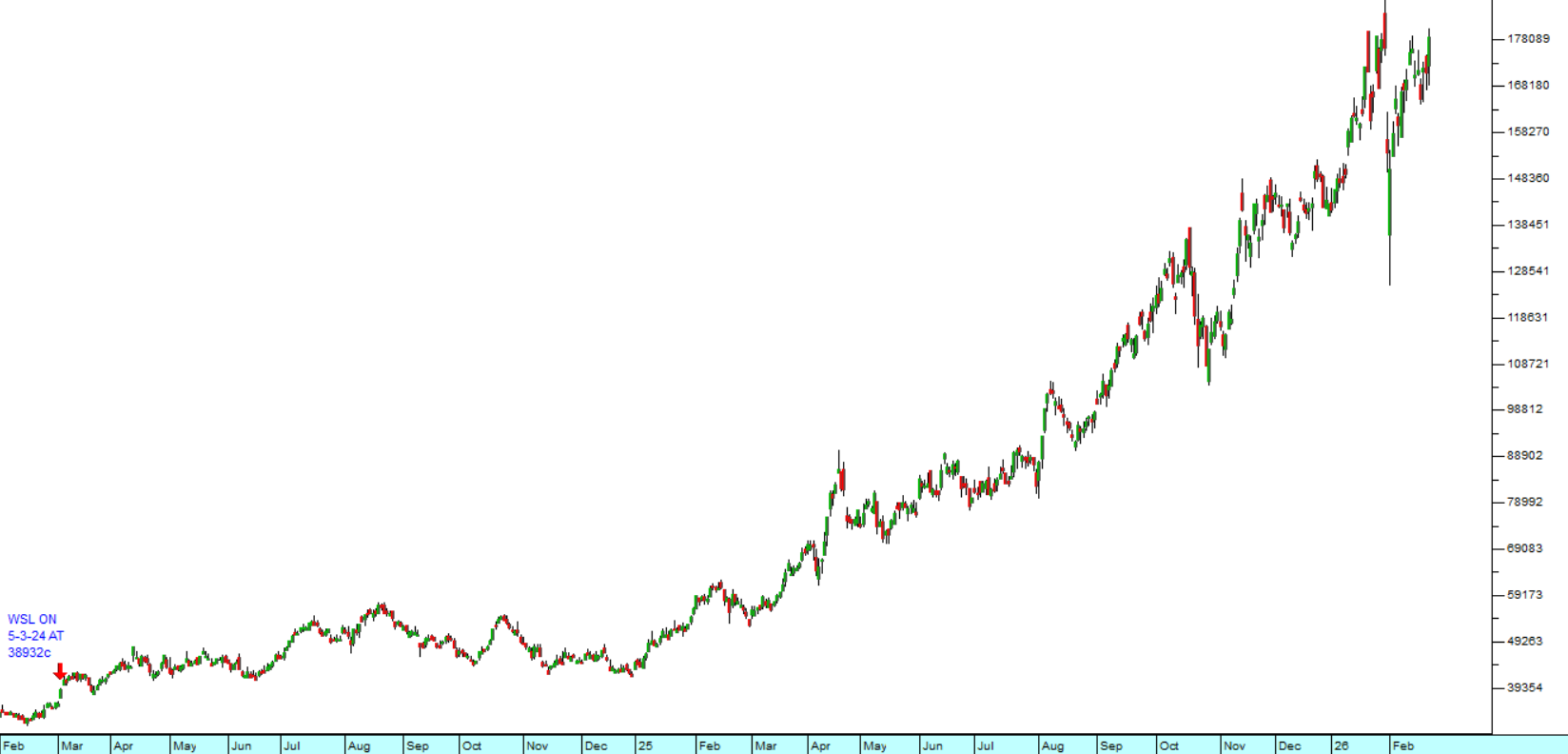
We added AngloGold to the WSL on 5th March 2024 at a price of 38932c – mainly because we could see that gold was breaking up through that key level at $2060. Since then the share has risen to 179102c – a gain of almost 340% in 718 days or 172,6% per annum. Consider the chart:

AngloGold Ashanti (ANG) : February 2024 - 20th of February 2026. Chart by ShareFriend Pro.

AngloGold is constantly adjusting its portfolio, adding exciting new gold prospects while divesting itself of non-performing assets. During 2025 it acquired Centamin which is proving to be a great addition. It also made three further acquisitions in Nevada. These acquisitions have increased the company’s mineral reserve to 36,5 million ounces – a 17% increase on 2024. This means that the company will be able to continue mining profitably for many years, especially considering its very low cost of extraction.

In our view, this share is speculative because it is dependent on the international price of gold over which it has no control. But it is geographically diversified and extremely well managed with relatively low costs and minimal debt. We believe that it will continue to perform well.

Hudaco Latest Financials  (2026-02-16)

In their latest financials for the year to 30th November 2025 Hudaco describes itself as “...a South African group specialising in the importation and distribution of a broad range of high-quality, branded automotive, industrial and electronic consumable products, mainly in the southern African…

In their latest financials for the year to 30th November 2025 Hudaco describes itself as “...a South African group specialising in the importation and distribution of a broad range of high-quality, branded automotive, industrial and electronic consumable products, mainly in the southern African region”.

It has long been one of our favourite shares on the JSE and we have written two articles extolling its virtues the first on the 7th February 2021 and the next on the 14th of February 2022. It is essentially an investment in the growth prospects of the South African economy. It is not a dramatic performer, but rather a company that is growing steadily both organically and through careful bolt-on acquisitions.

It is well worth taking the time to read their latest financials for the year to 30th November 2025. The fundamentals revealed in their figures should make any investor in their shares feel happy.

Their turnover for the year increased by 4,4% - which is barely above the inflation rate but still shows growth in real terms. What is impressive, however, is that out of that turnover, they managed to increase their operating profit by 8,9% and their headline earnings per share by 15,7% - and this is after taking a R104m goodwill impairment. Their return on equity (ROE) for the whole group was 17% and would have been 19,5% without the impairment. This shows that they kept costs tightly controlled while improving efficiencies across the board – in other words, that they have excellent management.

During the year the company made two acquisitions – Isotec and Flosolve – both of which have now been integrated into the business. Their results are only included for six and seven months respectively – so we can expect them to have a much greater impact on the current year’s results.

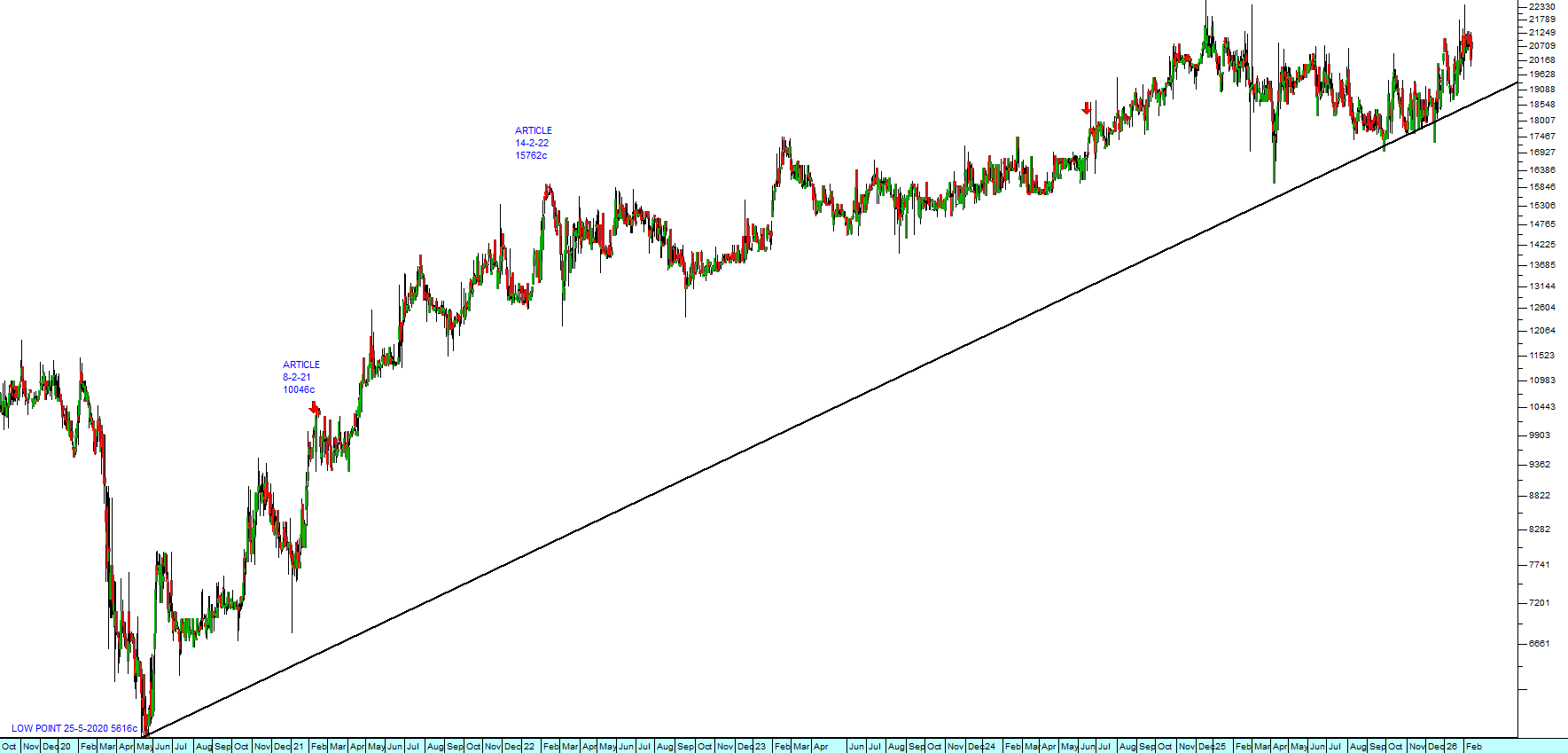
Consider the chart:

Hudaco (HDC) : October 2020 - 13th of February 2026. Chart by ShareFriend Pro.

The chart shows that following COVID-19, Hudaco reached a low point of 5616c on 25th May 2020. Since then it has been rising steadily. We wrote about it in our article on 7th February 2021 by which time the share has reached 10046c and then again, a year later, on 14th February 2022 when it was at 15762c. Since then, the share has climbed to 20680c and looks poised to go higher.

This business supplies a variety of products to the mining industry and so is benefiting indirectly from the rising prices of platinum group metals (PGM), gold and copper. They are also benefiting from the on-going reduction of interest rates and the falling cost of petrol in South Africa which directly impact on the profits of their customers.  

The current price/earnings ratio (P:E) is only 8.9 which is roughly half of the JSE’s average P:E of 16,8. This shows that its value is not yet fully appreciated by institutional investors.  With an average daily volume traded of more than R3,5m, Hudaco is certainly more than adequate for private investor requirements and can now accommodate small institutional investments comfortably.

We expect this share to continue to grow, especially considering its proven track record of conservative and effective management combined with its policy of making regular bolt-on acquisitions. If you are positive about the prospects of the South African economy in the medium term, then this share is well worth your consideration.

JSE Top 40

109,287.00 (-0.29%)

All Share

116,948.00 (-0.38%)

Financial 15

24,620.00 (-1.83%)

J200
J203
J212
Top Gainers
# Code Name Close (c) % move
1 OAO OANDO 20 +17.65%
2 MCZ MC-MINING 355 +12.34%
3 EXP EXEMPLAR 1550 +8.77%
Top Losers
# Code Name Close (c) % move
1 AII AIMIA 0 +0.00%
2 SZK SABKABILI 3000 -11.76%
3 ISB INSIMBI 63 -10.00%

Top Movers – Charts

Top Gainer: OAO
Top Loser: AII