Market View
J200 103,629.00 -0.82% J203 111,526.00 -0.77% J210 113,534.00 -0.23% J211 127,832.00 +0.41% J212 25,845.00 -2.43% J213 141,527.00 -1.06%
Winning Shares (Top 5)
Code Name Added Price Latest % Gain % Gain/Year
PMR PREMIER 2024-08-21 7635 18850 +146.89% +65.62%
GLD NEWGOLD 2024-01-18 35895 60577 +68.76% +24.30%
MTN MTN-GROUP 2025-01-15 9729 22905 +135.43% +73.78%
APN ASPEN 2026-02-14 12515 17500 +39.83% +52.87%
RDF REDEFINE 2025-07-18 480 648 +35.00% +26.29%
Opinions (Top 5)
Code Name Date Action
TKG TELKOM 2026-11-17 View

Historically, Telkom (TKG) was the government-controlled provider of fixed line telephone connectivity in South Africa. With the advent of cell phones, Telkom was forced to subsidise the development of its own competition in the form of Vodacom, MTN and more recently Cell-C. This subsidy takes the form of termination rates for calls which are now being phased out.

Over the past twenty years, the CEO of Telkom, Sipho Maseko, says that Telkom has effectively subsidised other networks to the tune of R70bn. Telkom is currently listed and is owned 41% by the government and 11,9% by the Government Employees Pension Fund (GEPF) - so it could still be considered to be government-controlled.

In reality, it operates as an independent organisation divided into 4 divisions. (1) Open Serve is South Africa's primary supplier of wholesale connectivity with the country's largest network. (2) Telkom Consumer is the largest supplier of broad-band internet connectivity with a growing mobile phone network.

(3) Yellow Pages provides advertising and marketing to local businesses. (4) BCX is an ICT solutions company operating in Southern Africa. In its results for the year to 31st March 2026 the company reported revenue up 1,4% and headline earnings per share (HEPS) up 30,1%. The company said, "Group EBITDA(1,2) up 5.8%(3) to R12 480 million, reflecting structural improvements in the cost base, resulting in EBITDA margin(1) expanding to 28.1%.

Further improvement in cost to income ratio(2) to 73.0% from 75.1%(3), benefitting from 1.1% decline in total costs". In an update on the 1st quarter to 30th June 2026 the company reported revenue up 8,8% and group EBITDA margin expanded to 27,7%. The company said, "The total Mobile subscriber base increased by 6.1% to 25.3 million, underpinned by pre-paid subscriber growth, while data subscribers grew 15.5% to 19.8 million".

Technically, Telkom's share fell from highs of around R98 in June 2019 to levels around R15.00 in March 2020. It has now entered a new upward trend and it was added to the Winning Shares List (WSL) on 16th November 2024 at 2884c. It has since risen to 5439c (4-8-26). The latest results and the special dividend from the sale of Swiftnet boosted the share's price.

In our view, this company has been battling to find a new direction in a recovering economy and against stiff competition, but the latest results are positive. On 16th November 2026 MTN announced that it had re-commenced negotiations to acquire Telkom resulting in a jump in Telkom's share price.

NY1 NINETY-1L 2026-11-17 View

17-11-2026 Ninety-One is an asset management company spun out of Investec and separately listed on Monday 16th March 2020. The listing occurred just as the corona epidemic was causing world stock markets to crash so the shares fell more than 40% below their pre-listing range on the first day.

There was no initial public offer (IPO). In our view this massive blue chip share is significantly under-valued at current levels. The company's employees now own 22,5% of its equity.  Obviously, this company's performance was impacted by the decline in equities since the pandemic - but the value of its assets under management (AUM) was rising as markets around the world recovered.

In its results for the six months to 30th September 2026 the company reported that its AUM increased by 19% and basic earnings per share (EPS) down by 8%. The company said, "We have successfully completed the integration of Sanlam Investment Management on schedule, and expanded our emerging markets presence".

This share is directly impacted by the direction of the trend on Wall Street and world markets. Technically, the share entered a downward trend in February 2026 and may now represent a buying opportunity on a P:E of 10,27 (13/10/2026). The company confirmed its assets under management at the 30th September 2026 at GBP181,4 billion compared to GBP171.8 billion on the 31st of March 2026.

Over the past year the Sanlam UK active asset management business has been taken over by Ninety One adding GBP18,3bn to its AUM. 

MTN MTN-GROUP 2026-11-17 View

17-11-2026 MTN is a leading emerging market mobile operator, serving 317.7 million people (including 29m in South Africa) in 19 countries across Africa and the Middle EaSt. MTN's three largest subscriber bases are in Iran, Nigeria and South Africa. Generally, companies supplying a mobile service have been faced with very stiff competition and declining voice revenue.

The sharp increase in data usage has, to some extent, mitigated this change, but these companies remain quite risky. MTN is especially risky because of the political risk in Iran and Nigeria. MTN is working with Sanlam to offer insurance products to its clients in the hopes that "fintech" will become a major part of its business.

The goal is to turn MTN into a "...digital operator with a major focus on the fintech, digital, enterprise and wholesale business areas." MTN has rolled out its mobile money services in both Nigeria and South Africa. It is currently offering these services in 19 out of the 21 countries where it operates, and it has 41,8m mobile money customers.

It is trying to increase that number to 60m. MTN has now listed on the Nigerian stock exchange. The company announced that Mastercard would take a R100bn stake in its fintech business and partner with it to expand that business. In its results for the six months to 30th June 2026 the company reported service revenue up 17,5% and fintech revenue up 13,3%.

Headline earnings per share (HEPS) increased by 21,3%. Total customers increased by 6,7% to 317,7m. The company said, "MTN delivered strong growth, record profitability and robust cash generation in H1 2026, while maintaining balance sheet strength and advancing key strategic initiatives that support long-term shareholder value creation".

In an update for the 3 months to 30th September 2026b the company reported service revenue up 17,2% and EBITDA up 22,9%. The company said, "Share buyback progressing: R2 billion worth of shares bought back during the period under the R6 billion buyback programme".

The share fell from its cycle high in March 2022 and we recommended applying a downward trendline from that peak and waiting for a clear upside break before investigating further. That break came on 7th December 2024 at a price of 9289c. It was added to the Winning Shares List (WSL) on 14-1-25 at 9729c and has since moved up to 22419c (9-11-26) after some profit taking.

We still see it as a good opportunity at the current price. On 13-11-26 the company announced that it had recommenced negotiations to acquire Telkom.

SRE SIRIUS 2026-11-17 View

17-11-2026 Sirius (SRE) is a real estate investment trust (REIT), listed on the JSE and the London Stock Exchange (LSE), which specialises in office, manufacturing, and warehousing properties in Germany. The company owns 141 assets with a book value of about 3.12bn euros. Obviously, this is a well-managed and growing rand-hedge which was benefiting directly from the recovery of the German economy before COVID-19.

The company has formed a joint venture (JV) with AXA Investment Managers in terms of which AXA will own 65% and Sirius will own 35%. The JV (called "Titanium") acquired 5 business parks from Sirius for 168m euros - which is a 19% premium to their book value. The JV will allow Sirius to double the value of its assets over the next two years.

In its results for the six months to 30th September 2026 the company reported revenue up 17,9% and earnings per share (EPS) down 62,7%. The company said, "Profit after tax decreased by 60.8% to €34.1m (30 September 2025: €87.0m) reflecting a net deficit in valuations of €24.0m after capital expenditure (compared to a €14.4m gain in the comparative prior period), a €9.5m net increase in finance expense due to increasing interest rates and decreasing interest income following the utilisation of cash for €400.0m bond repayment and the effect of a €29.5m deferred tax release in the comparable period last year due to reducing German corporate tax rates". Technically the share has been in a volatile rising trend since October 2022.

At current levels, it is on an earnings multiple of 16,91 - which makes it one of the most highly rated REIT's on the JSE and therefore possibly vulnerable. It is also, obviously, a rand hedge. 

EPS EASTPLATS 2026-11-17 View

17-11-2026 East Plats (EPS) is a mining exploration and development company engaged in the platinum group metals (PGM) and chrome markets in South Africa. The company is listed on the Toronto Stock Exchange (TSX) and the JSE. The company has three projects - the Crocodile mine, which ceased operating in 2012 and is under care and maintenance, Sound Mine Solutions engaged to produce an independent technical report on the Zandfontein tailings retreatment and storage facility to recover chrome, and the Zandfontein project, which is a tailing retreatment project conducted with Union Goal.

On 11th February 2019, the company announced that it had made its first shipment of 10 000 tons of chrome concentrate from the Zandfontein operation. The company still foresees considerable cash flow uncertainties over the next 12 months which brings its "going concern" status into question.

In its results for the year to 31st December 2025 the company reported revenue up 31,2% and a loss of 9c (US) compared with a loss of 6c in the previous period. The auditors expressed a material concern over the company's ability to continue as a going concern. The company said, "Net loss attributable to equity shareholders was $18.4 million ($0.09 loss per share) in FY2025 compared to net loss attributable to equity shareholders of $12.8 million ($0.06 loss per share) in FY2024".

In an update on the 1st quarter of 2026 the company reported revenue down 6,8% and an attributable loss of $4,1m compared with a loss of $6,9m in the comparable period. The company said, "We had a challenging first quarter as monthly run-of-mine processing tonnages at the Crocodile River Mine were lower than targeted".

In an update on the 3 months to 30th June 2026 the company reported revenue down 25,8% and a net loss of $6,1m. In an update on the 3 months to 30th September 2026 the company reported a net loss to shareholders of $2,8m. The company said, "Revenue for YTD 2026 decreased to $35.2 million (YTD 2025 – $39.2 million), representing a $4 million or 10.2% decrease". The share is very thinly traded with very few shares trading on average, each day - which makes it impractical for private investors.

The company announced that Changyu Liu would be appointed as interim CEO with effect from 13th August 2026.

Winning Share: PMR
Opinion: MTN
Nvidia  (2026-11-16)

Charismatic leadership in business can often be a major problem. When a company is dominated by a single individual who then becomes incapacitated for some reason, the result is normally a sharp downward re-rating of the share. Charismatic leadership can increases the key-person risk for an…

Charismatic leadership in business can often be a major problem. When a company is dominated by a single individual who then becomes incapacitated for some reason, the result is normally a sharp downward re-rating of the share. Charismatic leadership can increases the key-person risk for an investor.

In the current case of Nvidia, the CEO, Jensen Huang, has now resigned following a series of scandals regarding his extra-marital affairs and their possible link to Chinese spying. The impact on the share price over the past month has been substantial. On 6th October 2026 Nvidia shares closed at $241,90 and on Friday last week they closed at $162,83 – that is a drop of almost one third and wiped $1,85 trillion off its market capitalisation. Consider the chart:
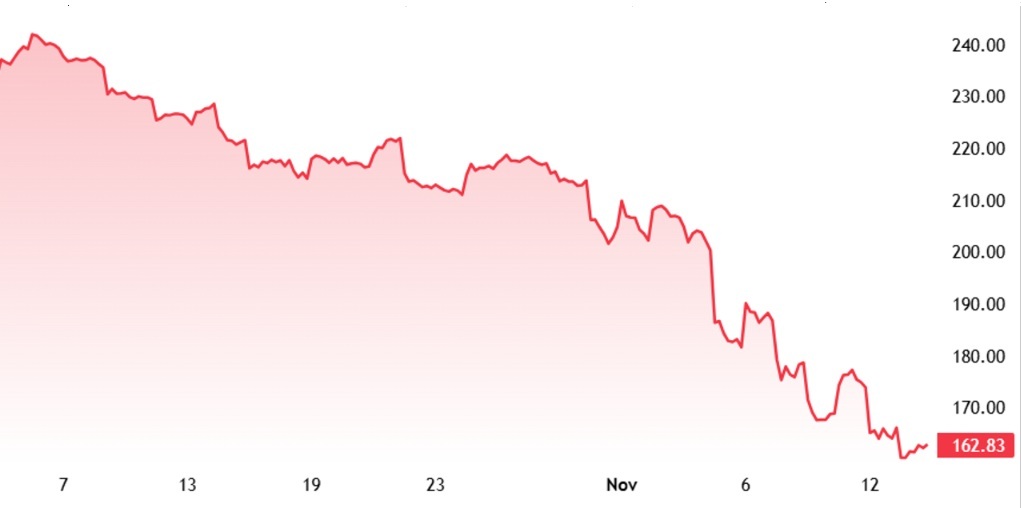
Nvidia : 7th of November 2026 - 13th of November 2026. Source: https://www.tradingview.com/symbols/NASDAQ-NVDA/?timeframe=3M


Huang was the co-founder of Nvidia in 1993 and had served as its President for 33 years. After early struggles, the company broke through with chips like the RIVA 128 and went public in 1999, the same year it introduced the GeForce 256—the world's first graphics processing unit (GPU). This led to the bold bet to launch CUDA, a parallel computing platform that allowed GPUs to handle general-purpose computing—laying the foundational software architecture for modern deep learning and artificial intelligence (AI). This scaled Nvidia into the backbone of the global AI and data centre revolution, driving the company to a multi-trillion-dollar valuation and transforming it into one of the most influential technology companies in history.

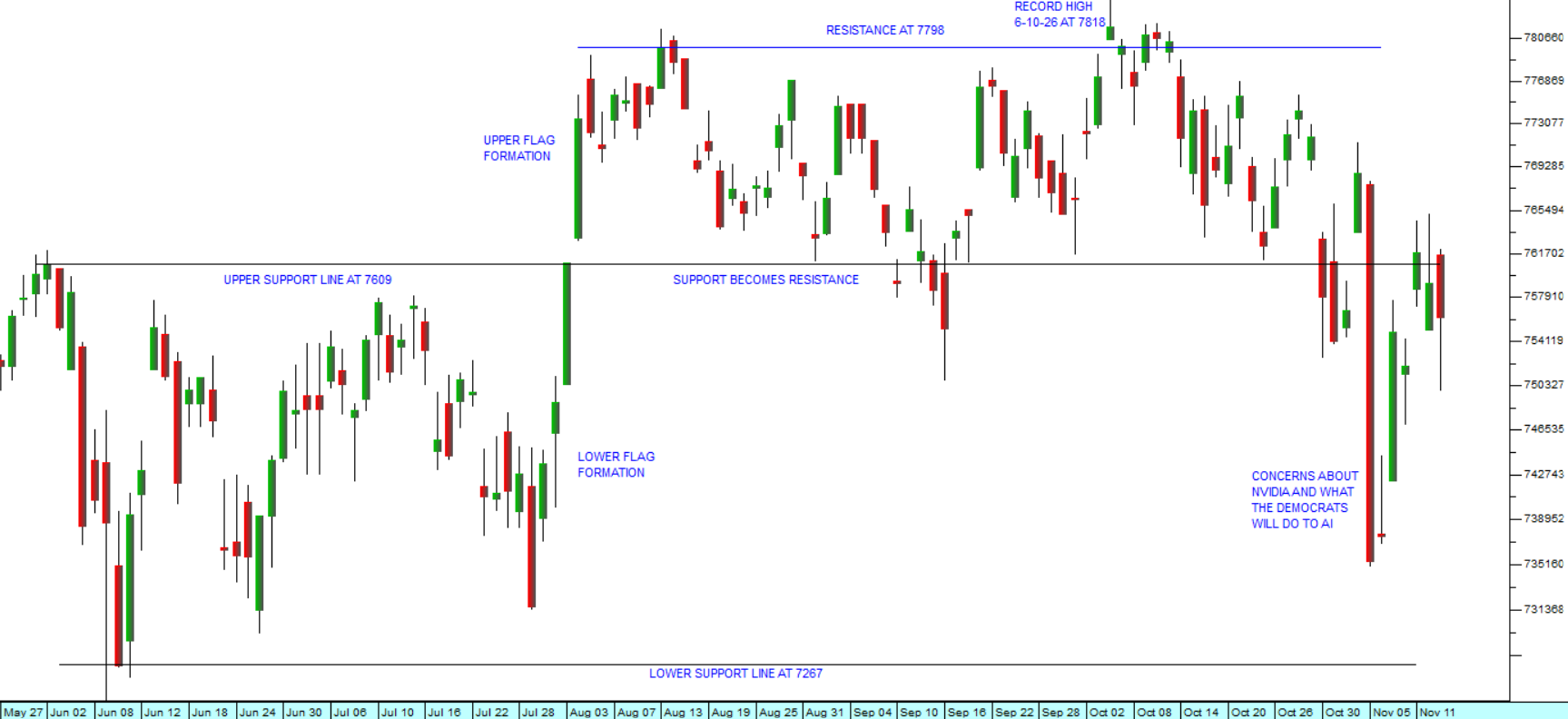
Clearly, Huang was an important person and his leadership on the Nvidia board was crucial – so when rumours began circulating of his relationship problems and the possible connection to China, investors began selling the stock as concerns about leadership uncertainty increased. What is interesting is that the sharp decline in the price of Nvidia has not dragged the other shares in the Magnificent 7 down with it, and while it was the main contributor to a correction in the S&P500, it has not precipitated a major collapse. The S&P500 also reached an all-time record high on 6th October 2026 closing at 7818, but it was only down by 3,3% from that record high at Friday’s close. Consider the chart:
S&P500 Index :  27th of May 2026 - 13th Of November 2026. Chart by ShareFriend Pro.

The chart shows that developments at Nvidia combined with concerns around what the Democrats might do to curtail the growth of AI took the S&P500 down but did not penetrate the lower support line at 7267. In our view, AI has its own momentum and is now stimulating growth in most companies across America and the world. The Democrat victory in the mid-term elections is unlikely to derail that. One major positive impact of the election was that it immediately brought the price of North Sea Brent down to $95.

In our view, the Democrat win also brings another major positive – it signals the end of the MAGA/Trump era with all the uncertainty that that entailed. Notably the JSE Overall index has actually been going up since 6th October 2026 showing that local investors never really believed that Wall Street was in a major correction. We are expecting further declines in the price of oil and fewer disruptive shocks from the Trump administration going forward.  
Democrat Sweep  (2026-11-09)

It seems fair to say that while most analysts and investors expected the Democrats to do well in the US mid-term elections, most were also caught completely off-guard by the extraordinary extent and depth of that win - and this has resulted in a burst of increased volatility in the markets as they…

It seems fair to say that while most analysts and investors expected the Democrats to do well in the US mid-term elections, most were also caught completely off-guard by the extraordinary extent and depth of that win - and this has resulted in a burst of increased volatility in the markets as they adjust to the new reality. Trump’s decision to appoint Stephen Miller as his Chief of Staff shows that he has no intention of moderating his position by working with the Democrats – instead he is doubling down on the extreme right-wing politics which has made him so unpopular.

The initial reaction to the vote was undoubtedly one of relief and euphoria as the Democrats claimed first the House and then the Senate. Then the next day that excitement gave way to fear that they might use their now overwhelming power to somehow curtail or limit AI and the build out of data centres across America.

This led, the next day, to a massive 4,4% drop in the S&P500, completely wiping out the gains of the previous day and taking the NASDAQ particularly, down sharply. Voters and newly elected officials have already passed dozens of local measures restricting data centres (from outright bans to temporary moratoriums), while incoming governors in states like Texas and Georgia have signalled plans to pause or heavily regulate new construction.

Hyperscalers and data centre operators have been funding massive expansions with heavy borrowing and private credit. Rising AI credit costs and heavy debt loads have sparked fears among investors of financial strain, stranded assets, or potential defaults if demand falls short. What if the direction of the technology changes and these huge investments are suddenly irrelevant and there is an unsupportable overhang of debt and abandoned assets?

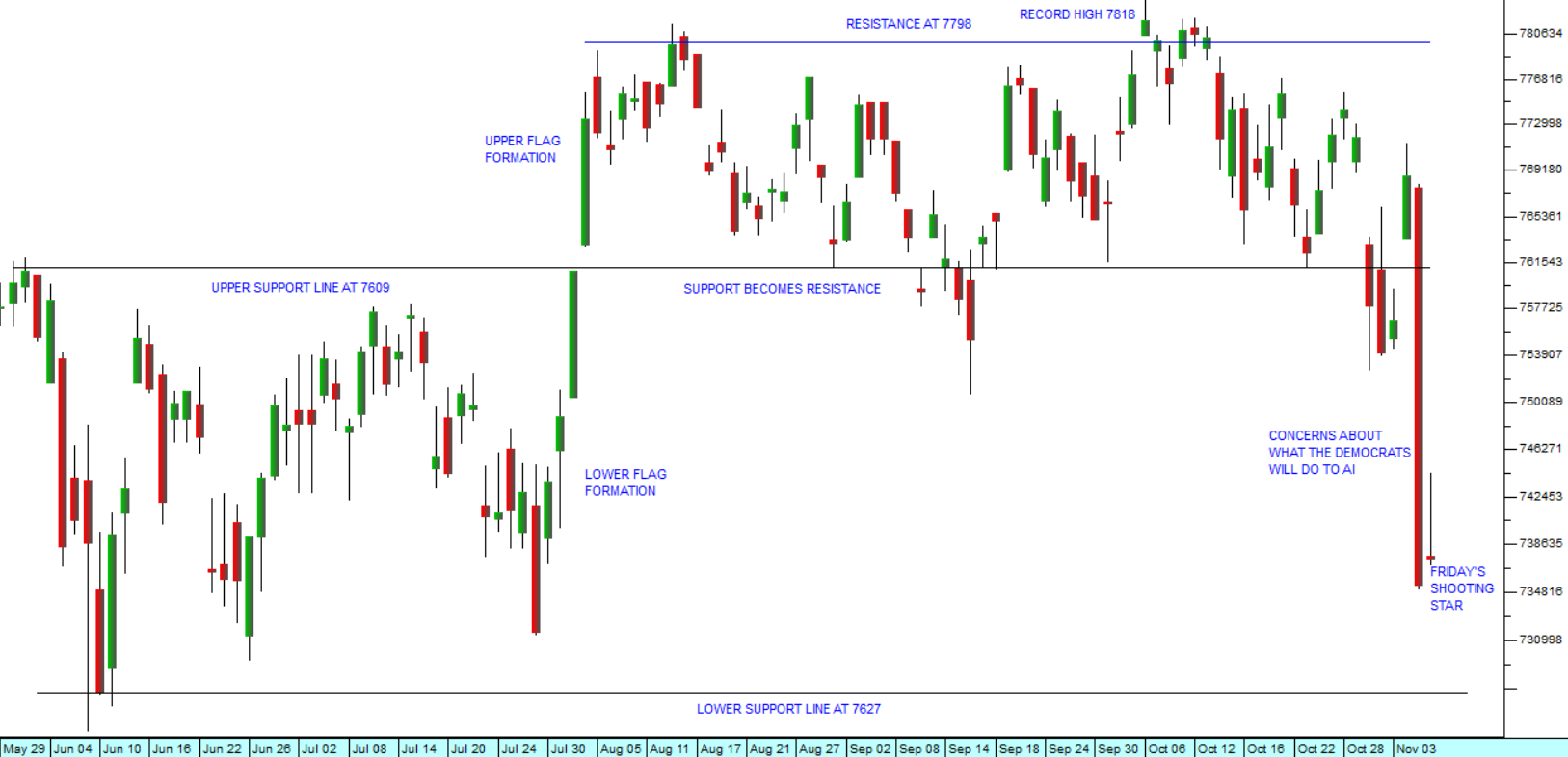
Those fears, added to the fact that tech shares were very already high and due for some kind of correction, has led to a rapid rotation out of AI and into other sectors or into cash. Consider the chart:

S&P500 Index : 29th of May 2026 - 6th of November 2026. Chart by ShareFriend Pro.

Of course, the Anthropic IPO is due to happen on 19th November 2026 and their prospectus has already been issued. They are looking to raise between $80bn and $100bn off a market valuation of between $1,5tr to $2tr. That will now almost certainly have to be curtailed – possibly to as little as $1tr. While Anthropic showed explosive growth - posting $16.3 billion in revenue for the first half of 2026 (up 1,300% year-over-year) - it also recorded an $80.7 billion net loss during that same period.

As a private investor on the JSE watching all this unfold on world markets and with our own election results in the background, you must obviously ask how these things will impact on emerging markets and on South Africa in particular. Our markets, and especially the rand have remained remarkably stable throughout the turbulence. The rand weakened, as far as R16,75 to the US$ and strengthened as far as R16,35, and now has settled in the middle ground of R16,51. This shows that the sharp downward move on Wall Street has not resulted in a huge shift towards risk-off among international investors. The smart money is still buying South African high-yield bonds and our relatively cheap high-quality equities.

On Friday, the US markets stabilised with many investors buying the dip and other even going as far as selling put options for a quick gain if the market recovers some of its former balance. However, the  shooting star formation does not bode well for the coming week. From a purely technical perspective, the lower support line on the S&P at 7626 now becomes important. If that is broken then we are in a full-blown correction.

Against this, we look at the underlying fundamentals of the third quarter S&P500 company earnings and feel that, at the very least, the Thursday sell-off was over-done. At this time 88,2% of S&P500 companies have reported and 82% of those have beaten earnings projections while 74,6% beat revenue expectations. This shows that the bull trend has been very well supported by rising profits across the board. In other words, it does not have the look of a bubble in the throes of bursting. But, in these turbulent times, your ultimate protection remains your stop-loss strategy.

Sasol and the Rising Oil Price  (2026-10-26)

Every major event that happens in the world inevitably offers some kind of investment opportunity for the private investor. The challenge is to work out how best to capitalise on it. So, it was with the war in Iran. At the time that the war began with the Israeli and American bombing raids on 28th…

Every major event that happens in the world inevitably offers some kind of investment opportunity for the private investor. The challenge is to work out how best to capitalise on it. So, it was with the war in Iran.

At the time that the war began with the Israeli and American bombing raids on 28th February 2026, we had already been watching the progress of Sasol for some time. The situation in Iran was tense with riots reported and North Sea Brent had climbed back up to $70 per barrel, but we had no idea that the Americans and Israelis were about to launch a bombing attack.

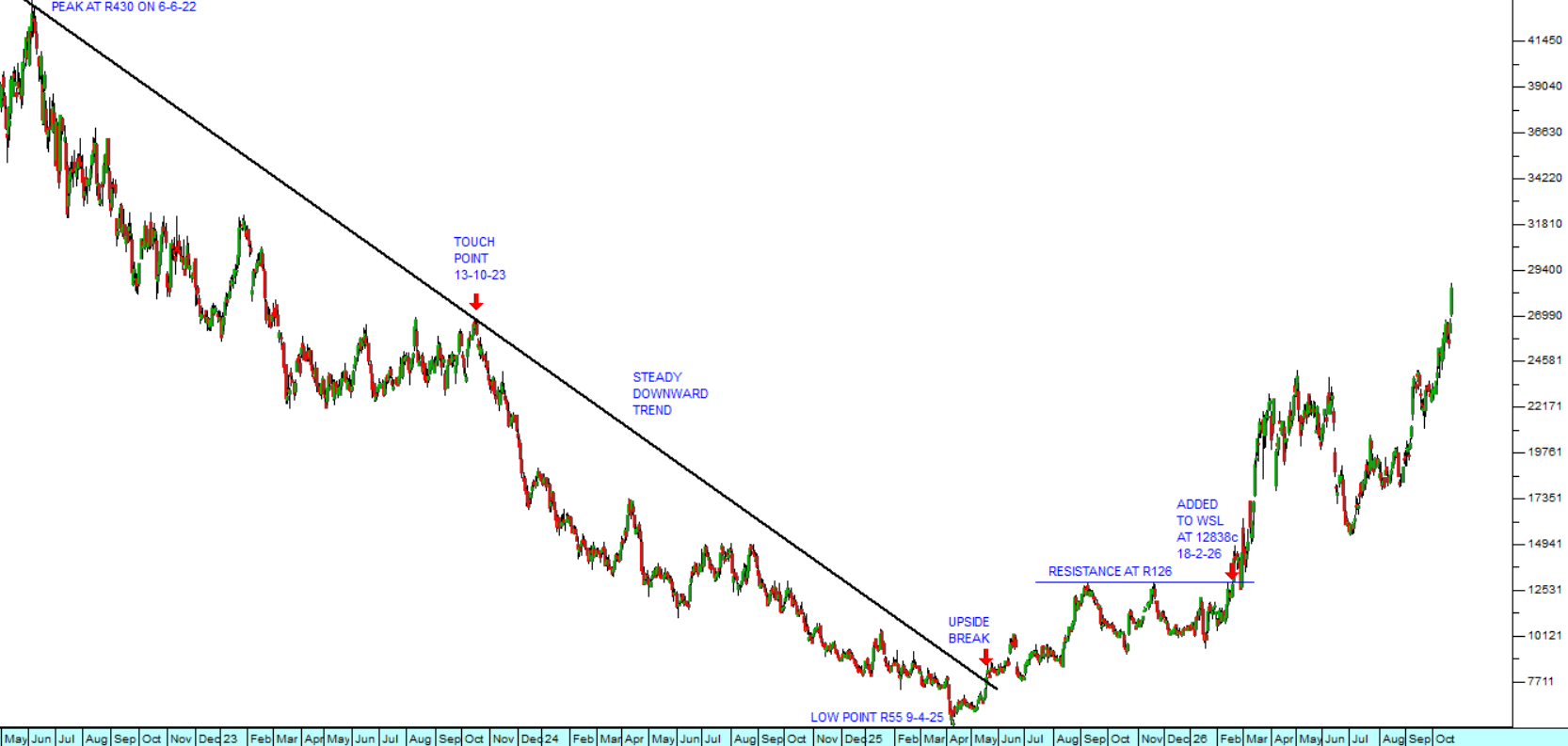
Sasol was always a blue-chip share and has historically occupied a dominant position in South Africa's synthetic fuels industry. It had, however been through some difficult times and the share price had fallen from a high of R430 per share to as low as R55 in April 2025. It then went through an extended period of sideways consolidation. We finally decided to add it to the Winning Shares List (WSL) on 18th February 2026 at a price of R128.36. Technically the share broke above resistance at R126 indicating that something was afoot. Consider the chart:

Sasol (SOL) : May 2022 - 23rd of October 2026. Chart by ShareFriend Pro.

The chart shows Sasol’s long downward trend that began in the middle of 2022, mainly because of the falling price of various grades of oil. North Sea Brent oil fell from a high of $125 per barrel on 8th March 2022 to its cycle low just below $60 per barrel in mid-December 2025. Since Sasol derives more than half of its revenues and profits from the fuel industry, it is directly linked to the price of oil.

Sasol had been recovering but had encountered significant resistance at R126 per share. When it broke decisively above that level, that gave us the signal we needed. Immediately prior to the start of the war the oil price had been climbing, and in January 2026 there were riots in Iran which Trump and Netanyahu used as a pretext to begin the bombing. The price of Brent rose above $70 per barrel on 18th February, before the bombing started, and that triggered a rise in Sasol’s share price. We decided then that Sasol was probably under-valued and due for an upside move.

Sasol’s latest results for the year to 30th June 2026 show the benefits of the rising price of oil. Turnover was up 9% and earnings before interest taxation depreciation and amortisation (EBITDA) was up 17% while the company reduced its debt by 11%.

We do not normally advise investors to buy commodity shares like Sasol because they are riskier, but sometimes they can offer very good capital gains. In the case of Sasol the share appreciated rapidly after we added it to the WSL and then there was a correction as the oil price temporarily fell back in June and July this year. We held on because we thought there might be further upside potential.

The best investment policy is to try to hold onto your shares for at least three years, unless you are moving into a loss position (i.e. you had to execute an early stop-loss sale). This is because if you hold them for less than 3 years the Receiver may seek to declare you to be a share dealer – and then any gain you make will be added to your taxable income and you will be taxed on it at your marginal rate. If you hold for longer than 3 years, then your appreciation is treated as a capital gain for tax purposes and taxed at 18%.

As it turns out holding on to Sasol was the right decision and the share has now appreciated by 134% in about 8 months since we added it to the WSL – which is just shy of 200% per annum.

JSE Top 40

103,629.00 (-0.82%)

All Share

111,526.00 (-0.77%)

Financial 15

25,845.00 (-2.43%)

J200
J203
J212
Top Gainers
# Code Name Close (c) % move
1 C4A CABLES4AF 115 +30.68%
2 SPP SPAR 5203 +11.41%
3 TKG TELKOM 6900 +11.29%
Top Losers
# Code Name Close (c) % move
1 PWR POWER 3350 -22.85%
2 ISO ASPI 2802 -12.52%
3 ACT AFRO-C 63 -11.27%

Top Movers – Charts

Top Gainer: C4A
Top Loser: PWR